

Reflex
Reflex (reflex-dev) · Coding
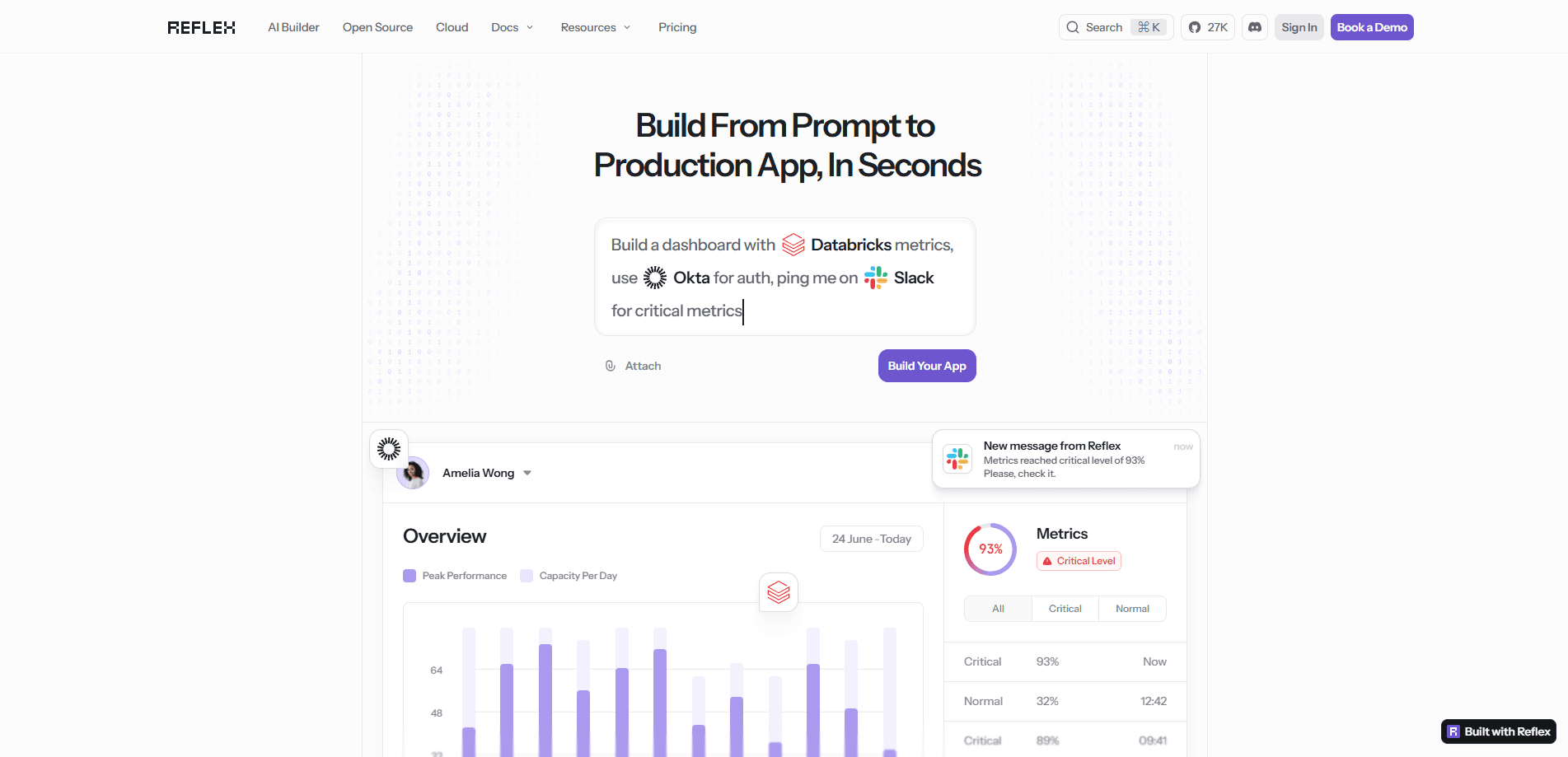
Reflex is an open-source Python framework for building full-stack web apps without touching JavaScript. You write your frontend and backend as ordinary Python, and the framework compiles your code into a React front end and a Starlette (ASGI) backend that runs in the browser. It targets Python developers who want production-grade interactive apps, not throwaway prototypes. Think of it as a way to ship pure Python web apps and pair them with a paid platform that adds hosted building, deployment, and team features.
About Reflex
What Is Reflex
Reflex is a full-stack Python web framework. It lets you define your app's state as a Python class and its event handlers as Python functions, then handles the browser rendering for you. Under the hood it compiles to React and Starlette, so you get a modern interactive front end without learning a second language.
The framework solves a specific pain: Python developers who need a real web UI usually have to hand off work to a JavaScript team or settle for a limited dashboard tool. Reflex keeps the whole stack in one language. Anything you can build in React, the makers say, you can build in Reflex.
The main limit is that it's still code-first. Reflex is friendly to someone who already knows Python, but it's not a no-code drag-and-drop builder. If you want to skip setup entirely, the Reflex AI Builder can generate an app from a prompt, and that part lives behind the paid platform.
Getting Started
- Install the package with
pip install reflex. - Run
reflex initto scaffold a new project folder with starter files. - Define your state class and UI components in Python, then wire up event handlers.
- Run
reflex runto start the local dev server and see the app live. - Deploy with
reflex deployto Reflex Cloud, or export the app and host it on AWS, GCP, Azure, or on-prem.
Product Information
A quick look at Reflex's pricing, supported platforms, and performance.
Best for
The users, tasks, and scenarios where this tool fits best.
Users
- Python developers who want a production web app without hiring frontend help
- Data and ML teams already working in pandas, SQLAlchemy, or scikit-learn
- Startups shipping internal tools fast
Tasks
- Building interactive dashboards with live state updates
- Wrapping an existing React component in Python
- Adding auth, routing, database, and background jobs to an app
- Giving AI coding agents a clean target
Scenarios
- Internal business tools where the team knows Python but has no dedicated frontend engineer.
- Revenue-generating customer apps that need to scale on AWS, Azure, or GCP without a rewrite.
- Enterprise deployments that require SSO, audit logs, and dedicated compute.
Key features
Write Everything in Python
Frontend and backend share one language. Your app state is a Python class, your event handlers are Python functions, and if you know Python you already know how to start. Nothing gets translated by hand.
Compiles to a Proven Stack
Reflex doesn't reinvent the browser. It compiles your Python into a React front end and a Starlette backend, the same ASGI server that powers FastAPI. That means the output runs on a stack your ops team probably already trusts.
Use Your Existing Python Libraries
pandas, SQLAlchemy, scikit-learn, or an internal library your company wrote: they all work inside Reflex with no adapters. You import them the way you always do. No wrappers. Companies like Man Group and Walmart have wrapped their own internal components this way.
Reactive State, No Page Reloads
Reflex uses reactive state management, so when data changes the UI updates instantly without re-rendering the whole page. This sidesteps the page-reload and nested-callback problems that show up in other Python frameworks. It just works.
60+ Components and React Wrapping
The framework ships with more than 60 built-in components. When you need something it doesn't have, you can wrap any React library in a few lines of Python instead of waiting for a native port.
AI-Native Tooling and MCP
Reflex targets the agentic coding era. Every app exposes an MCP by default, so an agent can drive it through an API instead of scraping screens. The Agent Toolkit feeds coding tools vetted abstractions, which cuts down on reinvented auth and database code.
Deploy Anywhere
Your app is standard Python, so it runs where you need it. Reflex Cloud is the managed option, and AWS, Azure, GCP, Databricks, and on-prem are all supported paths. You pick the deployment that matches your infrastructure.
Pros and cons
Pros
- One language for the full stack cuts real coordination overhead, since there's no frontend-backend handoff.
- Compiling to React and Starlette means the output rides on established, well-understood technology.
- The open-source framework is Apache 2.0 licensed, so you can self-host and read every line.
- Built-in auth, routing, database, and background jobs remove a lot of glue code for production apps.
- Strong AI-agent support makes it a good fit if your team leans on Claude Code or Cursor.
Cons
- It's still code-first, so someone without Python experience can't build an app here.
- The hosted AI Builder, team workspaces, and security controls sit behind paid plans.
- Free-tier limits are fixed, and hosted capacity is shared, which can slow down heavier projects.
- Money terms for Pro variants beyond the listed range aren't public, so budgeting needs a demo call.
Frequently asked questions
Reflex builds full-stack, interactive web apps entirely in Python. Developers use it for dashboards, internal tools, and customer-facing apps where they'd rather keep the whole codebase in one language instead of splitting frontend and backend work.
Related content
Explore related tools, skills, and articles for Reflex.
Reflex Alternatives
Forefront
Forefront · CodingForefront is a web platform for building with open-source AI. It lets you fine-tune leading open-source language models on your own data, evaluate how they perform, and run them through an API or export them to host yourself. Developers who want the convenience of a closed-source platform but insist on owning their models and data are the target audience here.

Startkit
StartKit.AI · CodingStartkit is a boilerplate for building AI SaaS and AI wrapper products. Think of it as an AI startup boilerplate with the boring parts already wired up: authentication, Stripe and Lemon Squeezy payments, usage limits, transactional email, and an AI API starter that talks to OpenAI, Anthropic, Groq, or Llama. You clone the repo, set your price, and start on the part of your product that people actually pay for. It's Next.js under React and Tailwind, so most of the boilerplate code already feels familiar.
Testim
Tricentis · CodingTestim is an AI-powered test automation platform for building and running end-to-end tests across web, mobile, and Salesforce applications. It leans on machine learning to keep tests stable when an interface changes, so teams spend less time fixing broken selectors. Not bad for an automated testing tool you can start using today. You create tests by recording actions in a browser, then optionally add JavaScript when you need more control. It's a solid pick for busy QA teams.