

Risely AI
Risely · Leaning
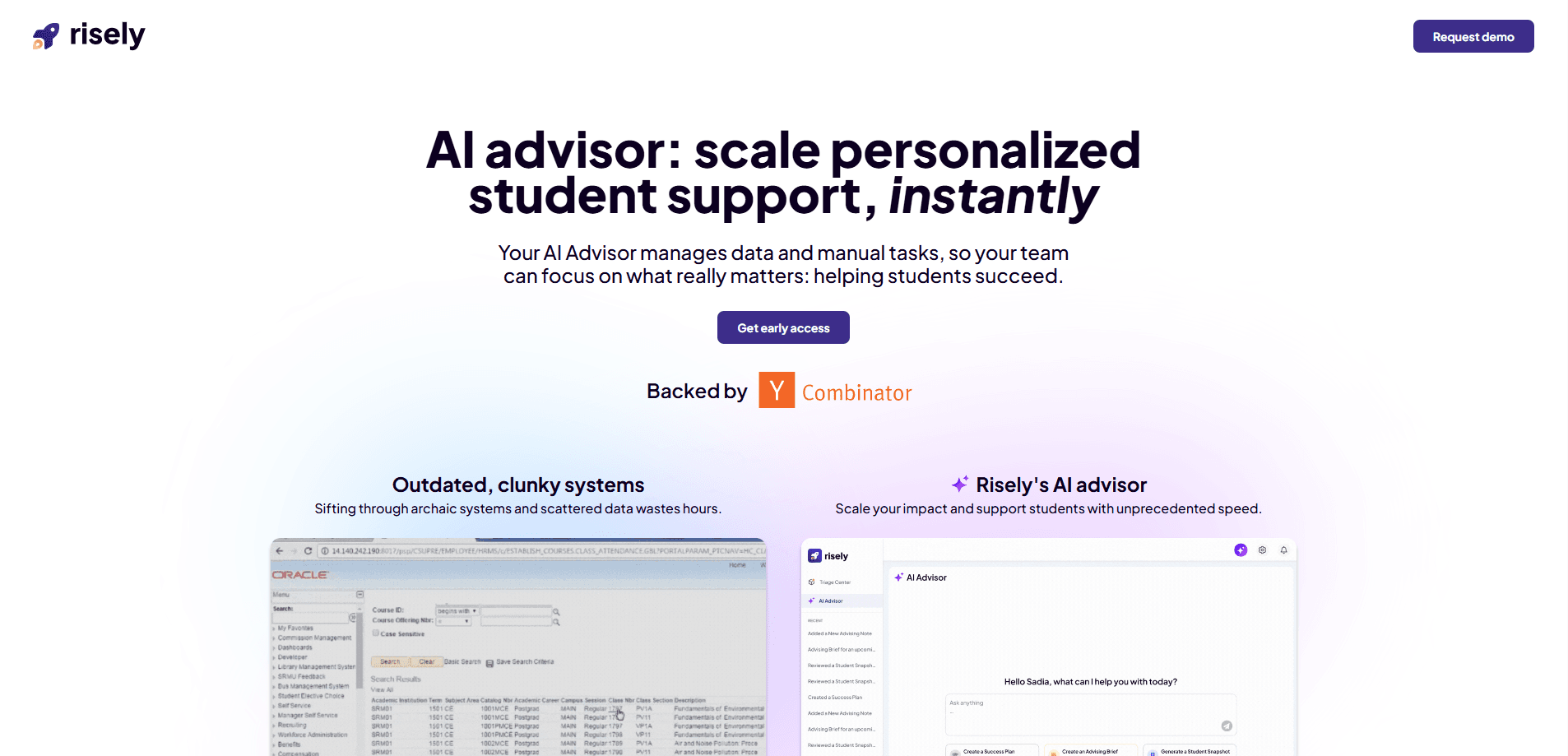
Risely AI is an agentic campus platform for colleges and universities. It unifies campus systems into one student record and sends approval-gated AI agents to do the follow-up work.
About Risely AI
What Is Risely AI
Risely AI is a platform that higher education institutions run to put AI agents to work across admissions, financial aid, advising, retention, the registrar and advancement. Instead of adding another dashboard, it reads the systems a campus already has, builds one clean record for every student and donor, and lets agents draft the next action from that record. A person approves every move before it goes out.
For teams weighing AI agents for universities, the selling point is capacity, not another software feature. Staff spend their days reconciling records, chasing forms and copying the same facts between systems, so the students who need the most help often get the least attention. Risely AI takes that repetitive work off the desk and keeps it moving. The company frames itself as the University OS, an intelligence layer that sits on top of the student information system rather than replacing it.
Three limits are worth knowing before a demo. It is built for institutions, not individuals, so there is no self-serve signup and no published price list. Nothing an agent proposes happens without a named staff approval, which is a feature for governance but does add a review step. And a rollout starts with one office and expands, so a full-campus deployment takes time.
Getting Started
- Schedule a demo and map which offices you want covered first, such as admissions, aid or retention
- Connect the systems already in place, like the SIS, LMS, CRM and aid platforms, through scoped read-only connectors
- Set the approval rules and named reviewers in Risely Arbiter so every agent action waits at a human gate
- Turn on agents one office at a time, then read the audit ledger to see who approved what and when
Product Information
A quick look at Risely AI's pricing, supported platforms, and performance.
Best for
The users, tasks, and scenarios where this tool fits best.
Users
- Enrollment teams
- Financial aid offices
- Advisors and retention leads
- Advancement researchers
Tasks
- Transfer credit evaluation
- Award letter packaging
- Early-alert outreach
- Donor research
Scenarios
- A student's behavior changes in one system while an advisor watches another
- Aid packaging season hits
- A one-person advancement shop
- An incoming class needs follow-up
- A registrar faces a backlog of transfer evaluations
Key features
Risely Fabric
Fabric is the connect layer. It reads the SIS, LMS, CRM and aid systems in place through scoped connectors and resolves the same person across all of them into one clean record. Nothing migrates and the SIS stays the system of record, so staff keep the screens they already know. The connectors are read-only by default and each one reads only the fields its workflows need.
Risely Agent Graph
The Agent Graph is the living map the work builds. Every student, course, dollar and donor is a point, and every connection between them is a line, so a student links to a course, a course to an aid award and an alum to a gift. Each action agents and staff take draws another line, which is why the map holds more of the institution every week it runs.
Risely Cortex
Cortex is where the agents do the work. The platform runs 146 agents that read the graph, decide what the moment calls for and draft the action, from an advising note to a rebuilt degree plan or a released aid award. The loop runs perceive, draft, approve, act and log, and Cortex works from everything Risely already knows about each person rather than a fixed script.
Risely Arbiter
Arbiter is the control layer and the gate every action passes through. No agent acts without a person approving it first, and the platform keeps an append-only ledger that shows who approved what and when. The data stays the institution's to export at any time, and access is least-privilege and logged.
Security and Compliance
Risely states SOC 2 Type 2 compliance, with the audit report covering a period rather than a single snapshot, and operates as a school official under FERPA. Student data is encrypted at rest with AES-256 and in transit with TLS, masked before it reaches a model, and never used to train public or foundation models. The platform also lists HECVAT and GDPR readiness.
One-Stop Student Front Door
Every office on campus stands behind one conversation. The record does the routing, and a person approves what matters, so a student asks one place and reaches admissions, aid, advising, the bursar or the registrar without learning which office owns the problem. Common questions like which programs miss their enrollment targets and by how much get a direct answer pulled from the graph.
Pros and cons
Pros
- Reads existing systems in place with no migration, so the SIS stays the system of record and staff keep their screens
- Every agent action waits at a named human approval and lands on an audit ledger, which fits how institutions govern
- Encrypts student data at rest and in transit and never trains public models on it, which answers a FERPA review
- Starts with one office and expands, so a campus can prove value before a full rollout
- Answers cross-system questions in one place, like which programs are missing fall targets and by how much
Cons
- Built for institutions, so there is no free plan, no self-serve signup and no published pricing
- A full-campus rollout takes time, since agents are turned on one office at a time
- The human approval gate adds a review step to every action, which slows work that a looser tool would automate away
Frequently asked questions
Risely AI is an agentic campus platform for colleges and universities. It connects the systems a campus already runs into one student record and puts AI agents to work on admissions, financial aid, advising, retention, the registrar and advancement. A person approves every action before it happens.
Related content
Explore related tools, skills, and articles for Risely AI.
Risely AI Alternatives

HireKey
HireKey · Voice & Language · Productivity · LeaningHireKey is an AI job search copilot built by a former tech recruiter. It checks role fit, tailors resumes, runs interview practice and tracks every application.

Lune
Retrograde Labs · Productivity · LeaningLune is a research search engine for scientific AI agents. It runs as an MCP server that lets Claude, ChatGPT and Cursor search peer-reviewed computer science papers and cite them.
Coddy
Coddy · Coding · LeaningCoddy is a gamified platform to learn to code through short interactive lessons in 20+ languages, with a browser editor, an AI tutor and free certificates.