

Robovision
Robovision · Image · Video
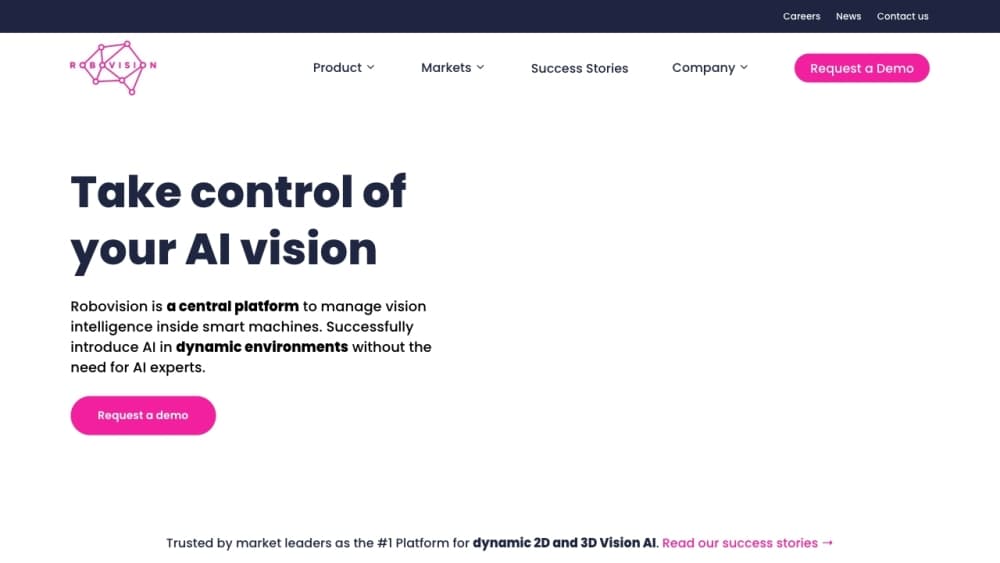
Robovision is an industrial vision AI platform where process experts label images, train models in a browser and run inspection at the edge, with no code.
About Robovision
What Is Robovision
Robovision is a Belgian company selling machine vision software for industrial plants, the inspection work that used to need a room full of engineers. Its product is now branded Indurion Suite. Machine builders and plant teams use it to label images, train models and push them onto machines that check products at line speed.
The pitch is control. You keep your cameras, your integrators and your data. Models run on your own hardware, air-gapped setups included, and you can export configurations and the full dataset if you ever decide to leave.
This computer vision platform is also honest about limits. Robovision reports what it sees: a cracked part, a missing component, a label slightly off center. It doesn't explain why the defect happened. A defect type the model has never seen needs a handful of labelled examples before it gets caught.
Getting Started
- Describe the process, the quality problem and the target numbers to the Robovision team.
- Run a site assessment to confirm camera, network and MES compatibility.
- Upload a starter set of images and label them in the browser interface.
- Train a model, test it on held-out samples, then deploy it to the machine agent.
- Train your own operators so they can adjust thresholds and add product variants alone.
Product Information
A quick look at Robovision's pricing, supported platforms, and performance.
Best for
The users, tasks, and scenarios where this tool fits best.
Users
- Machine builders
- Process and production engineers at food, agriculture or manufacturing plants
- Quality managers running several lines or sites
Tasks
- Defect detection and classification on high-speed lines
- Instance segmentation for packed or overlapping items
- Measurement and robot guidance
- Bringing an existing model in house
Scenarios
- Retrofitting an existing line
- Sites with weak connectivity or strict data rules
- Scaling from one proven recipe to a fleet
Key features
No-Code Model Training
The browser interface handles labels, training runs and threshold tuning. That no-code computer vision setup lets someone who knows the product build a working model without touching Python. That's the difference between a project that waits on the data science queue and one that ships this quarter.
Five Core Vision Techniques
Robovision builds around classification, instance segmentation, semantic segmentation and object detection, plus bring your own algorithm. Classification tells you what's in the frame. Instance segmentation traces individual outlines at pixel level, which is how it handles items that touch or overlap. The technique you pick decides what the model can measure.
Inspection That Survives a Network Drop
Classification and measurement run locally on an agent sitting at each machine, not in a distant data center. Production keeps moving when the connection fails. For plants that can't send images outside the building, that local-first design is usually the deciding factor.
Drift Detection and Fleet-Wide Correction
When a model returns a low-confidence result, the sample gets flagged and logged for review. An engineer validates the fix, and the corrected recipe can go back out to every connected machine. Robovision lists the drift detection method as patent pending. One fix, applied once, instead of a service visit per line.
Python SDK and Open Algorithm Specification
Data scientists who want to stay close to the code get a Python SDK and a documented specification for importing their own models. Configurations and datasets stay portable. Team roles split cleanly: engineers write code, operators run the line, and both work inside the same platform.
White-Label Deployment
Machine builders can put their own logo, interface text and documentation on every machine they ship. Deployment is single-tenant on customer infrastructure, with a Robovision-managed option. It's built for the vendor who doesn't want a third-party brand showing up in front of their customer.
Pros and cons
Pros
- Process experts can label, train and adjust models without waiting for a data scientist.
- Runs on your own infrastructure. Air-gapped single-tenant setups are supported.
- Vendor neutral across camera brands, integrators and algorithm frameworks.
- A validated correction reaches the whole fleet, not just the machine where it was found.
- Models, configurations and datasets stay yours and can be exported.
Cons
- No published pricing. You need a sales conversation and a site assessment before you know the cost.
- It reports defects but doesn't diagnose the cause, so root-cause analysis stays with your team.
- Camera and MES compatibility is confirmed during the site assessment, not from a spec sheet.
- The value shows up at multi-machine scale. A single camera project rarely justifies the setup work.
Frequently asked questions
It runs visual quality inspection in production. It finds defects, measures parts and sorts products. On some lines it also guides robots. Food, agriculture, manufacturing and recycling plants use it on lines where product variation breaks fixed rules.
Related content
Explore related tools, skills, and articles for Robovision.
Robovision Alternatives

Google EmbeddingGemma 2
Google DeepMind · Writing · Image · CodingGoogle EmbeddingGemma 2 is a 740M-parameter open model that turns text, code, images, audio, and video frames into vectors in one 768-dimension space, running on phones and laptops.

Tractionwave
TractionWave · Image · MarketingTractionWave is an AI attention heatmap tool for static ads. Upload a PNG or JPG and it returns predicted attention, ranked hotspots, and fixes before you spend budget.
Imejis.io
Imejis.io · Image · MarketingImejis.io is an AI design studio for agents and marketing teams. Describe an image in plain words, and it writes the copy, builds the layout, reflows it to every size, then exports a finished file.