
Rool
Lightpost One Ltd · Productivity · Chatbot · China AI
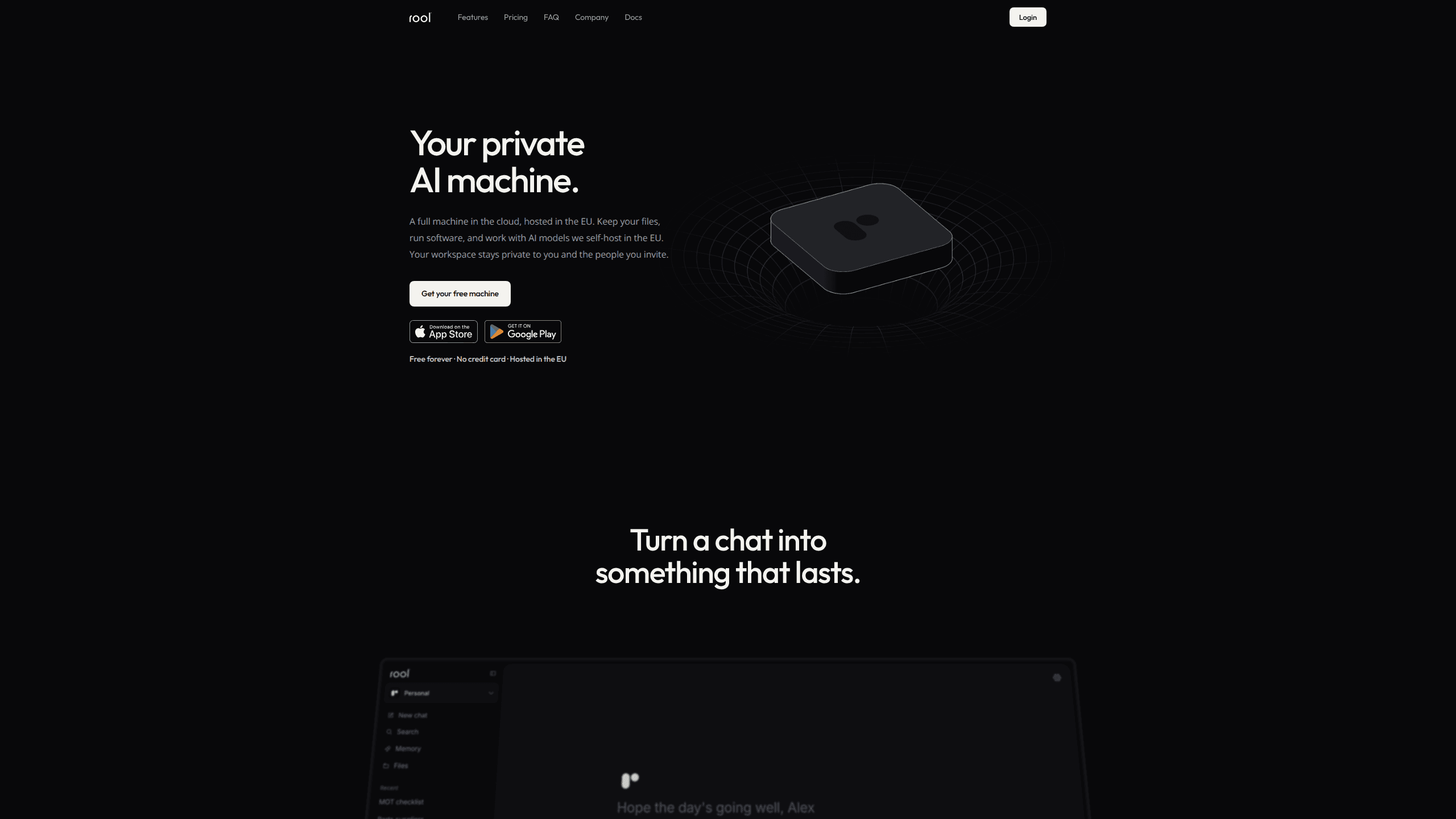
Rool is a private AI machine: a Linux cloud computer where chat, files, and persistent memory share one workspace, with self-hosted AI models running in the EU.
About Rool
What Is Rool
Rool is an AI workspace from Lightpost One, a company based in Dublin. The product gives each account a Rool Machine, a private Linux computer in the cloud with an AI agent running inside it. You start by typing a question, which feels like any other chatbot. The difference shows up later, when the files you made, the notes you saved, and the context behind them are still there for the next task.
The machine is the unit of storage. Documents, spreadsheets, PDFs, images, code, and audio sit in a file tree the agent can read and edit. Chats and ideas become Objects, structured records the agent can link to each other, so an old decision can surface while you work on something related. Rool calls this persistent AI memory, and it's the feature that separates the product from a chat window with a history tab.
The limits are concrete. Personal plans meter AI usage in credits: 480 a day on the free tier, 2,400 on Plus, 9,600 on Pro, with an hourly refill and a cap. Storage is per machine, from 1 GB to 10 GB, and it holds everything, including chats and memory. Most requests run on self-hosted AI models on GPUs in Finland, but a few features call outside providers that you can switch off in settings.
Getting Started
- Sign up at rool.dev with an email address. The Standard plan needs no card and has no trial clock.
- Open your first machine and ask a question in plain language. No prompt setup or API key is needed.
- Add files by uploading them or asking the agent to fetch and read a page.
- Keep working in the same machine. Save chats as Objects and link them when a project grows.
- Invite a collaborator, or install the PWA at rool.app and continue from your phone.
Product Information
A quick look at Rool's pricing, supported platforms, and performance.
Best for
The users, tasks, and scenarios where this tool fits best.
Users
- Freelancers who handle client documents
- Researchers and writers
- Privacy-conscious users in Europe
- Small teams sharing one body of work
Tasks
- Turning rough notes into a report
- Batch file work
- Building a small internal app
- Ongoing research
Scenarios
- A weekly newsletter that draws on months of saved interviews
- A side project that comes back after a break
- A two-person consultancy sharing client work
- Testing an AI workflow before paying
Key features
A private AI virtual machine
Each Rool Machine is a Linux VM with an operating system built to be driven by an agent. The agent runs inside the VM, so your files and conversations stay isolated at the machine level rather than behind an access rule. You can have two machines on the free plan and five on Pro, each with its own memory and its own projects.
Persistent memory through Objects
Chats, files, and ideas become durable Objects that the agent can read, link, and build on. Instead of compressing a conversation into a short summary, Rool keeps structured records that survive between sessions. A contact, a task list, or a catalogue can live as a collection with predictable fields, and the AI still sees the underlying data.
Real files, real output
You can bring in documents, images, spreadsheets, code, PDFs, audio, and video, then ask the agent to produce something new from them. It can turn a rough note into a report, process a batch of images, run calculations, or work on code. Because the software runs in the same machine, output lands in your file tree instead of a download folder.
Shared machines for collaborators
A machine can be opened to other people, who then see the same files and the same memory. Real-time sync and undo history mean nobody has to merge copies. Access is granted by membership, and an admin who joins a team machine appears in its member list, so there's no quiet access.
Connectors and MCP servers
Plus and Pro add connectors and custom MCP servers, which let outside services feed the machine. A team admin decides which providers each machine may use. Turning a provider off removes the feature it powers, and the rest keeps running on models Rool hosts itself.
SDK and API access
Rool publishes a TypeScript SDK, @rool-dev/sdk, under the MIT licence, with public source on GitHub. It exposes typed calls for files, Objects, machine execution, checkpoints, sharing, and account events. Developers can run Linux commands inside a machine, build small apps on top of its data, and export everything if they leave.
Pros and cons
Pros
- The free Standard plan runs forever with 480 AI credits a day, two machines, and no credit card.
- Files, chats, and memory sit inside one machine, so a project doesn't reset when a session ends.
- Hosting is in Finland and the company says your data is never used to train models, on any plan.
- Export, API access, and an MIT-licensed SDK keep you from being locked in.
- Pricing scales in small steps: €9 for Plus, €25 for Pro, and a €5 voucher when you need a burst of credits.
Cons
- Credits are hard to predict. A reasoning prompt averages around 10 credits, media generation costs more, and AI features pause when the balance hits zero.
- Storage is tight. The free plan gives each machine 1 GB, and a full machine turns read-only until you free space or upgrade.
- Connectors and custom MCP servers are paid features, so the free tier can't plug Rool into outside services.
- Support runs through email and Discord, with priority replies reserved for Pro and Team accounts.
Frequently asked questions
Yes. The Standard plan is free forever, with no card and no trial period. It includes 480 AI credits a day that refill hourly up to 1,000, two Rool Machines, 1 GB of storage each, and the same core AI features as the paid tiers.
Related content
Explore related tools, skills, and articles for Rool.
Rool Alternatives

Base Code
Base44 (Wix) · Coding · ProductivityBase Code is a shared cloud development environment from Base44. Teammates describe changes to an existing GitHub codebase in chat, preview them live and send them back as pull requests.

Knocket
Knocket (Tencent RTC team) · Productivity · Business · ChatbotKnocket is a free live chat and contact page tool that lets visitors message you from your website, app, or a shareable link, with every reply handled from Telegram or one inbox.

FloorGen
Vinit Kumar (FloorGen) · Productivity · China AIFloorGen is a browser-based floor plan maker that turns a sentence or a sketch into an editable 2D plan and a 3D walkthrough. Export to PDF, DXF or video, and draw without an account.