

RSIP Vision
RSIP Vision · AI Assistant
RSIP Vision develops custom medical imaging AI for device makers, covering medical image analysis, integration, and regulatory support from prototype to launch.
About RSIP Vision
What Is RSIP Vision
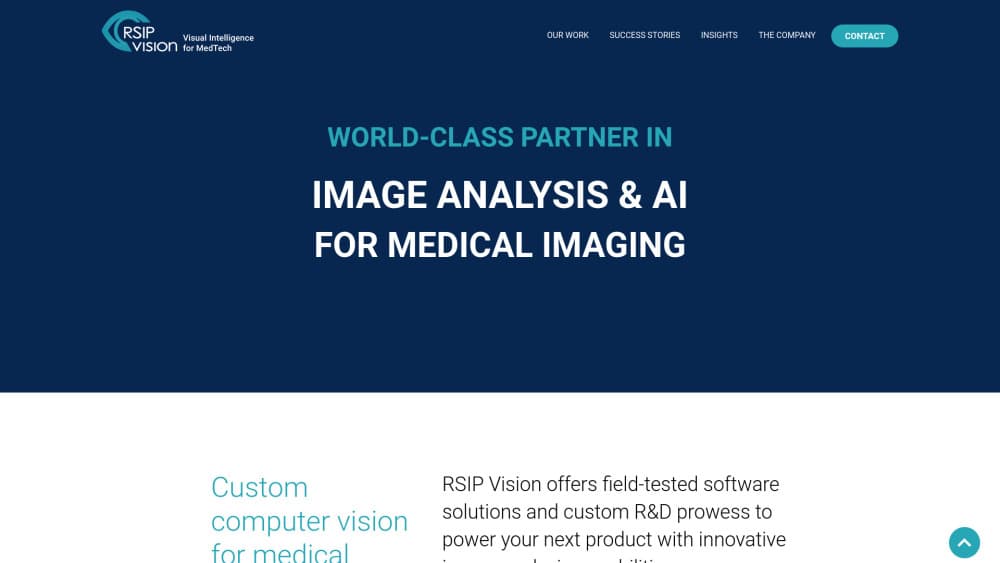
RSIP Vision is a medical imaging AI developer that works on contract. Device companies bring a clinical problem and imaging data; RSIP builds the algorithm, turns it into production software, and helps document it for regulators. The company has run this play since 1987, with offices in San Francisco, Tel Aviv, and Jerusalem, and it reports hundreds of completed projects for clients that include Hologic, Activ Surgical, and Biosense Webster.
The gap it fills is narrow but deep. A device team can own the scanner, the catheter, or the surgical console and still lack the computer vision for medical devices needed to turn pixels into a measurement a clinician trusts. RSIP supplies that layer: segmentation, detection, classification, and quantification models trained on clinical data, plus the annotators and clinical advisors who label and sanity-check it.
The limit is the business model. RSIP doesn't sell a self-serve product, a subscription, or a downloadable SDK with a price list. Every engagement is scoped as a project, so cost and timeline depend on the modality, the data quality, and how far the algorithm has to travel toward regulatory clearance. If you want to test a tool this afternoon, this isn't that kind of vendor.
Getting Started
- Describe the clinical task: what structure or event the software must find, in which modality, and how the output reaches the clinician.
- Share representative scans or video under an agreement, so the team can judge whether the signal supports the task.
- Run a feasibility phase: a working prototype on your data, with accuracy reported against your clinical reference.
- Move into the production build, where the model is optimized for runtime, integrated into your device software, and hardened for clinical use.
- Close with validation evidence and documentation for the regulatory pathway you've chosen.
Product Information
A quick look at RSIP Vision's pricing, supported platforms, and performance.
Best for
The users, tasks, and scenarios where this tool fits best.
Users
- Medical device product teams
- Imaging startups with a working prototype
- Clinical research groups
Tasks
- Organ and lesion segmentation
- Surgical video analysis
- Quantification for scoring systems
- Regulatory documentation
Scenarios
- An imaging device is nearly ready, but the AI feature promised in the brochure doesn't exist yet.
- A research model works in a lab notebook and needs to survive real clinical data, different scanners, and a quality review.
- A surgical platform wants guidance overlays during a procedure and needs latency low enough to be usable in the room.
Key features
Custom Algorithm Development
Every project starts from the clinical question, not from a pretrained model looking for a home. RSIP's AI algorithm development work builds detection, segmentation, classification, and quantification around the specific anatomy, modality, and workflow the client has. That matters when the target structure is small, low contrast, or moving.
Multi-Modality Image Analysis
The company covers CT, MRI, X-ray, ultrasound, OCT, microscopy, and point cloud data. Cardiology work spans CT, MRI, fluoroscopy, and ultrasound; ophthalmology work includes fundus stitching, eye tracking, and retinal layer segmentation on OCT. One vendor handling several modalities shortens the coordination work when a product combines them.
Surgical Video and Endoscopy Analysis
Medical video is the hardest input in the field. Cameras move, lighting shifts, tissue deforms, and smoke obscures the view for seconds at a time. RSIP has built surgical video analysis for bronchoscopy, cath lab, and laparoscopic use, including instrument tracking and tissue segmentation that hold up across cases.
Productization and Device Integration
A model that scores well in a notebook is not a product. RSIP takes research-grade code and turns it into software that runs inside a device: fixed runtime budget, defined memory ceiling, graceful failure, and an interface your engineering team can maintain. This step is where most academic collaborations stall, and it's the part RSIP sells explicitly.
Regulatory Support
The team writes algorithm documentation and validation evidence for FDA clearance and comparable pathways, often with clinical consultants who know what reviewers ask for. That reduces the usual loop of submissions returned for missing detail. The final clearance always belongs to the device maker.
Clinical Data Services
Annotation is done in house by medical annotators working with clinical advisors, not outsourced to a general labeling shop. For imaging work this matters, since a boundary drawn by someone who has never read a scan is worse than no label at all. Data acquisition and curation are handled in the same engagement.
Pros and cons
Pros
- Deep specialty coverage, with published work in cardiology, orthopedics, gastroenterology, pulmonology, urology, ENT, and ophthalmology.
- One team handles algorithms, annotation, clinical input, and regulatory paperwork, which removes the usual handoff losses.
- Support runs from a feasibility prototype to deployed, cleared software, so you don't have to change vendors midway.
- Real experience with surgical video and endoscopy, the modalities where generic vision tools fail most often.
- Long operating history gives the company pattern recognition across hundreds of device programs.
Cons
- No published pricing, so budgeting starts with a sales conversation rather than a calculator.
- No free tier, trial, or sandbox, which makes it hard to judge fit before committing to a scoped project.
- Timelines follow project scope and data readiness, so a fast proof of concept still takes weeks, not hours.
- You can't license a ready-made module for a quick internal test, since the output is built for one client's device.
Frequently asked questions
Contract development for medical imaging AI. The deliverable is software plus documentation, built for a specific device or clinical workflow, not a subscription product you log into.
Related content
Explore related tools, skills, and articles for RSIP Vision.
RSIP Vision Alternatives
Agibot
Agibot · Productivity · AI Assistant · ChatbotAgibot is a personal AI agent for Mac that keeps running after you close the window, runs routines on a schedule, and works from Telegram or Slack with your own API keys.

Foley
Hanamori Labs, LLC · Voice & Language · Productivity · AI AssistantFoley is a voice to-do list that turns a spoken sentence into a filed task, complete with project, date and time, then helps you plan the day around what is already there.

Ghost Core
Ghost · Productivity · AI AssistantGhost Core is a $3,499 screenless personal AI computer that runs local AI models on its own hardware, builds context from your apps and devices, and acts without waiting for a prompt.