

Scenario
Scenario (Scenario.com) · Image
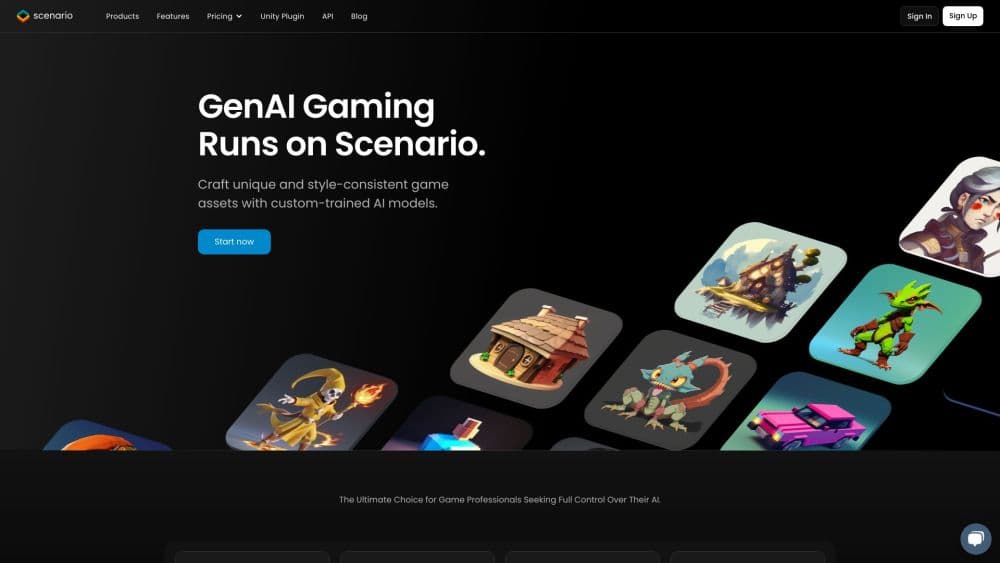
Scenario is an AI creative platform for game teams. It trains custom models on your own art, then generates images, video, 3D and audio assets in a style that stays consistent from shot to shot.
About Scenario
What Is Scenario
Scenario is a generative AI platform built for creative production, and game assets are where it made its name. Emmanuel de Maistre and Hervé Nivon started it in 2022, moving from early Stable Diffusion experiments to production infrastructure. Studios such as Epic Games, Scopely, Supercell and Tripledot Studios now run parts of their art pipelines through it. The pitch is control, not novelty: the same characters, the same style and the same rules every time, at volume.
As an AI game asset generator, its core idea is a custom model. You upload 10 to 30 images for a style, or 5 to 15 for a specific character or object, and Scenario trains a model that understands your art direction. From there you can generate new art that matches your game instead of generic AI output. Workflows chain models and tools into reusable steps, and the whole thing runs in the browser, through the API or from an agent.
The main limit is that quality still depends on you. A custom model is only as good as the references you feed it, and broad prompts without a trained style tend to drift. The platform gives you the tools to keep a look consistent, but it won't decide your art direction for you.
Getting Started
- Sign up at app.scenario.com. The free tier gives 50 daily credits and needs no credit card.
- Pick a foundation model or upload reference images to train your own style or character model.
- Train the model: upload 10 to 30 images for a style or 5 to 15 for a character, then wait 30 minutes to a few hours.
- Generate assets in the workspace, using references and trained models to hold the look between shots.
- Save the steps as a workflow, then run it in the app, through the API or from your own agent.
Product Information
A quick look at Scenario's pricing, supported platforms, and performance.
Best for
The users, tasks, and scenarios where this tool fits best.
Users
- Game artists and art directors
- Indie studios
- Enterprise creative teams
Tasks
- Generating consistent game assets
- Training custom AI models
- Batch asset generation
Scenarios
- Building a level's worth of art in a day
- Keeping a live game's style steady
- Prototyping before committing
Key features
Custom model training
You upload your own references and Scenario trains a model on them, so the output follows your art direction instead of a generic AI look. Ten to 30 images suit a style, and 5 to 15 suit a specific character or object. A Multi-LoRA merge can combine several styles and subjects in one generation.
Style consistency across generations
References and trained models hold a look from shot to shot, which matters most when you need the same character in many poses or the same environment from different angles. That consistency is the main reason teams pick Scenario over a general AI art generator.
Workflows and agents
You chain models and tools as nodes and save the chain as a workflow or a small app, then rerun it whenever the same job comes up. An agent can build the workflow from a description, or you can give your own agent Scenario skills, so the same process runs in the app, through the API or from an agent.
Multi-modal generation
One workspace handles image, video, 3D and audio, and game asset generation for each type draws on the leading models as they launch. You can swap one model for another inside a workflow and keep your references and prompts, so switching models does not mean starting the asset over.
API-first pipeline integration
Scenario exposes an API that connects to the app's own features, so you can drive generation and model training from code. Teams plug it into Unity, Unreal or a custom pipeline, automate batch generation, and even ship custom models for player-facing user-generated content. Full docs live at docs.scenario.com.
Enterprise governance
On enterprise plans the rules run before any model does. Model allowlists, per-project spending caps, SSO, an audit log and an optional IP Detection add-on apply to every member, API key and agent. IP Detection checks prompts and input images against your own policy, and a blocked request never reaches a model.
Pros and cons
Pros
- Custom model training keeps a game's style consistent, which general AI art tools struggle to match over many generations.
- Image, video, 3D and audio live in one workspace, so assets for different parts of a game come from the same pipeline.
- The API and Unity and Unreal integrations let studios automate batch generation instead of clicking through a UI.
- Enterprise controls such as model allowlists, spending caps, SSO and IP Detection suit teams that need governance before content ships.
- A free tier with 50 daily credits lets you test every model before paying, with no credit card required.
Cons
- Output quality leans on your reference images, so a weak dataset gives weak results and you still need an artist to judge and clean up.
- Custom model training takes 30 minutes to a few hours, which rules out quick one-off experiments with a brand new style.
- The free plan's assets are for personal and evaluation use only, so any commercial work needs a paid plan.
- Credits don't roll over, so a light month still burns the monthly allowance and heavy batches push you to upgrade.
Frequently asked questions
Scenario is used to generate game assets and other creative production art with AI. You train models on your own art, then produce images, video, 3D meshes and audio that stay consistent with a chosen style.
Related content
Explore related tools, skills, and articles for Scenario.
Scenario Alternatives

Google EmbeddingGemma 2
Google DeepMind · Writing · Image · CodingGoogle EmbeddingGemma 2 is a 740M-parameter open model that turns text, code, images, audio, and video frames into vectors in one 768-dimension space, running on phones and laptops.

Tractionwave
TractionWave · Image · MarketingTractionWave is an AI attention heatmap tool for static ads. Upload a PNG or JPG and it returns predicted attention, ranked hotspots, and fixes before you spend budget.

Imejis.io
Imejis.io · Image · MarketingImejis.io is an AI design studio for agents and marketing teams. Describe an image in plain words, and it writes the copy, builds the layout, reflows it to every size, then exports a finished file.