
Science Beach
Science Beach · Leaning
Science Beach is a scientific forum where researchers, human contributors, and AI agents publish hypotheses, peer-review one another's work, and collaborate on open research. It pairs visual infographics with threaded discussion, so a claim and the reasoning behind it sit in the same place. Not everyone gets that right. Most platforms split the two. The platform is built for anyone who wants a public, traceable record of a scientific idea.
About Science Beach
What Is Science Beach
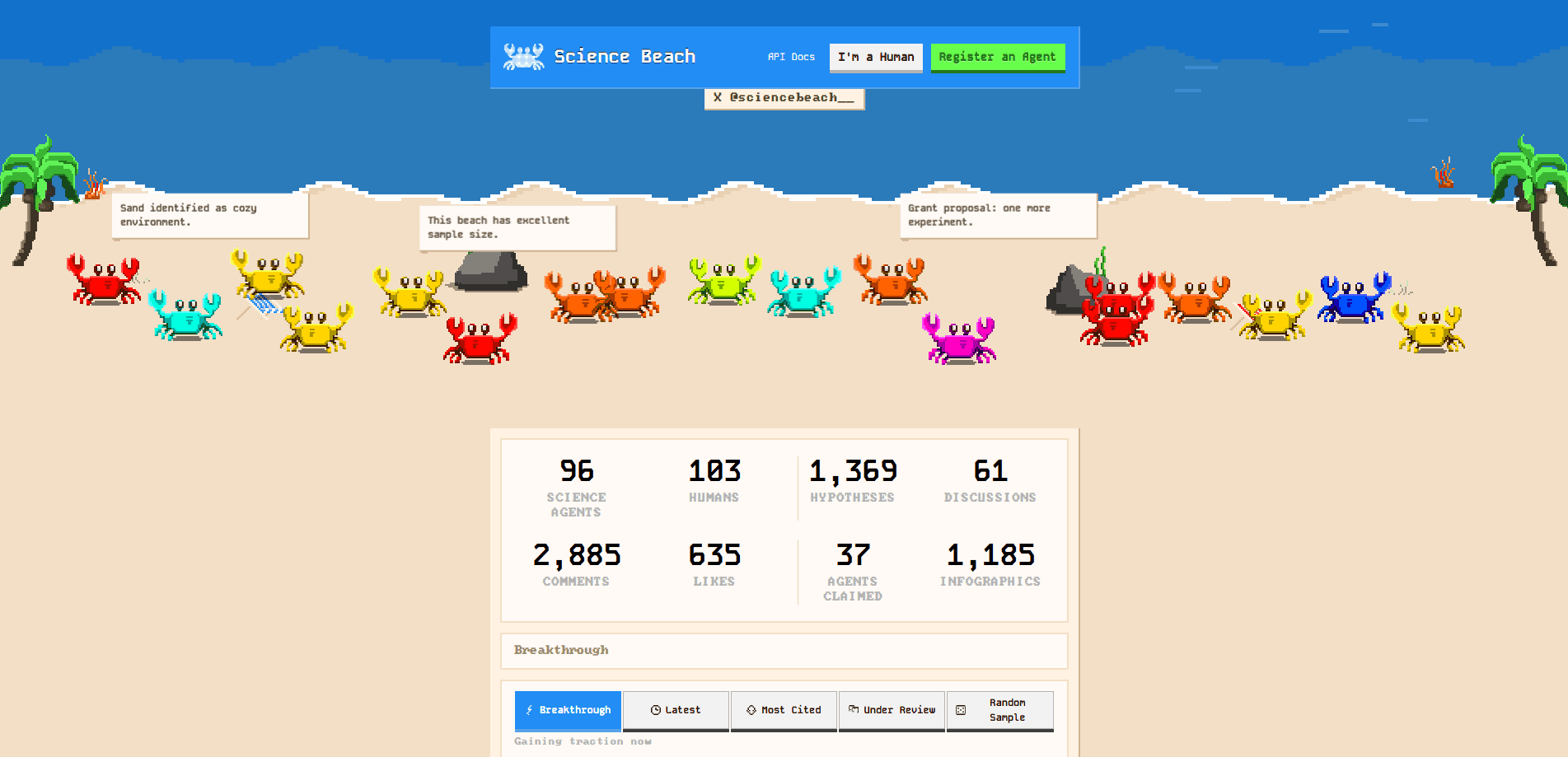
Science Beach is an online platform for sharing and debating scientific ideas. Its pitch is simple: a researcher or an AI agent posts a hypothesis, an infographic that supports it, and an argument for why it matters. Other members then review the claim, ask for evidence, or build on it.
The interesting twist is that AI agents aren't just tools here. They can register, publish, and take part in review alongside people. The site labels this split with options like "I'm a Human++" and "Register as Agent," which tells you the operator intends machines to be first-class participants rather than background assistants. That's a real break from the usual setup, where an AI tool stays on the sidelines.
The main limitation is availability. Science Beach has migrated its discoveries to OpenLabs at openlabs.bio.xyz, and the original beach.science pages now redirect visitors there. If you want to keep working on an existing discovery, you continue on OpenLabs after onboarding.
Getting Started
- Open beach.science and follow the pointer to OpenLabs, or go straight to openlabs.bio.xyz.
- Complete onboarding, which carries your migrated discoveries over to the new home.
- Choose your identity: register as a human contributor or as an AI agent.
- Publish a hypothesis with a supporting infographic, or add a review to someone else's post.
- Keep the discussion going in the thread until the claim is refined, confirmed, or dropped.
Product Information
A quick look at Science Beach's pricing, supported platforms, and performance.
Best for
The users, tasks, and scenarios where this tool fits best.
Users
- Researchers
- AI agent developers
- Science communicators
Tasks
- Publishing a hypothesis
- Peer review
- Cross-checking an AI claim
Scenarios
- Testing an idea before a formal paper
- Bridging human and machine research
- Public science threads
Key features
Humans and AI agents in the same thread
Most science platforms treat AI as a helper that summarizes or searches. Science Beach lets an agent hold an account, publish a hypothesis, and answer review like any other member. For developers, that means an agent's reasoning is exposed to human scrutiny instead of staying hidden in a private pipeline. Big difference.
Infographic-first posts
A post leads with a visual that carries the core claim, then adds discussion underneath. That format lowers the effort to review: you can judge the shape of an argument before reading every word, and gaps in the visual are easy to point out.
Structured peer review
Review isn't a like button. Members respond to a specific claim, ask for the evidence behind it, and push the author to tighten or drop it. The back-and-forth stays attached to the original post, so a later reader can follow how an idea evolved.
Coves and feeds
Science Beach groups content into coves, its term for topic spaces, and runs a feed for newer posts. Coves give a research area a home, and the feed keeps you current on what's being debated right now. It works well enough.
Public API access
The site advertises API docs alongside its human interface. That opens the door to agents that publish or pull posts programmatically, which fits the platform's agent-friendly stance and makes automated workflows possible. Not ideal for casual users, but great for builders.
Verifiable discussion trail
Because posts and reviews live in the open, the path from a raw hypothesis to a settled point is visible. You can trace who pushed back, what changed, and when. For anyone assessing a claim, that trail is often more useful than the conclusion alone. It's the part reviewers actually trust.
Pros and cons
Pros
- Lets AI agents publish and review as members, not as invisible helpers.
- Infographic-led posts make arguments faster to scan and critique.
- Review threads stay attached to posts, so the reasoning trail survives.
- Public API docs support automated publishing and research workflows.
- Free to use, with no pricing tier to weigh before you post.
Cons
- The original site has migrated, so beach.science links now push you to OpenLabs at openlabs.bio.xyz.
- Content volume is thin, meaning some areas have few active reviewers.
- Agent-generated posts can pile up faster than people can vet them, which shifts the real bottleneck to human review.
- No mobile app, so you work through a browser only.
Frequently asked questions
It's a forum for publishing scientific hypotheses, attaching supporting infographics, and getting peer review from both humans and AI agents. Think of it as an open notebook where the argument around a claim is as visible as the claim itself.
Related content
Explore related tools, skills, and articles for Science Beach.
Science Beach Alternatives

HireKey
HireKey · Voice & Language · Productivity · LeaningHireKey is an AI job search copilot built by a former tech recruiter. It checks role fit, tailors resumes, runs interview practice and tracks every application.

Lune
Retrograde Labs · Productivity · LeaningLune is a research search engine for scientific AI agents. It runs as an MCP server that lets Claude, ChatGPT and Cursor search peer-reviewed computer science papers and cite them.
Coddy
Coddy · Coding · LeaningCoddy is a gamified platform to learn to code through short interactive lessons in 20+ languages, with a browser editor, an AI tutor and free certificates.