

ScorAxis
ScorAxis · AI Assistant
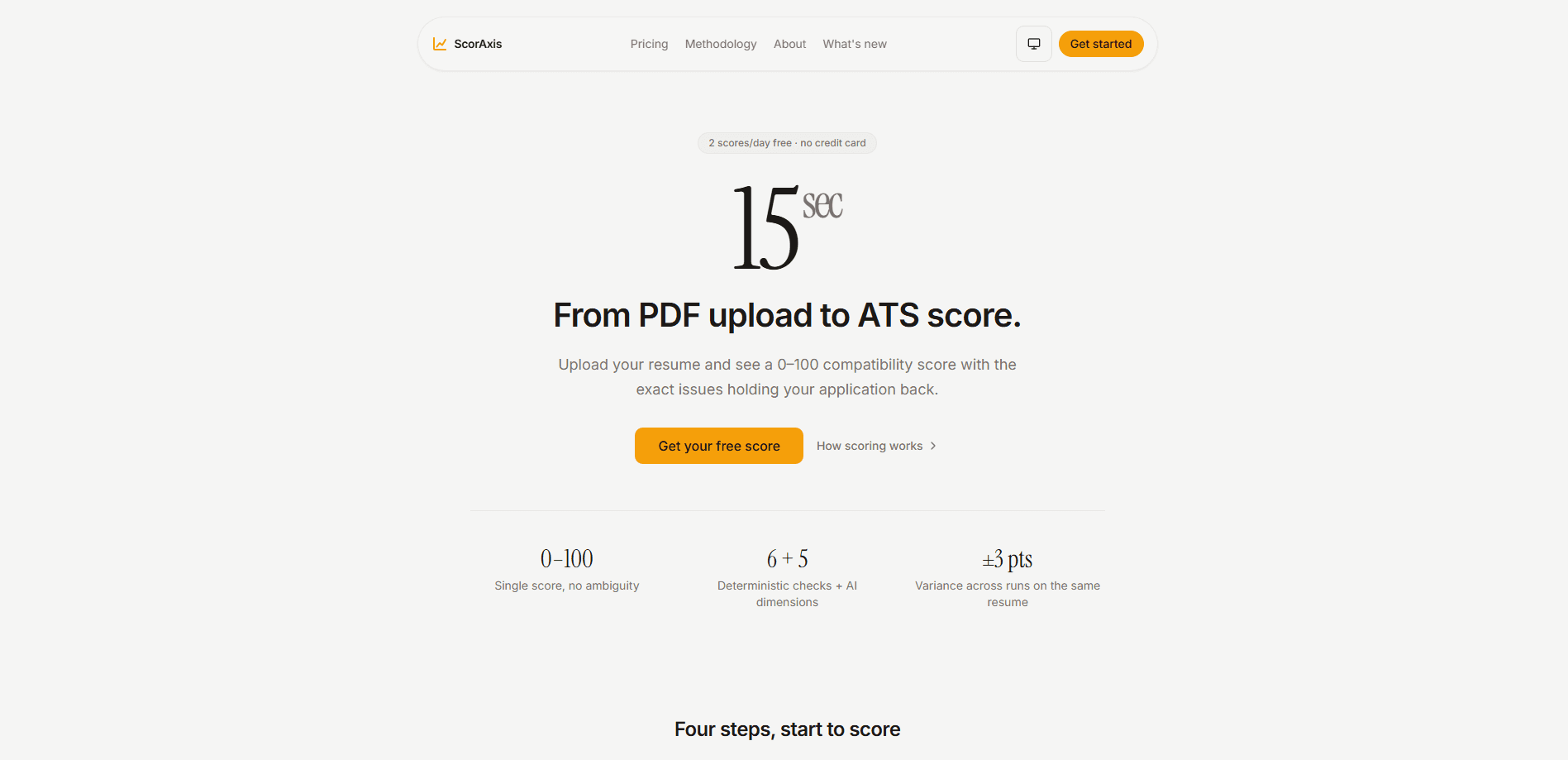
ScorAxis is an AI resume scanner that scores a PDF resume from 0 to 100 for ATS compatibility in roughly fifteen seconds. It combines a frozen deterministic rubric with AI-based quality checks, then flags the specific issues holding an application back. It suits job seekers who want concrete fixes instead of a generic tip sheet, and it runs entirely in the browser on text-based PDFs.
About ScorAxis
What Is ScorAxis
ScorAxis is a web-based resume scoring tool built to close an information gap. Most applications get filtered by an applicant tracking system before a person ever reads them, and the candidates who understand that usually have coaches or inside connections. What about everyone else? ScorAxis runs the same checks an ATS would run and shows every job seeker what's dragging a resume down.
The score splits into two halves. A deterministic rubric worth up to 70 points runs six fixed checks on the parsed resume, so the same input always returns the same result. An AI layer worth up to 30 points reads the writing itself, judging action verbs, quantified impact, keyword coverage, tense consistency, and buzzword overuse. Together they answer two questions: can the ATS read this, and is it worth acting on.
The biggest limit is the input format. ScorAxis only reads text-based PDFs. A scanned image of a printed resume won't parse, and neither will something that arrives as a photo. The free tier also caps usage at two scores a day and five in total across the account, and some paid features like AI bullet rewrite and JD match scoring are still on a waitlist.
Getting Started
- Sign up with an email address or a Google account. No credit card is needed for the free plan.
- Drag and drop your resume as a PDF, up to 10 MB. Exports from LinkedIn, Word, Pages, and Google Docs all work.
- Let the tool parse the file and run the six deterministic checks plus the five AI dimensions, which takes about fifteen seconds.
- Read the top issues, each with a plain-English explanation of what's wrong and what to change.
- Re-upload a revised version to see whether the score moved, which confirms a fix actually helped.
Product Information
A quick look at ScorAxis's pricing, supported platforms, and performance.
Best for
The users, tasks, and scenarios where this tool fits best.
Users
- Active job seekers in India
- Candidates switching roles or industries
- Students and early-career applicants
Tasks
- Checking ATS compatibility before submitting
- Tightening weak experience bullets
- Comparing resume versions
- Catching formatting problems
Scenarios
- Applying to a batch of roles in one sitting
- Prep before a career fair or campus drive
- Debugging a resume that gets no callbacks
- Freelancers updating a resume for a specific client role
Key features
Dual scoring model
ScorAxis blends a deterministic rubric worth up to 70 points with an AI quality layer worth up to 30. The rubric half is frozen and versioned, so the same resume returns the same number every time. The AI half reads the writing, which is the part a fixed rule set can't reliably judge. Why split it? Because each half catches what the other misses. The combined score tells you both whether the file parses and whether the content lands.
Six deterministic checks
The rubric runs six fixed tests on the parsed JSON rather than the raw PDF: contact information present, standard sections detected, word count inside the 350-900 range ATS parsers prefer, consistent bullet points, machine-parseable date ranges, and a single-column layout free of embedded tables. The check runs on the parse, so re-uploading the same content doesn't shift the result. Same file, same score. That's the point.
Five AI quality dimensions
An LLM scores the writing across five dimensions recruiters notice: action-verb strength, quantified impact, keyword density, tense consistency, and buzzword overuse. Each issue gets a severity, from high at minus four points down to low at minus one, and the AI half starts at 30 and counts down. Up to ten issues can surface per scan. Not ideal for a perfect score, but honest about what's weak.
Plain-English issue feedback
Instead of a generic tip sheet, ScorAxis returns specific titles with explanations of what's wrong and what to change. The About page frames this as the same feedback a paid career coach would give, delivered free. Each item points at one concrete fix, so a job seeker knows what to edit rather than guessing. Trust me, that beats another vague list of resume tips.
Public, reproducible rubric
The full scoring method, including weights, issue codes, and the reasoning behind each check, is documented on a public page. The rubric is versioned, so a v2 release comes with a version bump and any score shift is traceable. That transparency makes the number easier to trust than a black-box score.
Score history and export
Pro accounts keep a full score history and can export the result as Markdown or PDF. Watching the score move across drafts turns resume editing into a measurable loop. The free plan only lets you copy the score as Markdown, so history and export are the main reasons to upgrade. That's the trade-off.
Encrypted data handling
Resume PDFs upload straight from the browser to an S3 bucket with server-side encryption, and the parsed JSON sits in a private Postgres database in AWS ap-south-1. Presigned upload URLs expire in five minutes, and stored data is deletable on request. If you'd rather not leave a resume on a server, that's a real consideration, but the retention is described clearly. Fair enough.
Pros and cons
Pros
- Fast turnaround, roughly fifteen seconds per scan, so you can iterate on a draft without waiting.
- The deterministic half is frozen and versioned, so re-runs stay within about three points and results are reproducible.
- The rubric is public, so you can see exactly what's being measured instead of trusting a hidden score.
- Issue feedback is specific and fix-focused, which beats a generic list of resume tips.
- Free tier covers occasional use with no credit card required.
Cons
- Only text-based PDFs work, so scanned or image-based resumes won't parse at all and need to be re-exported first.
- The free plan is limited to two scores a day and five total across the account, which runs out fast during heavy job hunts.
- Pro features like AI bullet rewrite and JD match scoring are still on a waitlist, so the paid tier isn't fully live yet.
- Prices are listed in rupees, which adds a conversion step for job seekers outside India.
Frequently asked questions
It produces a single 0-100 ATS compatibility score for your resume. The number combines a deterministic rubric capped at 70 points with an AI quality layer capped at 30, so it reflects both whether an ATS can parse the file and how strong the writing is.
Related content
Explore related tools, skills, and articles for ScorAxis.
ScorAxis Alternatives

Iplan AI
Iplan AI · Productivity · AI AssistantIplan AI is an AI travel planner that turns a few trip details into a full day-by-day itinerary in seconds. You answer questions about your destination, interests, budget, and travel companions, and the tool builds a plan you can edit, share, and carry with you on any device. It targets travelers who want a solid draft without spending hours in spreadsheets and browser tabs. Think of it as an itinerary generator that does the tedious part for you.

Screenhelp
Screenhelp · Productivity · AI AssistantScreenhelp is an AI screen assistant that turns a single keyboard shortcut into real-time help. You press Ctrl+Shift+Space, it captures what's on your screen, and it streams an answer into a private panel in about two seconds. Think of it as an AI screenshot helper you trigger on demand. It runs on Mac, Windows, and the web, starts free with 30 answers a month, and stays invisible during screen sharing on Zoom, Teams, and Google Meet.
Rainbow
Rainbow · AI AssistantRainbow is an AI weather forecast app built around short-term precipitation nowcasting. Its engine pushes min-by-min rain and snow predictions up to four hours ahead, blending live satellite and radar feeds into hyperlocal forecasts. The app adds live rain radar, a seven-day outlook, precipitation alerts, home-screen widgets, and a hurricane tracker, and it runs on both Android and iOS with a free tier plus paid upgrades.