

Scrapeless
Scrapeless · Coding
Scrapeless is a cloud platform for web scraping and browser automation. It packs an anti-detect browser, unlocker API, residential proxies, and structured scrapers into one toolkit built for AI agents and data teams.
About Scrapeless
What Is Scrapeless
Scrapeless is a managed web data platform. Instead of running your own headless browsers, proxy pools, and CAPTCHA solvers, you send it a URL or drive a cloud browser session through a single API. The service handles bot detection, IP rotation, JavaScript rendering, and CAPTCHA challenges behind the scenes.
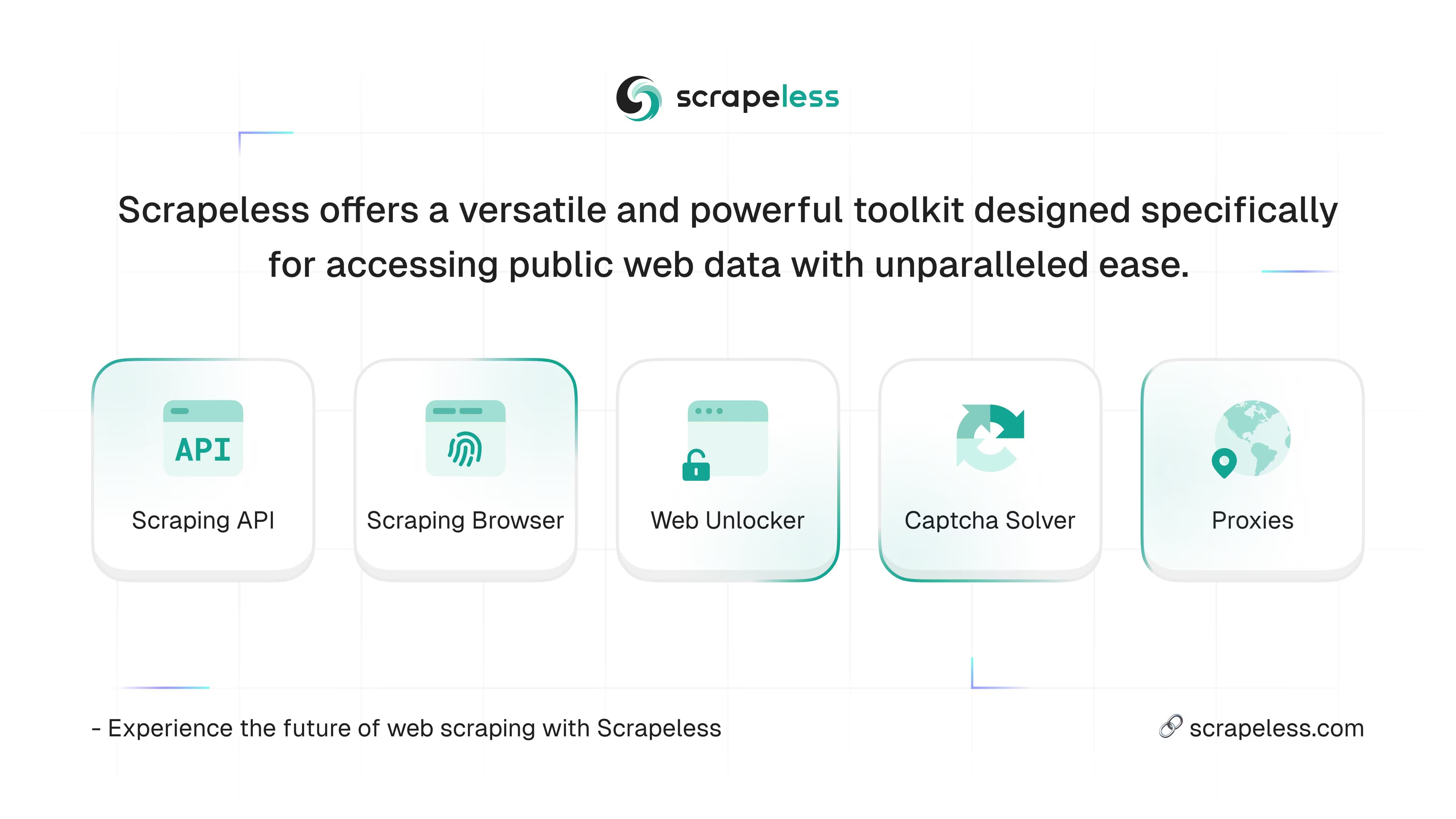
The product line covers several jobs. Agent Browser gives AI agents a real cloud browser to navigate, click, and fill forms. Web Unlocker pulls content from pages protected by Cloudflare, DataDome, or AWS WAF. AI Scraper collects answers and citations from engines like ChatGPT, Perplexity, and Gemini. Dedicated scrapers cover Google Search, Amazon, and TikTok. Crawl turns whole sites into Markdown or HTML for RAG pipelines, and Proxies give you geo-targeted IPs for your own stack.
The main catch is scope. Scrapeless is built for developers and data teams, so you need some code or an integration like n8n or Make to get real work done. Pricing is usage-based, which keeps small jobs cheap but can add up on very large crawls.
Getting Started
- Sign up at the Scrapeless dashboard. New accounts get $5 in free credit with no credit card required.
- Copy your API key from the dashboard and keep it private.
- Pick the product that matches your task, such as Agent Browser, Web Unlocker, or Scraping API.
- Send one test request through the REST API, an SDK in Python, Node, or Go, or the MCP server.
- Inspect the returned HTML, JSON, or Markdown and wire it into your pipeline.
Product Information
A quick look at Scrapeless's pricing, supported platforms, and performance.
Best for
The users, tasks, and scenarios where this tool fits best.
Users
- Data engineers
- AI agent builders
- SEO and growth teams
- E-commerce analysts
Tasks
- Scraping JavaScript-heavy sites
- Bypassing bot defenses
- Building RAG corpora
- Monitoring brand visibility in AI
Scenarios
- Running long agent workflows
- High-volume collection
- One-off research jobs
Key features
Agent Browser with Engine-Level Stealth
Agent Browser is a cloud browser that exposes a standard CDP WebSocket endpoint, so existing Puppeteer and Playwright code works with a one-line change. Anti-detection runs inside a purpose-built browser engine, not as a plugin. That covers TLS and JA3 fingerprints, Canvas and WebGL noise, audio context randomization, and WebRTC leak blocking.
Built-In CAPTCHA Solving
reCAPTCHA, Cloudflare Turnstile, and AWS WAF challenges are solved automatically inside the session. Scrapeless says its solver clears common CAPTCHA types at a 98% or higher rate, with an average time under two seconds. It ships free rather than through a separate paid solver.
Web Unlocker API
Web Unlocker takes a URL and returns clean HTML, JSON, Markdown, or a screenshot, giving you structured data extraction without any parsing setup. It detects the anti-bot system in play, rotates IPs, renders JavaScript, and retries on its own. Billing is per successful request only, so failed attempts don't cost you.
Residential Proxy Network
Every product sits on a residential proxy network spanning 195 countries, with state and city level targeting and sticky sessions for stateful crawls. Scrapeless lists four proxy types: residential, static ISP, datacenter, and IPv6.
Persistent Sessions and Live View
Cloud-stored profiles stay logged in across runs, cutting repeat authentication on long jobs. Live View streams the session DOM in under 100 milliseconds, and Session Replay replays frames with network and console logs attached, so you can see exactly what an agent saw when it failed.
MCP Server and Multi-Language SDKs
A native MCP server exposes browser actions, scraping, and search as callable tools for clients like Claude Code, Cursor, and Cline. For deeper integration, official SDKs cover Python, Node and TypeScript, and Go, with first-party connectors for n8n, Make, LangChain, and Dify.
Pros and cons
Pros
- One platform covers cloud browsing, unlocking, proxies, crawling, and structured scrapers, so you avoid stitching several vendors together.
- Usage-based pricing with a $5 free credit and no credit card needed to start.
- CAPTCHA solving and residential proxies are built in, not billed as separate add-ons.
- Existing Puppeteer and Playwright code connects through a standard CDP endpoint.
Cons
- It's a developer tool at heart. Non-technical users need an integration like n8n or Make to do anything useful.
- Usage-based costs can grow quickly on very large crawls, so you'll want to track credit consumption.
- Some self-reported success and speed figures come from Scrapeless itself and aren't independently verified.
- The product lineup is broad, which can make picking the right starting point confusing for newcomers.
Frequently asked questions
Scrapeless collects public web data and runs browser automation in the cloud. Teams use it to scrape protected sites, feed RAG pipelines, monitor AI search results, and give AI agents a real browser to work with.
Related content
Explore related tools, skills, and articles for Scrapeless.
Scrapeless Alternatives

Udon
Udon · Coding · ProductivityUdon turns an Apple Silicon Mac into a home server you run from a browser, with container controls, file shares, and an optional AI sysadmin.

offstage
offstage cloud · Coding · Productivityoffstage gives AI coding agents and CI jobs a real Mac: a fresh macOS account on Apple silicon, driven over an API and billed by the second.

BotBus
Chengdu Tuyang Tusen Technology Co., Ltd. · Coding · ProductivityBotBus lets you control AI coding agents from your phone and watch: approve commands, start tasks and read results while the code stays on your desktop.