

Second Nature
Second Nature · Leaning
Second Nature is an AI role play platform where sales and support teams rehearse real conversations with AI buyers, get instant scored feedback, and track readiness at team scale.
About Second Nature
What Is Second Nature
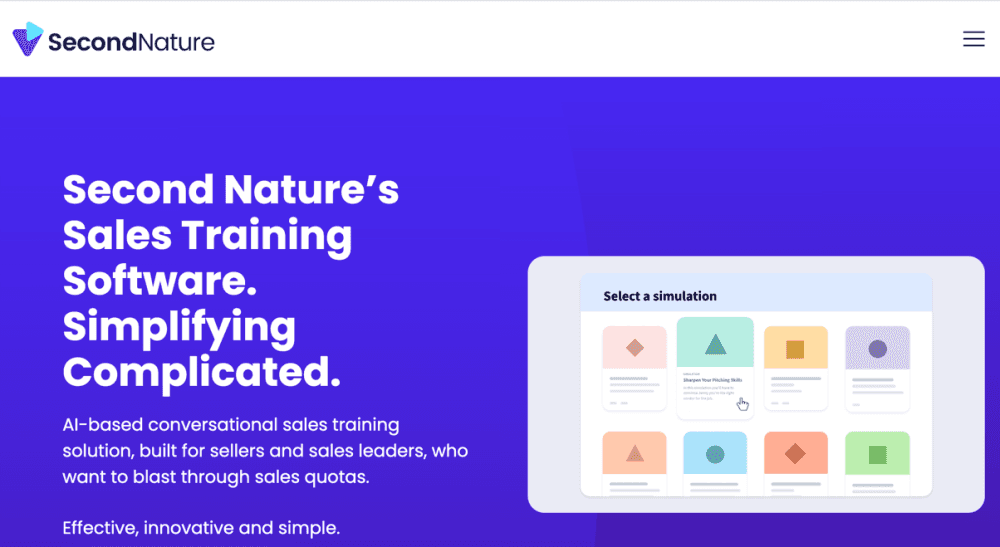
Second Nature is AI roleplay software built around a simple idea: reps get better at customer conversations by having more of them. The company sells it as AI role play sales training rather than a video library, and the difference shows up the moment a rep has to answer a hard question. Instead of reading a playbook or watching a recorded module, a rep opens a browser, picks a scenario, and talks to an AI persona that pushes back, asks follow-up questions, and behaves like the buyer on the other side of a real call.
The platform is aimed at teams that hire and onboard in volume, such as insurance, telecom, banking, BPO call centers, and B2B software sales organizations. Sales onboarding is the entry point for most of them, since a new hire can practice a full discovery call before touching a live account. Enablement managers build role plays from their own material, assign them to cohorts, and watch completion and score data roll in. Managers stop listening to call recordings one by one to judge whether a new hire is ready.
The main constraint is that Second Nature sells to organizations, not individuals. There's no self-serve checkout, so pricing and seat counts come from a sales conversation. Small teams that want a quick trial will find the free role play samples useful, but the full product assumes an admin, a content owner, and a rollout plan.
Getting Started
- Request a demo and get workspace access from the Second Nature team.
- Upload existing material such as PDFs, slide decks, docs, or call recordings, or start from a preset template built on frameworks like MEDDPICC, BANT, or SPIN.
- Define the scenario: persona background, call context, topics to cover, scoring weights, and the pass threshold.
- Assign the role play to a cohort and let reps practice in the browser.
- Review scores and transcripts in the manager dashboard, then adjust the scenario or add coaching where gaps show up.
Product Information
A quick look at Second Nature's pricing, supported platforms, and performance.
Best for
The users, tasks, and scenarios where this tool fits best.
Users
- Sales enablement managers
- Frontline sales reps
- Call center and support agents
Tasks
- New hire onboarding
- Product and messaging launches
- Certification and readiness checks
Scenarios
- High-volume hiring waves
- Regulated industries
- Distributed teams
Key features
AI Buyer Personas That Talk Back
Each role play runs on a conversational AI persona with a defined background, mood, and agenda. The AI answers questions, raises objections, and follows the thread of the conversation instead of reading a script. Reps get something close to the unpredictability of a live call, which is the part that slide decks never prepare them for.
Role Play Builder With Sales Framework Templates
Admins can upload PDFs, PowerPoint files, Word docs, or audio recordings and have the platform draft a scenario from them. Prebuilt templates map to common sales methodologies such as MEDDPICC, BANT, and SPIN, and the AI generates evaluation criteria that stay fully editable. That keeps setup in minutes rather than a content project.
Automated Scoring and Transcript Review
Every session gets scored against the criteria the admin set: topics covered, talk track adherence, style, and the pass threshold. Reps see where they lost points right away, and managers can read the transcript instead of replaying audio. Feedback arrives the same day, which is the difference between a habit forming and a habit sticking.
Manager Dashboard and Readiness Analytics
The dashboard rolls individual scores up to team and cohort level, so a manager can spot a proficiency gap by topic or by location. It doubles as a light AI sales coaching layer, pointing a rep to the exact segment where the conversation fell apart instead of a generic score. That data is what turns training from a completion checkbox into something you can report upward. It also shows who needs another pass before a certification date.
Call Analysis From Real Conversations
Recorded calls can be turned into training material, with the platform surfacing what worked and what didn't. Managers get an alternative to scoring recordings by hand, and the strongest and weakest real calls become practice scenarios for the rest of the team. The loop between live calls and practice closes without extra admin work.
Gamification and Always-On Access
Points, leaderboards, and streaks push reps to run another session without a manager asking. Because the AI partner is always available, practice fits around shifts and doesn't need a scheduled coaching slot. Remote agents in different time zones get the same experience as the head office team.
Integrations and Enterprise Controls
Second Nature connects to Salesforce, HubSpot, Microsoft Active Directory, SSO, and major LMS platforms, so roles and assignments follow the systems you already run. Compliance coverage includes GDPR, SOC 2, and CCPA, which matters for insurance, banking, and healthcare-adjacent teams. License reassignment makes it practical to move seats between cohorts as hiring slows or speeds up.
Pros and cons
Pros
- Conversation quality holds up over long sessions, so reps practice realistic dialogue rather than a keyword game.
- Scenario creation accepts the training material most enablement teams already have, including recordings and slide decks.
- Scoring criteria are visible and editable, which makes pass or fail decisions defensible.
- Dashboard data supports certification and ramp reporting without manual spreadsheet work.
Cons
- No public pricing and no self-serve signup, so evaluation starts with a sales call.
- The value depends on admin effort: weak scenarios produce weak practice, and nobody builds them for you.
- Deep customization and integrations land in enterprise plans, which puts the fullest version out of reach for small teams.
- Role plays measure conversation behavior, not live quota results, so you still need your own data to prove revenue impact.
Frequently asked questions
It runs AI role plays for sales, support, and call center teams. A rep talks to an AI buyer, gets scored on the conversation, and the manager sees the results in a dashboard.
Related content
Explore related tools, skills, and articles for Second Nature.
Second Nature Alternatives

HireKey
HireKey · Voice & Language · Productivity · LeaningHireKey is an AI job search copilot built by a former tech recruiter. It checks role fit, tailors resumes, runs interview practice and tracks every application.

Lune
Retrograde Labs · Productivity · LeaningLune is a research search engine for scientific AI agents. It runs as an MCP server that lets Claude, ChatGPT and Cursor search peer-reviewed computer science papers and cite them.
Coddy
Coddy · Coding · LeaningCoddy is a gamified platform to learn to code through short interactive lessons in 20+ languages, with a browser editor, an AI tutor and free certificates.