

Seeker AI
Seeker Group · Productivity · Business
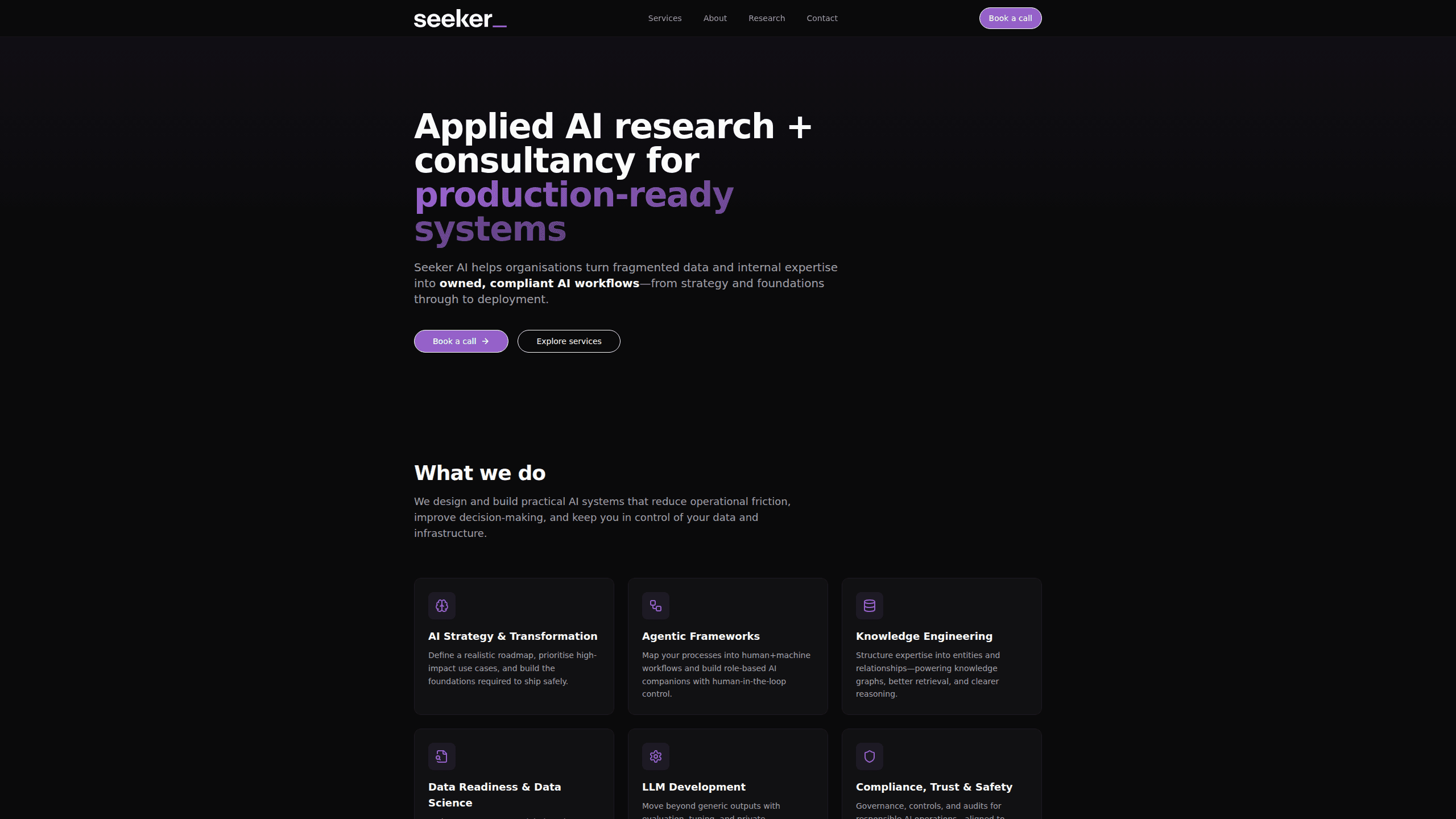
Seeker AI is an applied AI research and consultancy that helps organisations turn scattered data and internal expertise into AI workflows they own and control. It sits between generic AI tooling and full in-house teams, covering strategy, agentic frameworks, knowledge engineering, data readiness, LLM development, and compliance in a single engagement rather than stitching together several vendors. Think of it as AI workflow automation with a human still firmly in the loop. Companies that want production-ready AI without handing their data and infrastructure to a third party are the ones who get the most out of it.
About Seeker AI
What Is Seeker AI
Seeker AI is a consultancy, not a downloadable app. The team designs and builds practical AI systems for organisations: mapping messy processes, structuring internal knowledge, and deploying agents that keep a human in the loop. The pitch is ownership. Instead of renting a black-box tool, you end up with systems you run yourself. Your data stays on your infrastructure.
The main problem it targets is fragmentation. Most companies already have the data and the expertise to automate serious work; what they lack is the structure that makes models reliable in production. That's the gap. Seeker AI's data readiness and knowledge engineering work is aimed squarely at it.
The biggest limitation is that nothing here is self-serve. No public pricing page. No free trial. No API you can sign up for. So you're committing to a conversation and a custom scope before you see a number. Smaller teams with a single simple task will likely find it heavier than they need.
Getting Started
- Book a discovery call through the contact form and describe your current AI capabilities and goals.
- Work through the assessment stage to align on constraints, data maturity, and which use cases are worth pursuing.
- Approve a roadmap and governance model that sets out architecture, controls, and success measures.
- Move into the build phase, where prototypes are hardened into production workflows with evaluation and guardrails.
- Run the enable phase so your own team is trained and can maintain and iterate on the system.
Product Information
A quick look at Seeker AI's pricing, supported platforms, and performance.
Best for
The users, tasks, and scenarios where this tool fits best.
Users
- SME founders and operators assessing where AI actually helps
- Heads of operations, finance, or marketing chasing automation
- Agencies that need AI capability and delivery support
Tasks
- Building AI maturity assessments and roadmaps
- Designing knowledge graphs and RAG systems
- Cleaning and labelling data for production
- Governance and compliance reviews
Scenarios
- A company with scattered internal documents that no one can search reliably
- A business that wants agents but not full automation
- Teams under regulatory pressure
Key features
AI Strategy and Transformation
Seeker AI starts engagements with a maturity assessment and a prioritised roadmap, covering use case selection, business case, and stakeholder alignment. The goal is simple. Pick the work with the highest impact and the lowest risk of stalling. Teams get a plan they can defend to leadership, not a list of buzzwords.
Agentic Frameworks
This is where processes get turned into human-plus-machine workflows. Seeker AI designs agent architecture, orchestration, and tool and API integration, then wraps it in human-in-the-loop controls. The point is speed with accountability. You speed up repetitive decisions while keeping a person answerable for the ones that carry real consequences.
Knowledge Engineering
Knowledge engineering structures what a company knows into entities and relationships, which feeds knowledge graphs, better retrieval, and clearer reasoning. It covers graph design, entity extraction, taxonomy work, and RAG architecture. For firms whose value lives in undocumented expertise, this is the feature that matters most. It turns that expertise into something a system can actually use.
Data Readiness and Data Science
Models fail in production for boring reasons: messy, unlabelled, badly structured data. Seeker AI runs data quality assessments, builds pipelines, and handles labelling and feature engineering so agents have something reliable to run on. These are the building blocks behind serious enterprise AI systems. It's less glamorous than prompt work. It's usually the difference between a durable system and a prototype that never ships.
LLM Development
Rather than settling for generic model output, Seeker AI handles model selection, fine-tuning, prompt engineering, and private or on-premise deployment. The last part matters most. It means companies can keep sensitive data off public endpoints. The work is scoped to your domain and risk profile.
Compliance, Trust and Safety
Governance, controls, and audits run alongside the technical work, so risk gets addressed while the system is being built rather than after it ships. Seeker AI builds governance frameworks, runs risk assessment and bias testing, and maps privacy and data protection to regulations including the EU AI Act and GDPR. Compliance is treated as something built in from day one.
Owned, Compliant Systems
The through-line across every engagement is ownership. Why does that matter? Because dependency is a cost. Seeker AI's stated principle is to reduce reliance on third parties where it counts, and to encode what an organisation knows so knowledge compounds over time. For buyers wary of lock-in, that framing is the whole appeal.
Pros and cons
Pros
- Covers the full lifecycle, from strategy and roadmaps through to deployment and team enablement, so you don't stitch together several vendors.
- Strong emphasis on ownership and human-in-the-loop control, which suits organisations that can't hand over data or full decision authority.
- Compliance and governance work is built into engagements rather than bolted on at the end, which helps teams facing the EU AI Act and GDPR.
- Knowledge engineering and data readiness tackle the unglamorous groundwork that decides whether AI systems hold up in production.
Cons
- No public pricing, free plan, or trial, so you can't estimate cost without booking a call first.
- Fully custom, consultancy-style delivery means slower starts and higher cost than a self-serve AI tool for a simple task.
- No documented public API or product you can test on your own, which makes hands-on evaluation harder before committing.
- Best fit for organisations with real data and process complexity; a small team with one narrow task will likely find it overbuilt.
Frequently asked questions
Seeker AI is used to design and build AI systems inside organisations. That covers strategy and roadmaps, agentic workflows, knowledge graphs, data preparation, private LLM deployment, and compliance work. It's aimed at companies that want working systems rather than off-the-shelf software.
Related content
Explore related tools, skills, and articles for Seeker AI.
Seeker AI Alternatives

Base Code
Base44 (Wix) · Coding · ProductivityBase Code is a shared cloud development environment from Base44. Teammates describe changes to an existing GitHub codebase in chat, preview them live and send them back as pull requests.

Knocket
Knocket (Tencent RTC team) · Productivity · Business · ChatbotKnocket is a free live chat and contact page tool that lets visitors message you from your website, app, or a shareable link, with every reply handled from Telegram or one inbox.

FloorGen
Vinit Kumar (FloorGen) · Productivity · China AIFloorGen is a browser-based floor plan maker that turns a sentence or a sketch into an editable 2D plan and a 3D walkthrough. Export to PDF, DXF or video, and draw without an account.