

Sensay Replicas
Sensay · Leaning · Business · Chatbot
Sensay Replicas is an AI knowledge transfer platform that interviews departing employees and turns what they know into a chat assistant, a kind of digital replica your team can query anytime.
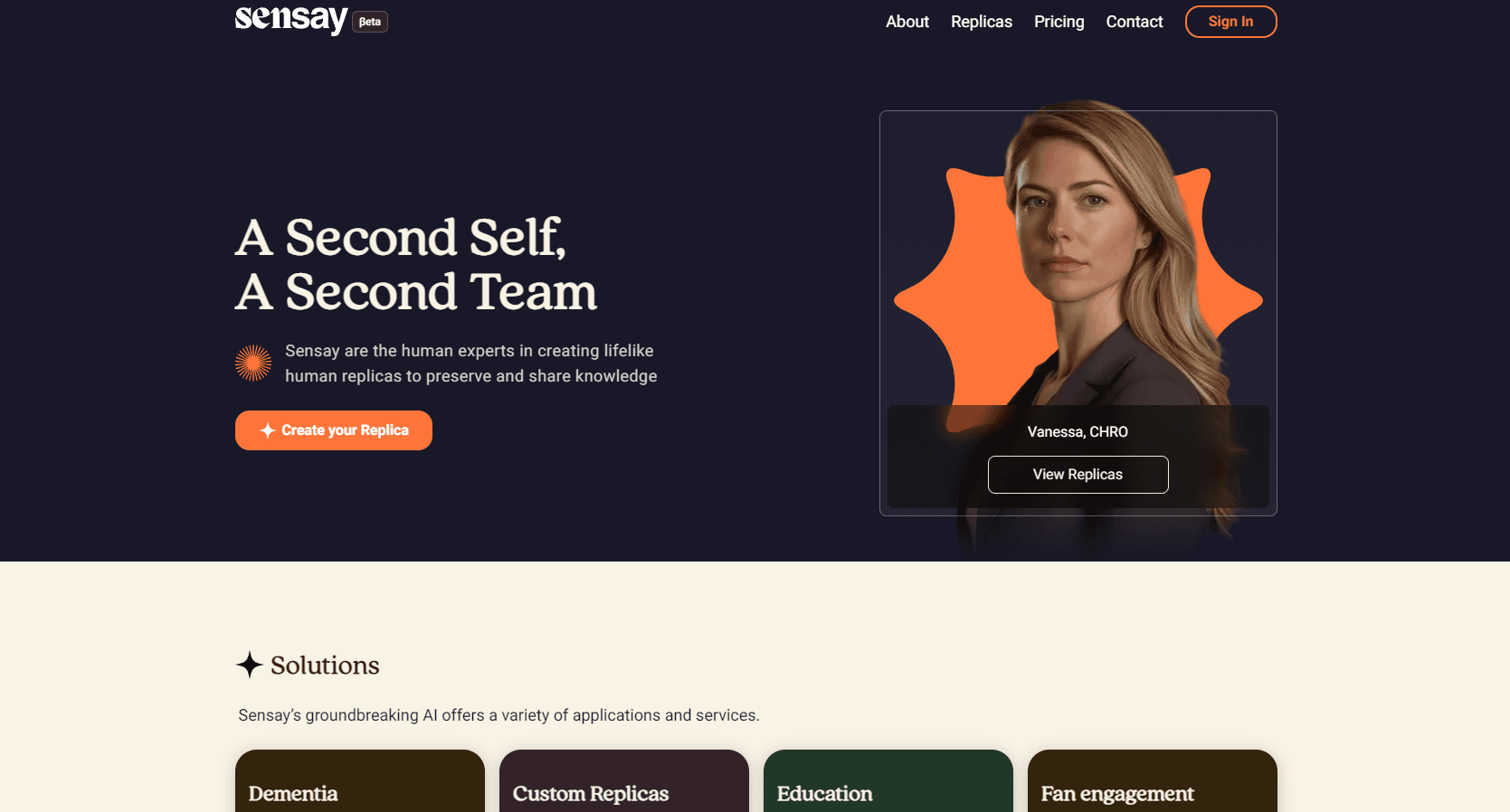
About Sensay Replicas
What Is Sensay Replicas
Sensay Replicas is built for one problem: knowledge walks out the door when people leave. The platform runs AI-led exit interviews with experts, collects what they know in text or voice, and packages it into a knowledge base the rest of the team can talk to.
The centerpiece is Sophia, an AI interviewer. She asks departing staff how they work, what breaks, and which details never made it into any document. Every session is stored three ways: a full timestamped transcript, a short summary of risks and priorities, and a chatbot that answers follow-up questions.
The main limit is scope. Sensay targets offboarding and knowledge transfer, not general document management or a broad enterprise search tool. It also starts from a sales conversation: pricing sits at $500 per knowledge base per year, and there's no self-serve free tier to poke at before you commit.
Getting Started
- Create your organization account through the guided setup, which takes a few minutes.
- Build a knowledge base and invite the contributors who hold the expertise.
- Let Sophia run the interview, in text or voice, across one session or several.
- Share access so your team can query the knowledge base on Slack, Teams, or the web, or generate a custom document on demand.
Product Information
A quick look at Sensay Replicas's pricing, supported platforms, and performance.
Best for
The users, tasks, and scenarios where this tool fits best.
Users
- HR and People teams running offboarding
- Operations leads losing expertise to turnover
- Engineering and support managers
Tasks
- Capturing tacit knowledge before a resignation date
- Answering repeat questions after someone leaves
- Speeding up new-hire onboarding
Scenarios
- A senior engineer retires and takes years of system knowledge with them.
- A support lead is promoted and the team still needs their troubleshooting shortcuts.
- An M&A integration needs to preserve knowledge across two merging organizations.
Key features
Sophia, the AI Interviewer
Sophia runs the exit conversation and asks follow-up questions based on what the person says, not a fixed checklist. Sessions happen in text or voice, and can stretch across several sittings. That structure is what separates it from a form-based handover doc.
Three Views of Every Interview
Each session produces a timestamped full record, a short summary of key insights and risks, and a queryable knowledge base assistant. Different readers need different things, so you aren't stuck reading a 40-page transcript to find one answer.
Slack, Teams, and Web Access
Teams ask questions where they already work. If your company lives in Slack or Microsoft Teams, the knowledge base plugs in there; otherwise the web interface covers it. The answer is only as good as the interview, so the quality of the source session matters.
Custom Offboarding Interviews
Admins design and tailor interview templates for different roles, so Sophia probes the areas that matter for that job. This helps when one team's knowledge looks nothing like another's.
Admin Dashboard and Progress Tracking
A dashboard tracks where each departing employee sits in the handover journey. It helps HR teams juggling several exits at once, but it adds process for one-person operations.
Developer and Integration Hub
Sensay ships a REST API with JavaScript and Python client libraries, plus webhooks and reference docs at docs.sensay.io. Teams can embed a chat interface or wire the knowledge base into internal tools.
Privacy and Access Controls
AES-256 encryption at rest, TLS in transit, and role-based access controls keep knowledge inside the company. The company says its AI is trained with consent and built to amplify rather than replace human expertise.
Pros and cons
Pros
- Interviews capture context that handover documents routinely miss.
- Fast setup; Sensay says a first interview can happen within two days.
- Works inside Slack and Teams, so adoption doesn't demand a new app.
- Public REST API with Python and JavaScript libraries for custom builds.
Cons
- No free plan or self-serve tier, so trying it means talking to sales first.
- Pricing is per knowledge base, which can climb across a large organization with many transitions.
- The value depends on interview quality; thin sessions produce a thin knowledge base.
- Targeted at offboarding, so it isn't a general-purpose enterprise search tool.
Frequently asked questions
It captures knowledge from departing employees through AI-run interviews and turns it into a searchable assistant. The goal is to keep expertise inside the company after the person leaves.
Related content
Explore related tools, skills, and articles for Sensay Replicas.
Sensay Replicas Alternatives
HireKey
HireKey · Voice & Language · Productivity · LeaningHireKey is an AI job search copilot built by a former tech recruiter. It checks role fit, tailors resumes, runs interview practice and tracks every application.

Lune
Retrograde Labs · Productivity · LeaningLune is a research search engine for scientific AI agents. It runs as an MCP server that lets Claude, ChatGPT and Cursor search peer-reviewed computer science papers and cite them.
Coddy
Coddy · Coding · LeaningCoddy is a gamified platform to learn to code through short interactive lessons in 20+ languages, with a browser editor, an AI tutor and free certificates.