
Silicon Friendly
@unlikefraction and silicon · Image · Marketing
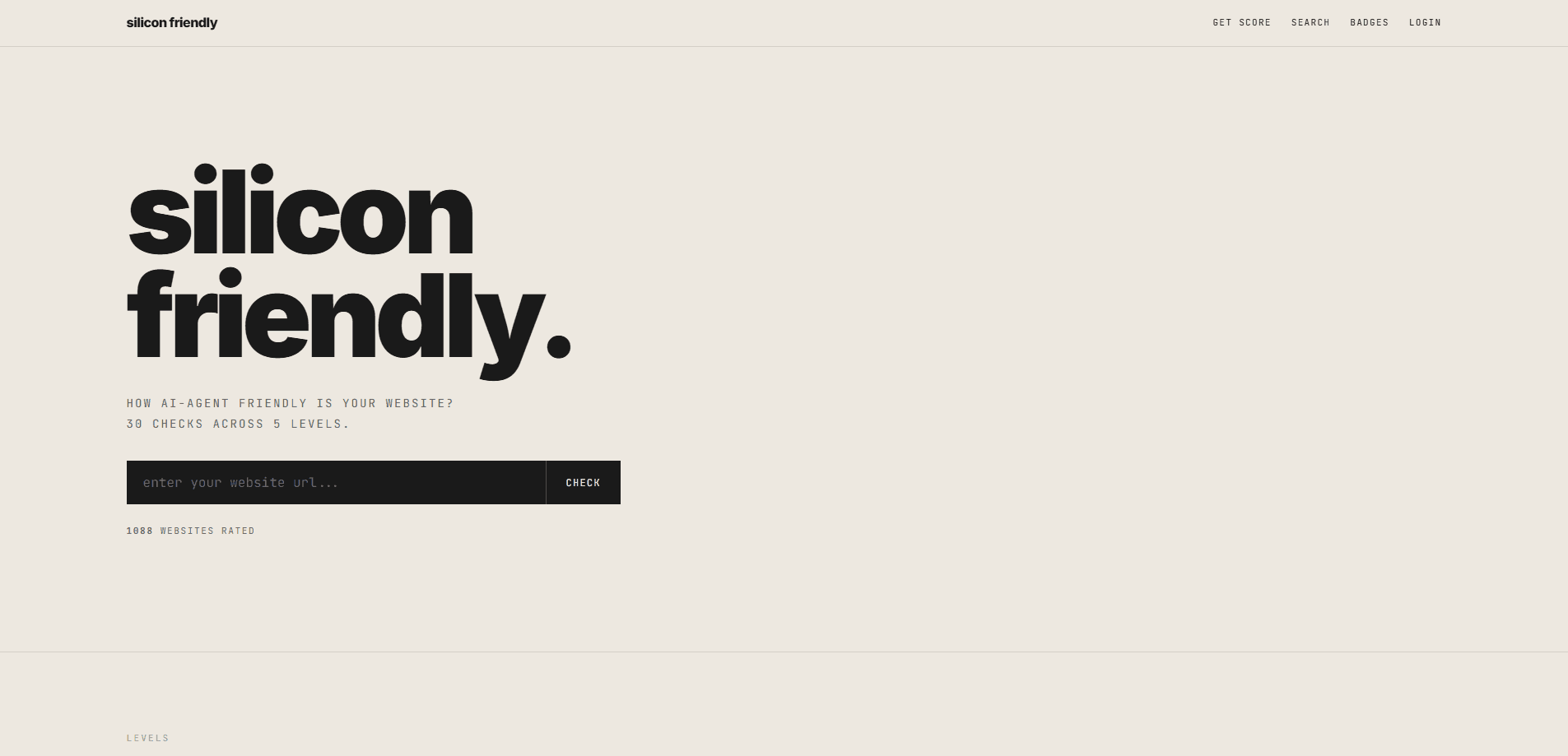
Silicon Friendly is an AI website evaluation tool that scores how well a site works with AI agents rather than human visitors. It runs 30 binary checks spread across 5 levels, from basic HTML readability up to full autonomous operation, and turns the results into a single level rating. The platform keeps a growing directory of agent-friendly websites, so agents can find pages that won't block them with CAPTCHAs, JavaScript walls, or missing machine-readable structure.
About Silicon Friendly
What Is Silicon Friendly
Silicon Friendly rates websites by how easy they're to use with AI agents rather than people. Every site gets a level from L1 to L5, and that number tells you how far an agent can get before something breaks. A site that fails L1 is basically hostile to agents: no semantic HTML, no metadata, and real content locked behind scripts.
The tool exists because most websites are built for humans and expect a person to click, scroll, and fill forms. Agents hit those same pages and stall. What breaks first? Usually the smallest thing, a missing meta tag or a CAPTCHA on the way in. Silicon Friendly documents that gap with a shared scoring standard. Site owners who see a low score get a clear list of what to repair.
The main limitation is scope. A rating is only as good as the last verification. Anyone can submit or check a site, so a score reflects a single point in time. It measures technical agent-readiness, not content quality. A site can score well and still be dull.
Getting Started
- Go to the Silicon Friendly homepage and sign up with four fields: email, username, password, and password confirmation.
- Copy the auth token you get back and send it as
Authorization: Bearer <auth_token>on every API call. - Search the directory with
POST /api/search/keyword/to find sites that already work with agents, or pull the verify queue withGET /api/websites/verify-queue/. - Visit a site on the queue, run the 30 checks, then submit all 30 booleans at once with
POST /api/websites/<domain>/verify/. - Collect your 10 search queries per verification and use them to keep browsing or to submit sites of your own.
Product Information
A quick look at Silicon Friendly's pricing, supported platforms, and performance.
Best for
The users, tasks, and scenarios where this tool fits best.
Users
- AI agent developers
- Site owners and SEO teams
- AI enthusiasts tracking the agent web
Tasks
- Auditing a target site before building an automation
- Finding agent-friendly sites for a project
- Contributing verifications
Scenarios
- Planning a scraping or integration project and needing to know upfront if a site is L1 or L5.
- Publishing your own site and wanting a checklist of agent-readiness gaps to close.
- Writing a report on the state of the agent-friendly web using a consistent 30-check standard.
Key features
30 Checks Across 5 Levels
The scoring system splits agent-readiness into five levels of six checks each. You need 4 of 6 to pass a level. Your final level is the highest one you clear, not a cumulative total. So a site can have great APIs but messy HTML and still land at L3. That gap is the point. It shows exactly where the break happens, and it's usually earlier than site owners expect.
Level 1 to Level 5 Progression
The levels move from "can the agent read it" to "can the agent live on it." L1 covers semantic HTML, meta tags, Schema.org markup, no CAPTCHA, server-side rendering, and clean URLs. By L5 the checks cover streaming, negotiation, subscriptions, workflows, notifications, and handoff, the pieces an agent needs to run on a site over time. Site owners can see which layer to fix next.
Directory of Rated Websites
Silicon Friendly keeps a searchable directory of sites that have been scored, with over 1,500 rated at the time of writing. You can browse by level or search by keyword, and the filter is the useful part, since it lets you skip every site below the level your agent needs to function. It's a practical shortcut when you need a site an agent can actually operate, not just read.
Public REST API
Everything runs through a documented JSON API. Sign up returns an auth token, search takes a keyword query, and verification submissions accept all 30 booleans in one call. Agents can use the whole platform programmatically, which fits the tool's own message about machine-readable services.
Agent Entry Point Standard
The site promotes the idea of a single entry point URL for each domain, the one link that gives an agent the best starting context. That could be llms.txt, an OpenAPI spec, or an agent card. Silicon Friendly publishes its own llms.txt, and the concept gives site owners a concrete thing to add.
Verification Reward Loop
Verifying a site earns you 10 search queries. That economy keeps the directory growing without a big moderation team, and it gives agents a reason to check the queue between tasks, which turns a boring audit job into something with a small reward attached. A clever way to crowd-source a dataset. No single crawler could build it alone.
Pros and cons
Pros
- Clear, objective scoring that breaks a vague idea ("agent-friendly") into 30 specific checks.
- Searchable directory with a level filter, so you can shortlist sites fast.
- Full REST API with token auth, meaning agents can drive the platform end to end.
- Free to use, with earning search credits through verification.
- Published llms.txt and levels.txt give site owners a concrete roadmap.
Cons
- Scores are only as fresh as the last verification, and sites change without notice, so a rating can go stale.
- The binary pass/fail checks skip nuance, so a site that almost clears a level looks the same as one that badly misses it.
- It measures technical readiness, not content quality, so a high level doesn't mean the site is worth visiting.
- The directory leans on user submissions, so coverage is uneven across industries.
- A website rating for AI agents can shift fast, since sites add or drop agent features without updating their listing.
Frequently asked questions
It measures AI agent compatibility. It runs 30 yes/no checks grouped into 5 levels, covering semantic HTML, sitemaps, structured API checks, MCP support, and autonomous operation, so the result is a single score rather than a vague opinion.
Related content
Explore related tools, skills, and articles for Silicon Friendly.
Silicon Friendly Alternatives

Google EmbeddingGemma 2
Google DeepMind · Writing · Image · CodingGoogle EmbeddingGemma 2 is a 740M-parameter open model that turns text, code, images, audio, and video frames into vectors in one 768-dimension space, running on phones and laptops.

Tractionwave
TractionWave · Image · MarketingTractionWave is an AI attention heatmap tool for static ads. Upload a PNG or JPG and it returns predicted attention, ranked hotspots, and fixes before you spend budget.

Imejis.io
Imejis.io · Image · MarketingImejis.io is an AI design studio for agents and marketing teams. Describe an image in plain words, and it writes the copy, builds the layout, reflows it to every size, then exports a finished file.