

Stable Diffusion 3
Stability AI · Image
Stable Diffusion 3 is Stability AI's open-weight text-to-image model, built to hold multi-subject prompts together and render short strings of legible text inside an image.
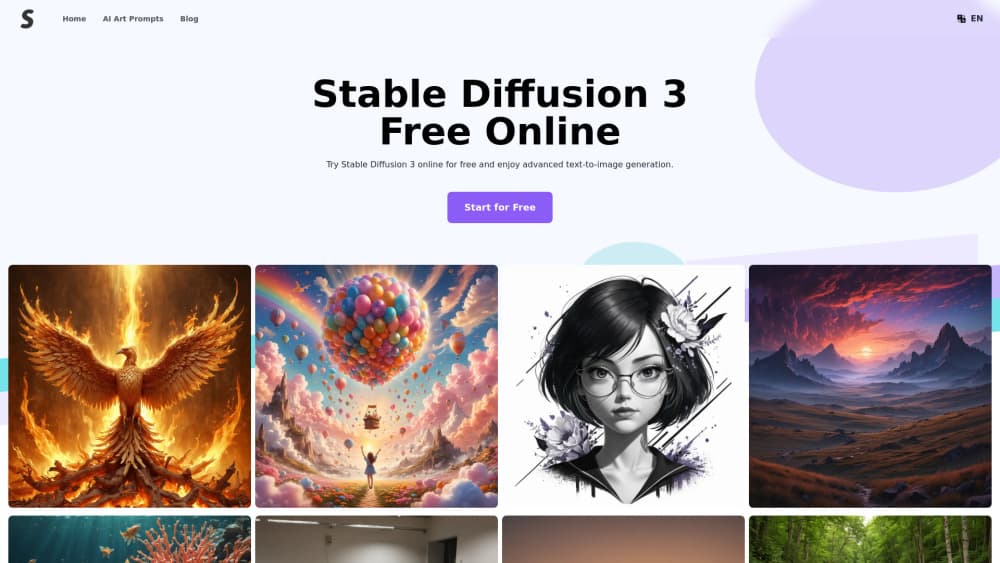
About Stable Diffusion 3
What Is Stable Diffusion 3
Stable Diffusion 3 is an open-weight text-to-image model from Stability AI. You give it a written prompt, it returns a picture. The basic job matches Midjourney or DALL·E, with one difference that decides the purchase for a lot of teams: the weights are downloadable, so the model can run on hardware you control.
Stability announced the SD3 family in February 2024 and released the Medium build in June 2024. Medium carries 2 billion parameters. The larger 8 billion parameter versions stayed behind paid access on the company's own apps and API. Under the hood the model pairs a Multimodal Diffusion Transformer (MMDiT) with a 16-channel VAE, which means text and image patches are processed together instead of a text reader being bolted onto an image generator.
The practical gain over earlier Stable Diffusion releases shows up in prompt accuracy. Crowded scenes hold together, hands and small objects fail less often, and short text inside an image often comes out readable. That last point pulled a lot of poster and mockup work toward SD3.
One limit belongs at the front. Stability retired the SD3 endpoints on its own API in April 2025 and moved callers onto Stable Diffusion 3.5. The weights remain on Hugging Face and third-party hosts still serve the model, but a team planning around the official Stability API is really building on 3.5 today.
Getting Started
- Create a Hugging Face account and accept the license on the stable-diffusion-3-medium model page, then download the weights or pull the diffusers build.
- Pick a runner. ComfyUI suits node-based workflows, Automatic1111 suits familiar form-style settings, and the diffusers library suits Python scripts and batch jobs.
- Load the model at roughly 1024x1024 and keep the prompt descriptive. SD3 responds better to a plain sentence about the scene than to a pile of comma-separated tags.
- Set a seed, generate a small batch, then fix what failed in the prompt rather than rerolling blindly. Save the settings that worked so the same look can be reproduced later.
Product Information
A quick look at Stable Diffusion 3's pricing, supported platforms, and performance.
Best for
The users, tasks, and scenarios where this tool fits best.
Users
- Illustrators and concept artists
- Design studios with client confidentiality rules
- Developers building image features into an app
- Hobbyists learning how diffusion models work
Tasks
- Poster and packaging mockups
- Multi-subject scene drafting
- Style exploration before a shoot
- Batch asset production for games and apps
Scenarios
- Studio work under an NDA
- A team already running ComfyUI
- Research on image models
Key features
MMDiT Architecture
SD3 splits attention between text tokens and image tokens at every block instead of compressing a prompt into one vector. The result is better instruction following on long, specific prompts. If your prompt names a subject, a material, and a lighting condition, SD3 usually honors all three.
Legible Text Rendering
Short words and labels inside an image come out readable far more often than they did on SDXL. Poster headlines, shop signs, and packaging copy are now realistic targets. Long paragraphs still break down, so keep text to a handful of words.
Prompt Accuracy on Crowded Scenes
The model handles multiple subjects without merging them into one blob. A prompt that asks for two people shaking hands in a kitchen with a cat on the counter tends to produce all of those things, in roughly the right places. Composition drift still happens, and a second pass with inpainting fixes it.
2 Billion Parameter Medium Build
Medium is small enough to run on a single consumer GPU and still produces gallery-grade output at 1024x1024. That combination is the reason it became the default SD3 download for individuals, while the 8 billion parameter versions stayed behind paid access.
Open Weights and Fine-Tuning
The full weights are on Hugging Face, and the diffusers library loads them in a few lines of Python. LoRA training, ControlNet adapters, and custom schedulers all work, which is how studios build a consistent house look on top of the base model.
Flexible Aspect Ratios
SD3 was trained around one megapixel, so 1024x1024, 1344x768, and 768x1344 all sit inside its comfort zone. Vertical and horizontal frames don't need cropping after the fact, and the model keeps composition stable across those shapes.
Pros and cons
Pros
- Open weights mean no per-image fee, no queue, and no content filter between you and the output once the model is local.
- Text rendering is a genuine step up, which removes a tedious cleanup step from poster and packaging work.
- Multi-subject prompts hold their structure, so complex scene drafts need fewer retries.
- The Stable Diffusion 3 Medium build runs on a single consumer GPU, and the surrounding tooling (ComfyUI, diffusers, LoRA) is mature.
Cons
- Stability retired the SD3 API endpoints in April 2025, so the official hosted route now serves 3.5. Teams that need a current first-party API should plan around that.
- The 2 billion parameter model trails dedicated flagship models on fine detail and photorealism, especially skin texture and distant faces.
- Running it locally means owning the hardware cost, the driver updates, and the model files, which is real work for a small team.
- The Community License free tier stops at $1M in annual revenue, so a growing business eventually needs a paid enterprise license.
Frequently asked questions
The weights are free to download, and the Community License covers research plus commercial use for organizations under $1M in annual revenue. Above that line you need an enterprise license from Stability AI. Hosted API calls are billed per image by whichever provider you use.
Related content
Explore related tools, skills, and articles for Stable Diffusion 3.
Stable Diffusion 3 Alternatives

Google EmbeddingGemma 2
Google DeepMind · Writing · Image · CodingGoogle EmbeddingGemma 2 is a 740M-parameter open model that turns text, code, images, audio, and video frames into vectors in one 768-dimension space, running on phones and laptops.

Tractionwave
TractionWave · Image · MarketingTractionWave is an AI attention heatmap tool for static ads. Upload a PNG or JPG and it returns predicted attention, ranked hotspots, and fixes before you spend budget.

Imejis.io
Imejis.io · Image · MarketingImejis.io is an AI design studio for agents and marketing teams. Describe an image in plain words, and it writes the copy, builds the layout, reflows it to every size, then exports a finished file.