
Standard Wizard AI
Standard Wizard · Leaning
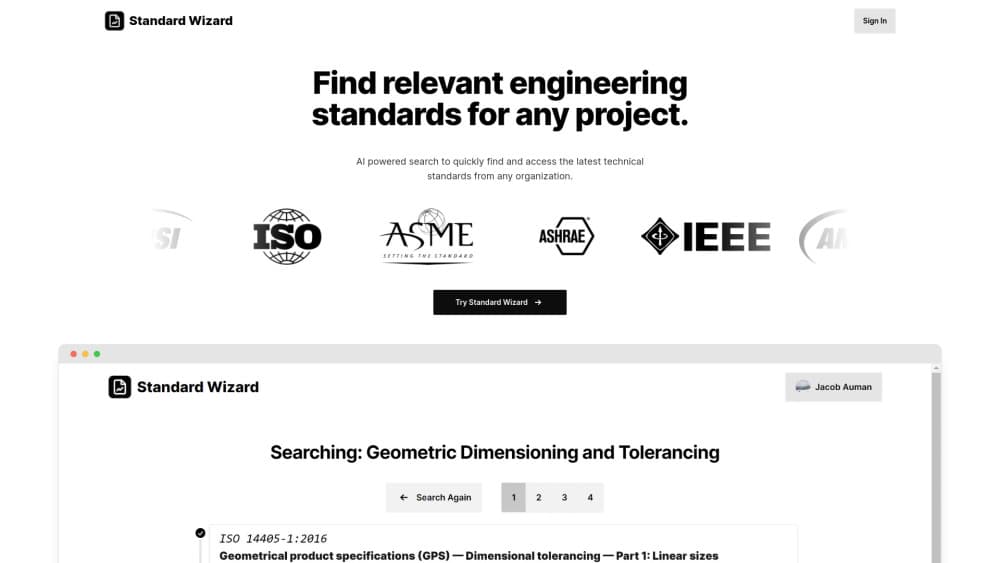
Standard Wizard AI is a browser based engineering standards search tool over 28,000+ documents, returning AI summaries and links to the official PDFs.
About Standard Wizard AI
What Is Standard Wizard AI
Engineering work runs on documents nobody enjoys reading. A designer needs the right ISO tolerance callout before a drawing goes out. A compliance lead needs to know which ASME section covers a weld test. Standard Wizard AI turns that hunt into a sentence.
You describe the problem in everyday words and it returns the standards most likely to cover it. The catalog holds more than 28,000 documents from ISO, ASME, IEC, ASTM and other publishers. Each hit carries an AI generated summary, a link to the publishing organization, and a PDF download where the publisher allows one.
That makes it a technical standards database rather than a document store. You get a pointer to the source, not a copy of it. Two limits matter here. Summaries are secondary descriptions, and any real decision needs the purchased text. Coverage also stops where the index stops, so an obscure national code may not be in there.
Getting Started
- Sign up at standardwizard.com with an email address.
- Pay the one time $39 fee to unlock the full index.
- Search by problem ("flatness tolerance for a machined flange") or by reference (ISO 14405-1).
- Read the AI summary, then open the source link or the PDF.
- Copy the reference number into your drawing notes or compliance checklist.
Product Information
A quick look at Standard Wizard AI's pricing, supported platforms, and performance.
Best for
The users, tasks, and scenarios where this tool fits best.
Users
- Mechanical and design engineers
- Quality and compliance staff
- Manufacturing and process engineers
- Students and junior engineers
Tasks
- Finding the right tolerance standard
- Checking which standard covers a test method
- Verifying a reference before it reaches a drawing
- Assembling a reading list for a new project
Scenarios
- Early project scoping
- Supplier documentation review
- Audit preparation
Key features
Plain Language Semantic Search
You type the engineering problem, not the standard number. A conventional ISO standards search expects a number or a title fragment, which is why people give up and call a colleague. This one reads intent, so "surface finish for a hydraulic cylinder bore" returns finish specifications even when those exact words never appear in a title. Results rank by relevance to the description. This is the part that saves the most time on unfamiliar ground.
An Index of 28,000+ Standards
The catalog pulls from ISO, ASME, IEC, ASTM and a long list of national and industry bodies. Breadth matters more than depth here, because most design questions sit at the seam between two organizations. One search covers all of them instead of five separate publisher portals.
Exact Standard Lookup
When you already know the reference, switch to lookup mode and enter the organization plus the number. ISO 5459 lands on the right record with its summary. This kills the guessing that comes with partial titles. For an ASME standards lookup, or any other publisher, it's the fastest way to confirm a citation someone sent you.
AI Generated Summaries
Every result comes with a short description of what the document covers, written in plain English. For an unfamiliar code, that paragraph tells you whether it's worth the purchase. Read it as a map, not as the territory. Clauses and exceptions still live in the paid text.
Source Links and PDF Downloads
Each record links to the organization that publishes the standard, and many include a direct PDF where the publisher makes one available. You buy from the source, which keeps the citation clean and the revision current. No file sharing workarounds, no guessing which revision a random copy reflects.
Topic Browsing
Beyond search, the AI standards lookup can run in browse mode. You can browse standards by subject area, including grouped topics like geometric dimensioning and tolerancing. Handy when you're learning a domain and don't yet know what to ask. The grouping shows how a family of documents fits together before you spend money on any single one.
Pros and cons
Pros
- Semantic search understands a described problem, which beats keyword matching on publisher portals.
- One index spans ISO, ASME, IEC and ASTM, so cross organization questions take a single query.
- AI summaries give enough context to judge relevance before buying a document.
- Links point to the official publisher, so citations stay accurate and revisions stay current.
- A one time $39 payment is far below most subscription based standards research tools.
Cons
- Summaries can miss nuance in scope and exceptions, so critical decisions still need the full text.
- Coverage depends on what's indexed, and niche national codes may be absent entirely.
- No public API, which rules it out as a component in an automated compliance pipeline.
- Updates arrive through periodic refreshes, so a standard revised mid cycle may lag behind the publisher.
Frequently asked questions
It searches a catalog of engineering standards and returns the documents that match a described problem or an exact reference. Each result includes an AI summary and a link to the publisher.
Related content
Explore related tools, skills, and articles for Standard Wizard AI.
Standard Wizard AI Alternatives

HireKey
HireKey · Voice & Language · Productivity · LeaningHireKey is an AI job search copilot built by a former tech recruiter. It checks role fit, tailors resumes, runs interview practice and tracks every application.
Lune
Retrograde Labs · Productivity · LeaningLune is a research search engine for scientific AI agents. It runs as an MCP server that lets Claude, ChatGPT and Cursor search peer-reviewed computer science papers and cite them.
Coddy
Coddy · Coding · LeaningCoddy is a gamified platform to learn to code through short interactive lessons in 20+ languages, with a browser editor, an AI tutor and free certificates.