

Stepsize AI
Stepsize (acquired by ClickUp) · Productivity · Marketing
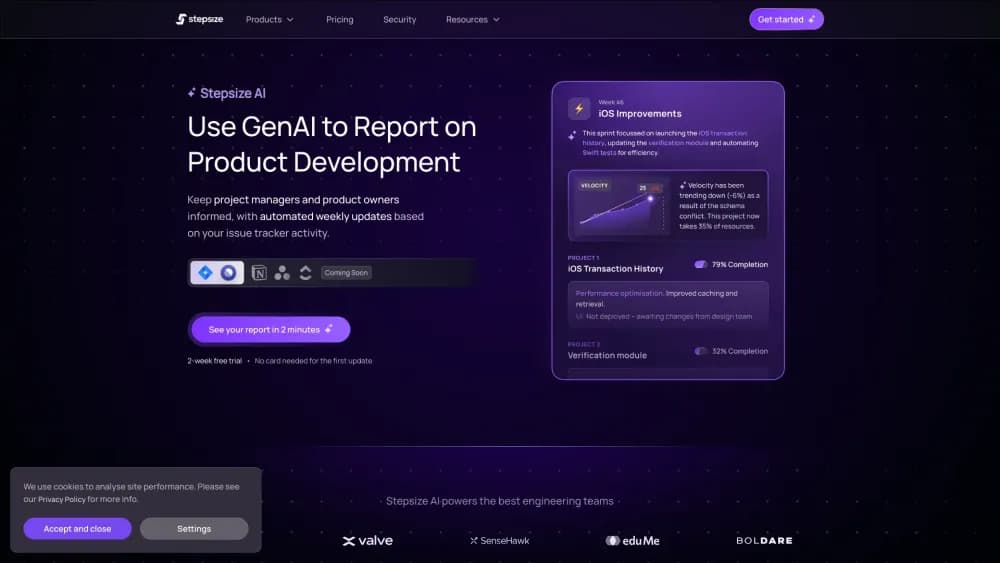
Stepsize AI turns Jira boards and Linear teams into weekly product development reports, with AI-written commentary on progress, sprint themes, and delivery risks.
About Stepsize AI
What Is Stepsize AI
Stepsize AI is an AI reporting tool for software teams. It connects to a Jira board or a Linear team, reads the issues and their status changes, then writes a weekly update that engineering managers can send upward without rewriting a spreadsheet by hand.
The product comes from Stepsize, a UK company that ClickUp acquired in early 2024. Stepsize AI still runs as its own paid service, separate from the ClickUp workspace. That matters if you're comparing it with a project management suite: this is a reporting layer, not a place to plan work.
The output is a dashboard with charts, plain-language notes, and links back to the issues behind each number. Each report covers one board or team, so a company with five squads buys five subscriptions. Reports depend on clean tracker data too. If issues sit in the wrong column or nobody updates status, the AI has little to work with and the summary will say so in softer terms.
Getting Started
- Sign in at ai.stepsize.com with your work email and connect either a Jira Cloud board or a Linear team.
- Pick the projects, channels, and repositories that should appear in the report, so private work stays out of the weekly summary.
- Generate the first report and read the AI-generated commentary next to each chart, then open the source issues to check the claims.
- Set the weekly schedule and invite the managers or stakeholders who need the update.
Product Information
A quick look at Stepsize AI's pricing, supported platforms, and performance.
Best for
The users, tasks, and scenarios where this tool fits best.
Users
- Engineering managers
- Heads of engineering and CTOs
- Product managers
- Agile coaches and delivery leads
Tasks
- Writing weekly status updates
- Preparing a sprint review
- Spotting slipping projects
- Reporting across several squads
Scenarios
- A Monday leadership meeting
- A remote team spread across time zones
- A team with a messy backlog
Key features
Weekly Reports Built From Issue Tracker Data
Stepsize AI reads issue activity from a connected Jira board or Linear team and assembles a report every week. Jira reporting and Linear reporting follow the same layout, so a manager who moves between both tools reads one format. Each section ties back to the tickets behind it, so a manager can click through when a number looks wrong. You set the cadence once, and the update arrives without anyone rebuilding a dashboard.
AI-Generated Commentary on Engineering Metrics
Charts alone don't explain why velocity dropped or why a project stalled. The AI writes a short narrative beside the numbers and points out sprint themes, completed work, and shifts in scope. The commentary is a starting point for a manager's own reading, not a replacement for it.
Project Insights From Epic Structure
The tool uses your epics to group loose tasks into themes, then reports progress at the project level as well as the team level. This is the part that separates product development reports from a raw ticket count. If your epics are vague or unused, the grouping gets weaker, so the structure you already have matters.
Delivery Risk Detection
Stepsize AI surfaces risks it finds in the tracker and pairs each one with a practical suggestion. A cluster of blocked issues, a sprint with no completed items, or a project that keeps moving its end date all count as signals. You decide what to act on, and the report keeps a record of what was flagged.
Sprint Themes and Goal Tracking
The report names the themes a sprint actually pursued, based on the issues that moved, and compares them with the stated goal. Teams that write thin sprint goals get a useful mirror here. The output also helps when a stakeholder asks what the team did all week and the answer needs to fit in one paragraph.
Data Scope Controls
You choose which channels, projects, and repositories feed a report. That control matters for agencies with client work or companies with sensitive internal projects. Narrowing the scope also makes the commentary sharper, because the AI spends its attention on fewer issues.
Security and Data Handling
Stepsize says customer data is never used to train large language models, and the service encrypts data at rest and in transit with AES-256. Reports stay inside the account and are shared with the people you invite. Teams in regulated industries should still read the information security guide before connecting a board.
Pros and cons
Pros
- Produces a readable weekly status update from tracker data without manual chart building.
- The AI commentary explains movement in plain language and links to source issues.
- Delivery risk detection turns vague worries into a list a manager can act on.
- Data scope controls let you leave client projects or sensitive repositories out of a report.
- The first report is free and every plan starts with a two-week trial, so you can test it on a real board.
Cons
- At $29 per Jira board or Linear team each month, the cost climbs quickly for organizations with many squads.
- It only connects to Jira Cloud and Linear, so teams on Azure DevOps, Asana, or GitHub Issues can't use it.
- Report quality depends on tracker hygiene, and a backlog with stale statuses produces weak or misleading summaries.
- There's no public API and no mobile app, which limits automation and on-the-go checking.
Frequently asked questions
It builds weekly reports from Jira or Linear activity. Each report combines charts, AI-written commentary, project insights, and delivery risks, with links back to the underlying issues.
Related content
Explore related tools, skills, and articles for Stepsize AI.
Stepsize AI Alternatives

Base Code
Base44 (Wix) · Coding · ProductivityBase Code is a shared cloud development environment from Base44. Teammates describe changes to an existing GitHub codebase in chat, preview them live and send them back as pull requests.

Knocket
Knocket (Tencent RTC team) · Productivity · Business · ChatbotKnocket is a free live chat and contact page tool that lets visitors message you from your website, app, or a shareable link, with every reply handled from Telegram or one inbox.

FloorGen
Vinit Kumar (FloorGen) · Productivity · China AIFloorGen is a browser-based floor plan maker that turns a sentence or a sketch into an editable 2D plan and a 3D walkthrough. Export to PDF, DXF or video, and draw without an account.