

Stock Alpha
Stock Alpha, Inc. · Coding · Business
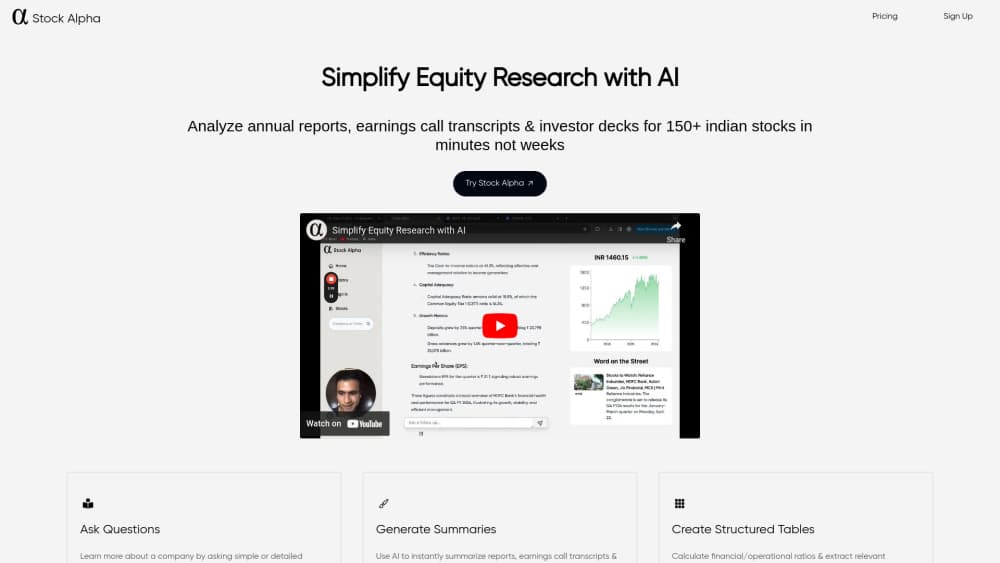
Stock Alpha is an AI equity research tool that answers questions and summarizes annual reports, earnings calls, and investor decks for more than 200 Indian stocks.
About Stock Alpha
What Is Stock Alpha
Stock Alpha is a web app for people who read Indian company filings. You pick a stock from its coverage list, ask a question in plain English, and get an answer drawn from annual reports, earnings call transcripts, and investor decks. It's a stock research AI built around documents, not around price charts.
The pitch is time. Most Indian stocks research still means downloading a 300-page PDF and hunting for six paragraphs. Stock Alpha reads the document for you, shows the section it used, and takes follow-up questions without making you start over. You get an annual report summary in about the time it takes to skim the table of contents.
The limits matter as much as the features. Coverage stops at Indian listed companies, so a US or European portfolio needs a different tool. Answers come from what companies file, which means small caps with thin disclosure get thin answers. Most AI stock analysis tools answer from the open web and hope for the best. This one stays inside filings, which is narrower and more useful for the job.
Getting Started
- Create an account at stockalpha.xyz with your email, then sign in to reach the dashboard.
- Pick a company from the stocks list. The library holds annual reports, transcripts, and investor decks for each name.
- Ask a question, or run a one-click summary on a document. Follow-up questions keep the same company in context.
- Switch to the table view when you need numbers, and request profit and loss, balance sheet, or cash flow lines as structured output.
Product Information
A quick look at Stock Alpha's pricing, supported platforms, and performance.
Best for
The users, tasks, and scenarios where this tool fits best.
Users
- Retail investors who follow Indian large caps and mid caps
- Junior equity research analysts
- Finance students and CFA candidates
Tasks
- Digging through an annual report for the parts that matter
- Pre-earnings preparation
- Financial data extraction
- Building a quick sector view
Scenarios
- You hold twelve Indian stocks and want to keep up with results without losing a weekend every quarter.
- A stock you don't own shows up in the news and you need the business model and growth drivers in ten minutes.
- You're writing a note or a blog post and need earnings call transcript analysis you can quote with a source.
Key features
Question answering across filings
Ask about revenue mix, capex plans, related-party transactions, or management's own words on demand, and the answer comes back with the document and section it used. A loose question like "why did margins fall last year" still lands on the right pages. Follow-ups keep context, so a research thread builds instead of resetting each time.
One-click document summaries
Annual reports, transcripts, and investor decks each get a summary on demand. The output follows the structure of the source, which makes it easier to see what the company chose to emphasize. You can also ask for a summary shaped around your own investing style, value or growth, rather than a generic recap.
Structured table extraction
The tool turns filing data into tables: profit and loss, balance sheet, cash flow, plus ratios you request by name. That kills the copy-paste loop between PDF and spreadsheet that eats most of a modelling afternoon. Output is only as clean as the filing, so odd formats and restated figures still need a human look.
Custom reports
You can define the sections you care about and have the app generate a report in that shape. A credit analyst and a growth investor end up with different documents from the same filings. Reports are a starting draft, not a finished note, and the prose still reads like a summary rather than an argument.
Playground for modelling work
Pro users get a Playground for automating parts of financial modelling on a stock. It suits people who already know what they want to calculate and would rather describe it than click through cells. If you've never built a model, expect a real learning curve.
Coverage of 200+ Indian stocks
The library spans more than 200 listed Indian companies, with filings going back several years for the larger names. Depth varies by company, and that's the honest constraint. A Nifty 50 name has a full paper trail, while a small cap may have two transcripts and one annual report.
Pros and cons
Pros
- Answers cite the document they came from, so verification takes minutes rather than hours.
- Table extraction removes the worst part of equity research, which is retyping numbers out of a PDF.
- Summaries follow the source's structure, which makes management's emphasis visible instead of smoothed over.
- The interface needs no prompt engineering. You type a question the way you'd ask a colleague.
- India focus pays off in document depth that general chatbots don't have for Indian mid caps.
Cons
- Coverage is Indian listed stocks only, so a global portfolio needs a second tool.
- Document depth thins out for small caps, and thin disclosure means thin answers.
- There's no public API. Automation lives inside the Playground, and that's a Pro feature.
- Pricing sits behind a sign-in, so you can't compare plans before creating an account.
Frequently asked questions
It answers questions about Indian listed companies using their annual reports, earnings call transcripts, and investor decks. It also summarizes those documents and pulls financials into tables.
Related content
Explore related tools, skills, and articles for Stock Alpha.
Stock Alpha Alternatives

Udon
Udon · Coding · ProductivityUdon turns an Apple Silicon Mac into a home server you run from a browser, with container controls, file shares, and an optional AI sysadmin.

offstage
offstage cloud · Coding · Productivityoffstage gives AI coding agents and CI jobs a real Mac: a fresh macOS account on Apple silicon, driven over an API and billed by the second.

BotBus
Chengdu Tuyang Tusen Technology Co., Ltd. · Coding · ProductivityBotBus lets you control AI coding agents from your phone and watch: approve commands, start tasks and read results while the code stays on your desktop.