

Stride
Newlight Solutions LLC · Productivity
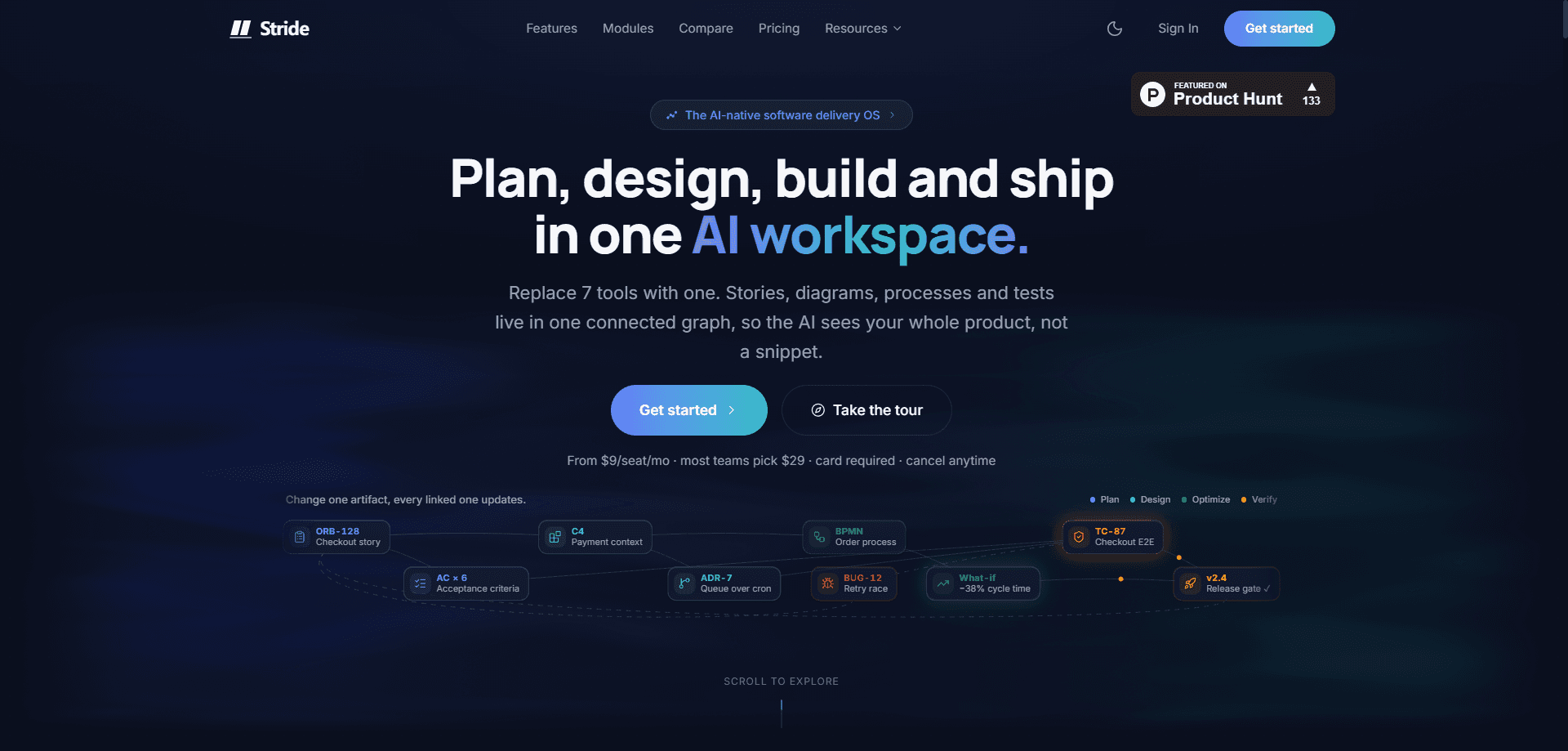
Stride is an AI software delivery platform from Newlight Solutions that folds planning, design, process analysis and verification into a single connected record. The company markets it as an AI-native delivery OS. Instead of scattering a product ask across a sprint planning tool, a docs tool, a diagramming app and a test management system, teams keep every artifact in one place, and AI coding agents like Claude Code, Codex and Cursor read and update that same record through the Model Context Protocol. It's built for software teams that want traceability from a raw request to a shipped release without wiring seven tools together.
About Stride
What Is Stride
Stride is one workspace with four modules that share the same underlying graph. Plan holds requests, tasks and releases. Design holds screens, drawings and the decisions behind them. A third module shows how work really moves through a team and where it stalls. Verify holds tests, bugs and release checks. Each module writes to the same record. So a story, an architecture decision, a process model, a test and a release note are nodes in one structure, not records in four disconnected tools. Modernize covers legacy-system analysis.
That shared record is the whole point. It's what the AI works from. Stride exposes roughly 130 tools over the Model Context Protocol, so an external coding agent signs in with a key the team creates and then works on the same delivery record the team plans in. Product, design, QA and engineering all work inside the Stride UI. The agent edits alongside them instead of guessing from a single chat prompt. Nothing it does gets buried in a chat window. Your agent signs in with a key you make.
The limits are worth knowing before you commit. There's no free plan, so you can't kick the tires without paying, and Starter starts at $15 per seat per month. AI work runs on a credit allowance. When the balance runs out, AI pauses until credits are added. It's also a young product, and it competes with entrenched trackers like Jira and Linear. Teams with deep existing workflows should weigh migration cost carefully.
Getting Started
- Create a Stride workspace and pick a plan: Starter at $15 per seat per month, or Pro at $39.
- Invite your product, design, QA and engineering members. Set their roles and project access.
- Open Plan and describe what you need in a sentence. Stride drafts the task and its checklist for done.
- Link the design, architecture diagram and test cases to that task so they stay tied to the same record.
- Open Settings. Generate an agent key, scope it to the projects you want, and connect Claude Code, Codex or Cursor over MCP.
Product Information
A quick look at Stride's pricing, supported platforms, and performance.
Best for
The users, tasks, and scenarios where this tool fits best.
Users
- Software product teams
- Teams already using AI coding agents
- Engineering leads tracking flow
Tasks
- Turning a raw request into a scoped backlog
- Keeping design decisions attached to work
- Writing test cases and release checks
- Modernizing a legacy system
Scenarios
- Following one everyday request through a full week so nothing gets lost between handoffs.
- Onboarding an AI agent into an existing backlog without giving it access to everything.
- Replacing a stack of separate trackers, docs and diagramming subscriptions with a single bill.
Key features
One connected delivery record
Every artifact in Stride, from a product ask to an architecture decision, a process step, a test and a defect, stays linked as a single delivery record. Change the ask and the connected pieces move with it. That's what makes traceability from request to release possible without manual cross-referencing.
Four modules on one platform
Plan, Design, process analysis and Verify each handle a stage of delivery, and since July 2026 every paid plan includes all four. Starter used to cap Design and process analysis as Pro-only features, so smaller teams now get the whole platform at the lower price.
MCP access for coding agents
Stride exposes about 130 tools over the Model Context Protocol, so Claude Code, Codex and Cursor connect as first-class runtimes and work in the same record the team sees. The agent doesn't just read; it can pick up a task, write a test case, file a bug or link a design, and every action is recorded under the agent's own name rather than yours.
Scoped agent keys with real permissions
You mint the key an agent signs in with, and you decide what it can reach, either a fixed list of projects or everything your access allows. An agent passes the same permission checks you do. Switch it off whenever you like. And it can't even tell that hidden projects exist.
AI credits metered by task
AI work draws on a monthly credit allowance, with everyday jobs like drafting a user story costing from one credit and deeper generations like an architecture option or a UI mockup from three. Full pipelines such as a PRD wizard running to a 60-story backlog cost around 100 credits, and purchased credits never expire.
Process analysis and DORA metrics
Stride reads how work actually moved through your team and points to the hold-up, including modernization analysis for legacy systems. It pairs with DORA metrics so leads can see cycle time and where work sits waiting, not just whether tasks are marked done.
Built-in docs and diagrams
The platform includes a library with documents and diagrams, covering types like ERD, BPMN, system context, sequence and data flow. Diagrams are readable by external agents. So an agent implementing a ticket can see the architecture it has to build against.
Pros and cons
Pros
- One record replaces a stack of separate trackers, docs tools and diagramming apps. That cuts the number of contracts and logins a team juggles.
- Coding agents read and update the real delivery record rather than a throwaway chat prompt, which reduces re-explaining the same context.
- Agent keys carry the same permission checks as human accounts and can be scoped or revoked, so you control access closely.
- Every paid plan includes all four modules as of July 2026, so the entry price covers the full platform.
- Purchased AI credits don't expire, which helps teams with uneven monthly AI use.
Cons
- There's no free plan, so you pay before you can judge whether it fits your workflow.
- AI pauses when your credit balance runs dry, which can interrupt work mid-task if you don't watch usage.
- It's competing with deep-rooted tools like Jira and Linear, and migrating existing backlogs and habits takes real effort.
- The platform is young and still shipping fast, so expect frequent changes as features mature.
Frequently asked questions
Stride is an AI software delivery platform that keeps planning, design, process analysis and verification on one connected record. Teams use it to trace work from a raw request to a shipped release without stitching separate tools together.
Related content
Explore related tools, skills, and articles for Stride.
Stride Alternatives

Base Code
Base44 (Wix) · Coding · ProductivityBase Code is a shared cloud development environment from Base44. Teammates describe changes to an existing GitHub codebase in chat, preview them live and send them back as pull requests.

Knocket
Knocket (Tencent RTC team) · Productivity · Business · ChatbotKnocket is a free live chat and contact page tool that lets visitors message you from your website, app, or a shareable link, with every reply handled from Telegram or one inbox.

FloorGen
Vinit Kumar (FloorGen) · Productivity · China AIFloorGen is a browser-based floor plan maker that turns a sentence or a sketch into an editable 2D plan and a 3D walkthrough. Export to PDF, DXF or video, and draw without an account.