

Struct
VillageAI, Inc. · Productivity · Chatbot
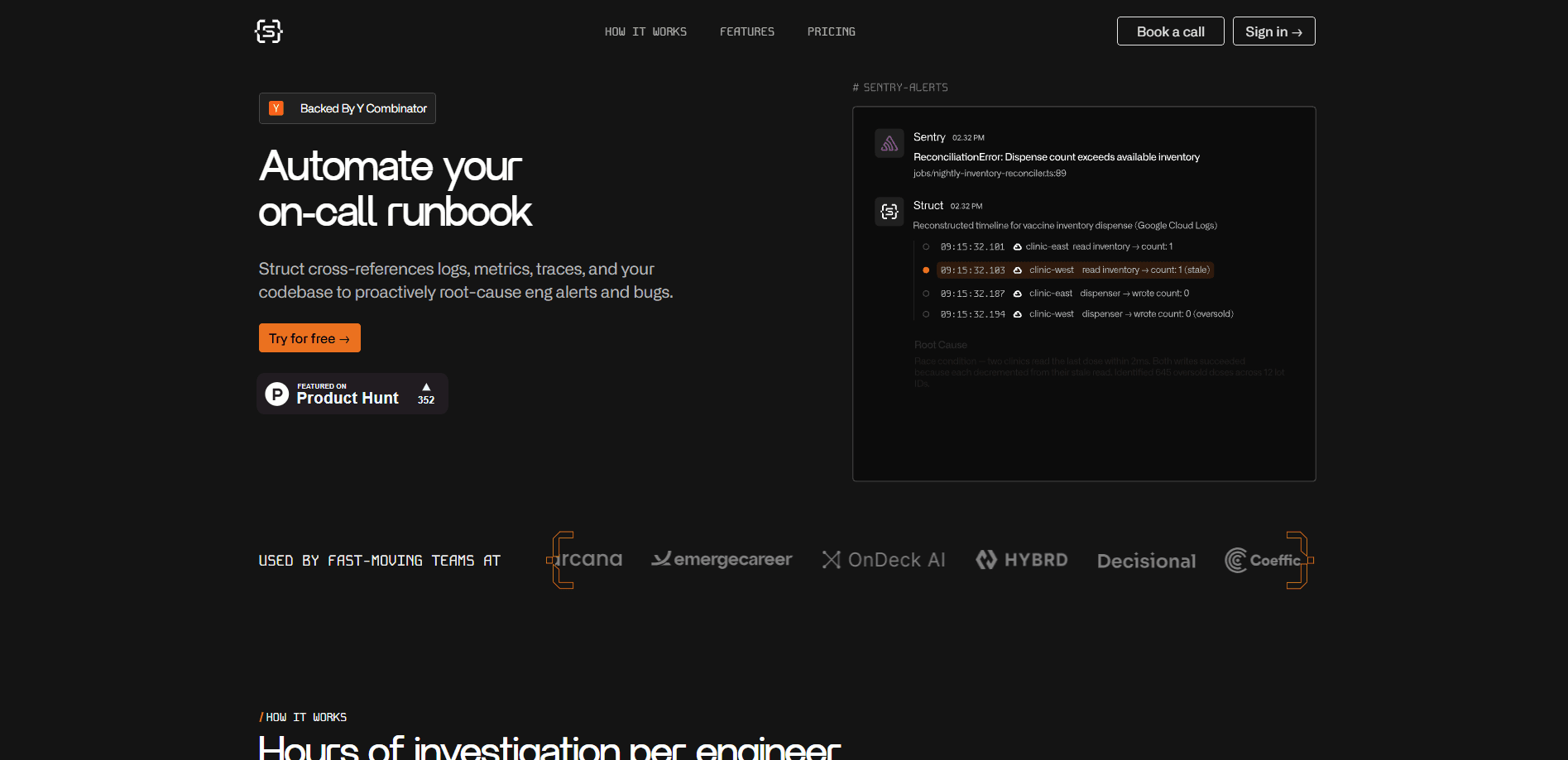
Struct is an AI production engineer that watches your software after every deploy and fixes it when it breaks. It reads each pull request, builds monitors for the changes it finds, and checks them in production. When something regresses, Struct triages the alert, escalates only the real issues, and, once it's confident, opens a pull request with a fix. Development teams use it to cut manual on-call work without losing coverage.
About Struct
What Is Struct
Struct is a production monitoring and incident response platform built around an AI agent, not a dashboard you babysit. The idea is simple: you ship code, and Struct stands watch over what happens next. It treats every deploy as something to verify, which is a different job than the alert tools most teams already run. That shift matters.
The product comes from VillageAI, Inc., and it's aimed at engineering teams that ship fast and don't have enough senior people to chase every noisy alert. Struct's site describes it as targeted at "fast-moving teams" that would rather spend engineer hours on new work than on triage.
Teams evaluating Struct usually compare it to a stack of separate tools: a monitor, an error tracker, and a manual incident response process. Struct rolls incident response automation into one agent.
The main limit is scope. Struct is built for monitoring and fixing production behavior, so it works best where teams already deploy continuously and have clear signals, such as error trackers and alerts. If your team deploys once a quarter, the automated detection has little to do. Less value, plain and simple.
Getting Started
- Sign up for a free trial at the Struct site and connect your code repository and alerting or error-tracking tools.
- Point Struct at the environment you want watched and let it read recent pull requests so it learns what your deploys are supposed to change.
- Review the monitors Struct creates for each change and set how sensitive the alert thresholds should be.
- Let it run against production; when it flags a regression, read the cited root cause and suggested fix before approving anything.
- Connect your own coding agent if you want Struct to open fix pull requests on its own when it's confident.
Product Information
A quick look at Struct's pricing, supported platforms, and performance.
Best for
The users, tasks, and scenarios where this tool fits best.
Users
- Startup CTOs
- Senior engineers
- Platform and DevOps teams
Tasks
- Verifying a deploy actually worked
- Cutting alert noise
- Finding the root cause of an incident
- Auto-fixing production issues
Scenarios
- Shipping several times a day
- A small team facing a spike in load
- Teams adopting AI coding agents
- Reducing on-call fatigue
Key features
Deploy-Aware Monitoring
Struct creates monitors for every pull request and verifies them in production. It reads the intent behind each change, instruments the checks needed to confirm it worked, and baselines alert thresholds once the PR deploys. That means coverage grows as your code changes instead of going stale.
Automated Alert Triage
Rather than paging someone for every signal, Struct reviews each alert and escalates only real issues. You control the sensitivity, and the system keeps tuning thresholds to weed out flapping and slow decay. Escalations arrive with a fully cited root cause and a suggested fix, so the person who gets pulled in isn't starting cold. That's a real difference at 3 a.m.
Hands-Free Fixes
When the system is confident, it opens a pull request to resolve a production issue on its own. If your team already runs a coding agent or a "software factory," you can connect it so Struct hands off the fix instead of doing it itself. Either way, the fix lands as a reviewable PR, not a silent change.
Auto Issue Tracker
A single view tracks every issue currently affecting production, from open to resolution or recurrence. Basic stats are included, so you can see what's live without assembling a report by hand. No spreadsheet required.
On-Call Intelligence
Struct builds context from your past issues, alerts, and investigations. Over time that history sharpens how it responds, which means fewer repeat mistakes and better guesses about what a new alert actually means. It learns your system.
Secure by Design
Your data is logically isolated and never used for training, per Struct. The platform is fully SOC2 and HIPAA compliant, which matters if you handle regulated data and need the monitoring layer to clear the same bar as the rest of your stack.
Pros and cons
Pros
- Covers detection, triage, and fixes in one system, so you don't stitch together three separate tools
- Escalations carry a cited root cause and a suggested fix, which shortens the time to a working hypothesis
- Works with an existing coding agent, letting teams that already automate code changes extend into automated fixes
- SOC2 and HIPAA compliance plus no training on your data suit regulated teams
- Free trial and a fixed $200/mo Pro tier make it easy to test before committing
Cons
- The Pro tier caps usage at 75 PR scans, 25 investigations and fixes, and 250 active monitors, which a high-volume team could burn through quickly
- Heavy usage and enterprise controls like RBAC and SSO sit behind custom pricing, so costs are hard to predict at scale
- API availability isn't documented on the site, so teams that need programmatic access should confirm it before relying on it
- It's built for continuous deployment; teams that ship infrequently get much less from the automation
Frequently asked questions
Struct monitors changes to your production environment, verifies that each deploy works as intended, triages the alerts that follow, and, when confident, opens a pull request to fix what broke. It combines detection, triage, and repair in one platform. So what's the catch? Coverage depends on how you deploy.
Related content
Explore related tools, skills, and articles for Struct.
Struct Alternatives

Base Code
Base44 (Wix) · Coding · ProductivityBase Code is a shared cloud development environment from Base44. Teammates describe changes to an existing GitHub codebase in chat, preview them live and send them back as pull requests.

Knocket
Knocket (Tencent RTC team) · Productivity · Business · ChatbotKnocket is a free live chat and contact page tool that lets visitors message you from your website, app, or a shareable link, with every reply handled from Telegram or one inbox.

FloorGen
Vinit Kumar (FloorGen) · Productivity · China AIFloorGen is a browser-based floor plan maker that turns a sentence or a sketch into an editable 2D plan and a 3D walkthrough. Export to PDF, DXF or video, and draw without an account.