

Synthesis
Synthesis · Leaning
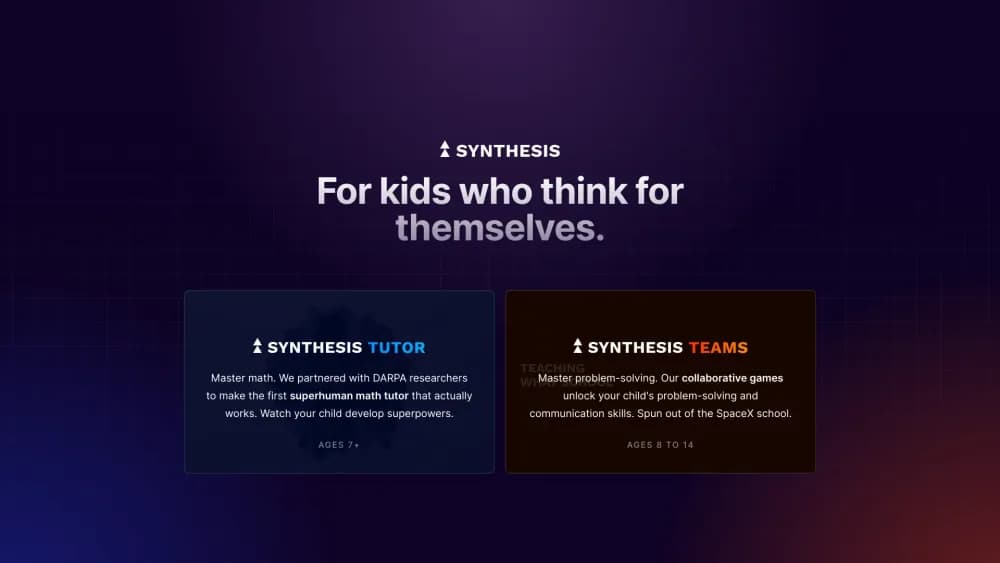
Synthesis Tutor is an AI-powered math tutoring app for kids ages 5 to 11. Lessons adapt in real time, and answers are read aloud to early readers.
About Synthesis
What Is Synthesis
Synthesis is an educational platform best known for its Tutor app, which teaches elementary math to children ages 5 to 11. Instead of a fixed curriculum that moves on a schedule, the Tutor watches how a kid answers during a lesson and adjusts what comes next. Miss a step and it slows down; breeze through and it moves ahead. That live adjustment is the whole point, and it's what separates the app from a stack of printable worksheets.
The company is upfront about how it uses AI. The Tutor leans on AI where it helps, but a team of educators and neuroscientists designs the actual lessons and interactions. Synthesis says it doesn't hand your kid's teaching over to a language model and walk away. In practice you get narrated, interactive problems rather than a chatbot that answers math questions.
Two limits matter before you sign up. The Tutor covers elementary math only, so it won't help with algebra or high school coursework. And progress happens through regular sessions, not a one-time test. Kids who use it a few times a week get more out of it than kids who open it once. For families who want steady practice without hiring a private tutor, that tradeoff is usually fine.
Getting Started
- Go to synthesis.com and start the Tutor. Getting started is free, so you can try lessons before picking a plan.
- Set up a profile for your child. The Tutor asks a few questions to gauge where they are, then builds a starting point.
- Run the first lesson. Your child works through narrated problems while the Tutor checks understanding after each step.
- Turn on read-aloud if needed. For kids under 7, text and answer choices are read automatically, and voice speed can be adjusted in settings.
- Track progress and keep going. Micro-assessments in every lesson show what's mastered, and your child moves on once a concept sticks.
Product Information
A quick look at Synthesis's pricing, supported platforms, and performance.
Best for
The users, tasks, and scenarios where this tool fits best.
Users
- Parents of kids ages 5 to 11
- Families of neurodiverse learners
- Homeschooling families
Tasks
- Daily math practice
- Catching up on a weak topic
- Enrichment for an advanced kid
- Filling a summer gap
Scenarios
- Building a home routine without a private tutor
- Supporting a kid with math anxiety
- Testing the fit before committing
Key features
Adaptive Lessons That Adjust in Real Time
The Tutor doesn't follow a fixed script. It reads how a child answers during a lesson and changes the pace, the difficulty, and what comes next. A student who stumbles on a step gets more support; a student who's ready moves ahead. This live adjustment is what keeps the app from being either too easy or too frustrating, and it's the core of the adaptive learning and personalized learning pitch.
Micro-Assessments in Every Lesson
Rather than testing once and moving on, the Tutor checks understanding constantly through small assessments built into each lesson. A child advances only after showing they've grasped the material. Parents get a clearer picture of what's actually been mastered, not just what's been covered, which matters when you want to know if a topic needs another pass.
Read-Aloud and Early-Reader Support
The Tutor reads everything on screen, so a child who can't yet read independently can still use it. For users under 7, text and answer choices are read aloud automatically, and the narration can be turned off or on from settings. Voice speed is adjustable too. This makes the app workable for emerging readers and for kids who process spoken instructions better than written ones.
Multi-Sensory, Gentle Approach
Lessons are designed to make math concrete and interactive rather than a wall of numbers. The app pairs visuals, spoken prompts, and hands-on problems, which is the approach Synthesis says pays off most for neurodiverse and neuro-atypical students. Dyslexia, dyscalculia, ASD, and ADHD come up often in customer feedback, and the app's approach to pacing is a big reason why.
Cross-Platform Access
Synthesis Tutor runs on the web, including on Chromebooks, and has separate apps for the iPad App Store and the Google Play Store for Android tablets. A kid can pick up a lesson on a school Chromebook and continue on a tablet at home. It's built for touch, so a tablet is the smoother choice for younger learners.
Spanish and Classroom Options
The Tutor is available in Spanish alongside English, with more languages in progress. Schools, homeschool pods, and districts can also bring it into a classroom through a dedicated program that Synthesis runs separately from the consumer app. That extends the same tool from a single family to a group setting.
Pros and cons
Pros
- Lessons adapt in real time, so the difficulty tracks the child instead of a fixed grade level.
- Read-aloud support and adjustable voice speed make it usable for kids who can't read independently yet.
- Micro-assessments show what's actually been mastered, not just what was presented.
- Runs on the web, iPad, and Android tablets, so it fits both home and school devices.
- The free start and month-to-month plans let you test the fit before paying for a year.
Cons
- It covers elementary math only, so it can't help once a student reaches algebra or higher.
- Progress depends on regular sessions. A child who opens it once won't get much out of it.
- It's a supplement, not a replacement for a teacher or a one-on-one human tutor.
- Full access needs a paid subscription, and the free tier is limited to trying the experience.
Frequently asked questions
Synthesis Tutor is an AI-powered app that teaches elementary math to kids ages 5 to 11. It runs narrated, interactive lessons and adjusts the pace based on how a child answers, then tracks mastery as they go.
Related content
Explore related tools, skills, and articles for Synthesis.
Synthesis Alternatives
HireKey
HireKey · Voice & Language · Productivity · LeaningHireKey is an AI job search copilot built by a former tech recruiter. It checks role fit, tailors resumes, runs interview practice and tracks every application.

Lune
Retrograde Labs · Productivity · LeaningLune is a research search engine for scientific AI agents. It runs as an MCP server that lets Claude, ChatGPT and Cursor search peer-reviewed computer science papers and cite them.
Coddy
Coddy · Coding · LeaningCoddy is a gamified platform to learn to code through short interactive lessons in 20+ languages, with a browser editor, an AI tutor and free certificates.