

Tacet
Axite · AI Assistant
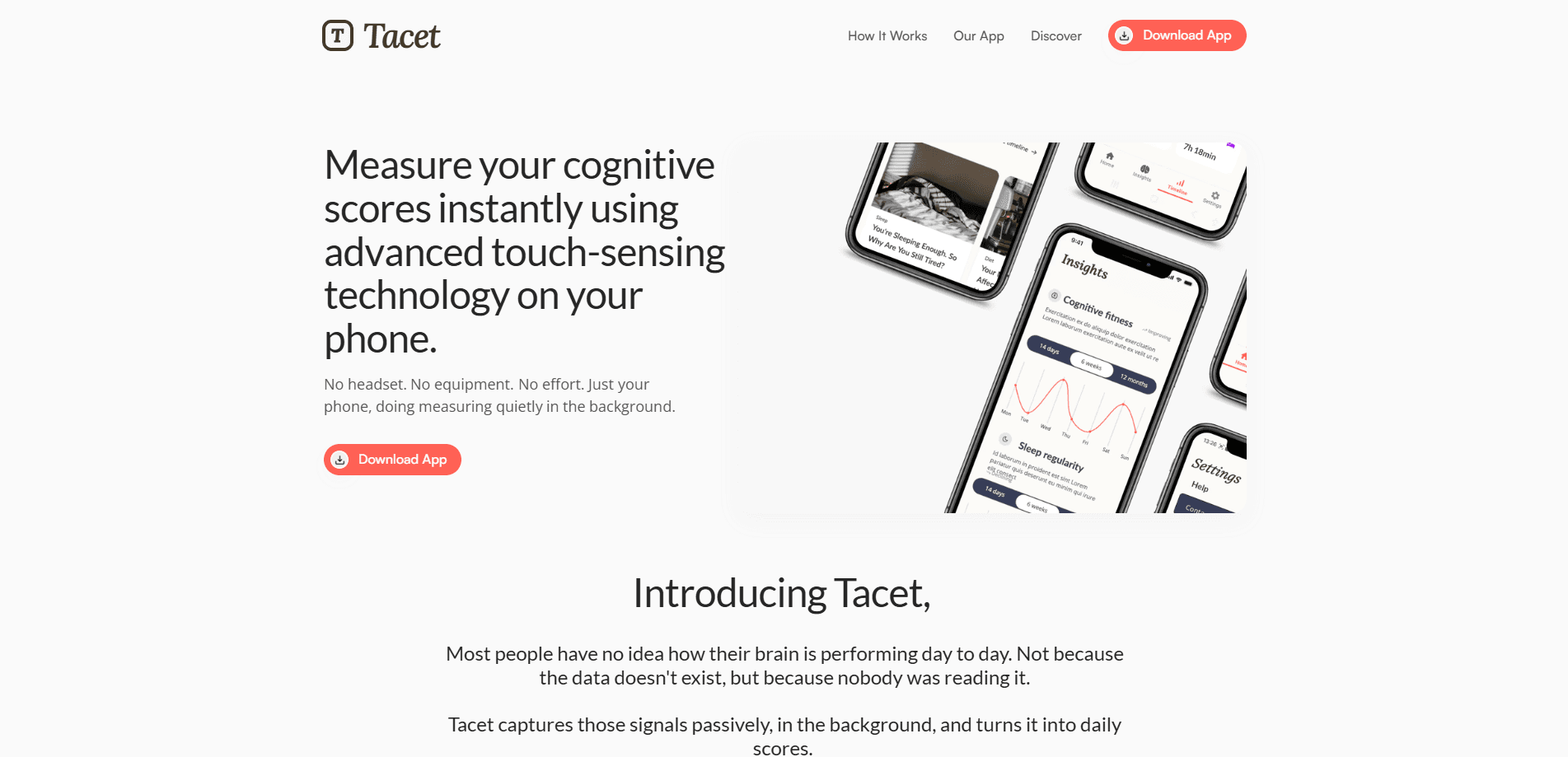
Tacet is a passive cognitive fitness and sleep-quality tracking app that turns your everyday phone tap rhythms into daily brain-performance scores. It runs in the background and uses touch-sensing technology to read the timing patterns in how you tap. No headset. No wearable. No setup routine to follow. The Tacet app for Android is available today, with an iPhone version in the works through a waitlist.
About Tacet
What Is Tacet
Tacet is a health tracking app built around one unusual idea: that the way you tap your phone already carries a signal about how your brain is doing. The app reads those timing patterns in the background and converts them into a daily cognitive fitness score, along with sleep quality tracking. Axite, the company behind it, describes the approach as passive. That means you don't sit down for a test or wear any gear. It's built on neuroscience research from Leiden University, and the core promise is simple: a brain monitor that's already in your pocket.
The appeal here is for people who want some read on their mental sharpness and sleep without adding another device or a daily questionnaire to an already crowded routine. Medical wearables and brain-training apps usually ask for either hardware or dedicated sessions. Tacet skips both. So what's the catch?
I'm not fully sure how much day-to-day variation shows up in the scores yet, since the app is early and review coverage is thin. What's clear from the official site is the trade-off: convenience over clinical precision. Tacet is a wellness tool, not a diagnostic device, and that distinction matters if you're hoping for something a neurologist would sign off on. If you need medical-grade measurements, this isn't that.
Getting Started
- Download Tacet from Google Play on your Android phone. iPhone users can join the waitlist on the official site.
- Open the app and grant the permissions it needs to read background touch activity.
- Use your phone as you normally would for a day or two so Tacet can build a baseline from your tap rhythms.
- Check the dashboard for your daily cognitive fitness score and sleep quality trends.
- Review the scores over a week to spot patterns tied to sleep, stress, or workload.
Product Information
A quick look at Tacet's pricing, supported platforms, and performance.
Best for
The users, tasks, and scenarios where this tool fits best.
Users
- Knowledge workers who want a rough daily read on focus and mental fatigue without adding another gadget to the pile.
- Sleep-conscious adults curious whether their rest is actually supporting their thinking the next day.
- Biohackers and self-trackers who already log habits and want one more passive data stream they don't have to maintain.
Tasks
- Tracking cognitive fitness over time
- Monitoring sleep quality
- Noticing off days
Scenarios
- A busy workweek where you want to know if your focus is holding up without pausing for tests.
- Waking up and checking whether last night's sleep shows up in your numbers.
- Long-term self-tracking for people who already follow sleep and performance trends.
Key features
Daily Cognitive Fitness Score
Tacet produces a single daily score meant to summarize how your brain is performing. It comes from the timing patterns in ordinary taps rather than a quiz or task, which means the number reflects a full day of normal phone use instead of a five-minute test you might game or rush through when you're already tired. The point is a number you can glance at and compare against yesterday. No effort on your part.
Sleep Quality Tracking
Alongside the cognitive score, Tacet tracks sleep quality and links it to the same underlying signals. Instead of asking you to log bedtime and wake time the way most sleep apps do, it leans on passive data to surface how rest relates to your tap patterns over time. That makes it easier to keep up with than a manual sleep diary. Miss a night of logging? It still works.
Passive Touch-Sensing Technology
The app's core mechanism reads the rhythm of how you tap your screen using touch-sensing technology. Those micro-timings, which you never think about and could never report accurately if asked, are what the model works from. No headset, no camera, no extra hardware. It's the feature that separates Tacet from most cognitive and brain-training tools, which demand dedicated sessions you have to schedule, sit through, and complete before you get a result.
No Setup Required
You install it, grant permissions, and go about your day. There's no onboarding test and no calibration routine. No wearable to charge either. For anyone who's abandoned a fitness tracker because of the upkeep, that low friction is the main draw.
Grounded in Leiden University Research
Axite states that Tacet is built on neuroscience research from Leiden University. That's the company's claim, not an independent finding, so treat it as a starting point rather than proof. Still, it puts the app on firmer footing than tools that offer no research grounding at all.
Android App with iPhone Waitlist
Tacet ships on Android today through Google Play, so most users can get started right away. iPhone support isn't live yet. The official site collects emails for a waitlist and says it'll notify you at launch, so if you're on iOS you're looking at a wait rather than a download today.
Pros and cons
Pros
- Completely passive tracking, so there's no test to sit through and no device to charge.
- Combines cognitive fitness and sleep quality in one app instead of splitting them.
- Free to start, with a low introductory cost if you decide to subscribe.
- Runs on the phone you already own, which keeps the barrier to entry near zero.
Cons
- iPhone users can't use it yet and have to join a waitlist.
- Scores are wellness-oriented, so they won't replace a clinical cognitive assessment.
- Because everything is passive, you have limited control over when a reading is taken.
Frequently asked questions
Tacet tracks cognitive fitness and sleep quality by reading the rhythm of how you tap your phone. It turns those passive signals into a daily brain-performance score, so you get a simple number without running any tests.
Related content
Explore related tools, skills, and articles for Tacet.
Tacet Alternatives

Iplan AI
Iplan AI · Productivity · AI AssistantIplan AI is an AI travel planner that turns a few trip details into a full day-by-day itinerary in seconds. You answer questions about your destination, interests, budget, and travel companions, and the tool builds a plan you can edit, share, and carry with you on any device. It targets travelers who want a solid draft without spending hours in spreadsheets and browser tabs. Think of it as an itinerary generator that does the tedious part for you.

Screenhelp
Screenhelp · Productivity · AI AssistantScreenhelp is an AI screen assistant that turns a single keyboard shortcut into real-time help. You press Ctrl+Shift+Space, it captures what's on your screen, and it streams an answer into a private panel in about two seconds. Think of it as an AI screenshot helper you trigger on demand. It runs on Mac, Windows, and the web, starts free with 30 answers a month, and stays invisible during screen sharing on Zoom, Teams, and Google Meet.
Rainbow
Rainbow · AI AssistantRainbow is an AI weather forecast app built around short-term precipitation nowcasting. Its engine pushes min-by-min rain and snow predictions up to four hours ahead, blending live satellite and radar feeds into hyperlocal forecasts. The app adds live rain radar, a seven-day outlook, precipitation alerts, home-screen widgets, and a hurricane tracker, and it runs on both Android and iOS with a free tier plus paid upgrades.