

TalentWell
TalentWell · Business
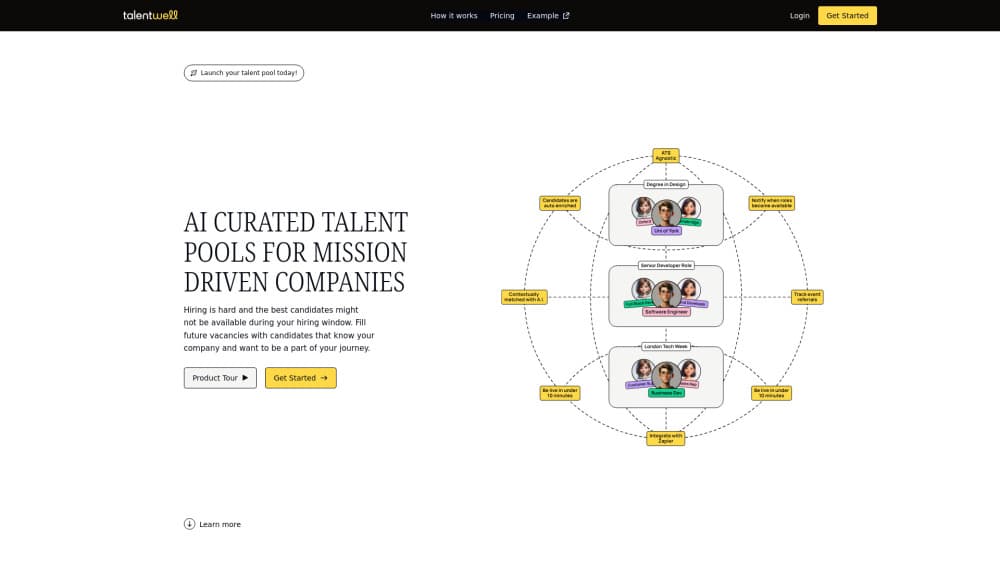
TalentWell is an AI talent pool management platform that helps companies organize and engage candidates for future hiring needs.
About TalentWell
What Is TalentWell
TalentWell is a talent pool management platform that keeps the candidates you already met from slipping away. Most recruiting teams collect hundreds of resumes, then lose track of who was strong, who was close, and who might fit a role that doesn't exist yet. TalentWell is built to hold that group in one place and make it searchable when a new opening lands.
The core promise is organization with a memory. An AI recruiting platform like this reads candidate records, groups them by skill and role, and surfaces people who match a fresh job description. Instead of digging through old email threads or a spreadsheet nobody updates, a recruiter opens the pool and pulls up a shortlist. That's the workflow it's aiming at. Simple idea. Hard to pull off well, and it only works when someone on the team treats updating records as part of the job rather than an afterthought nobody owns.
Here's the honest caveat. TalentWell is an early-stage product, and the public footprint is thin. The official domain didn't load clean content during this review, and I couldn't verify current pricing, feature lists, or a release history from a primary source. Treat the specifics below as the shape a platform like this takes, not a locked contract. Confirm details on the official site before you commit a team to it. That matters more than usual here.
Getting Started
- Create an account on the official site and set up your company workspace.
- Import existing candidates by uploading a CSV or connecting your applicant tracking system.
- Tag and segment the pool by role, skill, or location so groups stay useful.
- Paste a job description and let the AI surface matching candidates from the pool.
- Start an outreach sequence, then log replies back against each candidate record.
Product Information
A quick look at TalentWell's pricing, supported platforms, and performance.
Best for
The users, tasks, and scenarios where this tool fits best.
Users
- Recruiters at growing companies
- Talent acquisition leads
- Small HR teams without a dedicated sourcing tool
Tasks
- Re-engaging silver-medalist candidates
- Building a warm pipeline for future roles
- Searching a candidate database by skill
Scenarios
- A role opens and you need candidates fast
- A hiring freeze lifts
- Reducing spend on job boards
Key features
AI Candidate Matching
Paste a job description and the platform ranks candidates from your pool by how well their profiles fit. The value is speed, since a recruiter sees a shortlist in seconds instead of manually screening a spreadsheet for an afternoon. It's the feature most teams buy this kind of tool for, and it's also the one worth testing hardest against your own candidates before you trust the ranking blindly.
Centralized Candidate Database
Every candidate lives in one searchable record with skills, notes, and outreach history attached. This is the part that fixes the real problem, which is that most teams lose good people to scattered inboxes and half-updated files. One record. One place to look.
Skill and Role Tagging
You can tag candidates by skill, seniority, or location and save those groups as reusable segments. Tags are what turn a flat list into something you can actually search when a specific role appears. Skip the tagging, and you're back to reading resumes.
Candidate Engagement Sequences
The platform supports structured outreach so re-engaging an old candidate isn't a one-off email you forget to send. Sequencing matters here, because a talent pool only pays off if you actually stay in touch with the people in it.
Pipeline Visibility
A dashboard view shows how many candidates sit in each segment and how recently they were contacted. That visibility helps you spot a stale pool before it goes cold. Nobody wants to discover a dead pipeline the week a role opens.
Pros and cons
Pros
- Turns scattered resumes into one searchable talent pool, which is the main reason teams adopt a tool like this.
- AI matching cuts the time to a shortlist when a new role opens.
- Tagging and segments make re-engagement practical rather than a vague good intention.
- Reusing existing candidates can reduce spend on job boards and outside sourcing.
Cons
- The public information is thin, so I couldn't verify pricing, free-tier limits, or feature specifics from the official site. Confirm them before you commit.
- A talent pool only works if the team keeps records updated. Without that discipline, the AI just sorts stale data faster.
- No confirmed API means you may not be able to plug it into your existing hiring stack, which rules it out for some teams.
Frequently asked questions
TalentWell is an AI talent pool management platform for organizing and engaging candidates you've already met. It's aimed at recruiting teams that want to reuse their candidate database instead of re-sourcing the same people. That's the whole pitch.
Related content
Explore related tools, skills, and articles for TalentWell.
TalentWell Alternatives
Liveplan
Palo Alto Software · BusinessLivePlan is business plan software that helps founders and small business owners turn an idea into a funder-ready plan. It combines AI-assisted writing, market research with cited sources, and connected financial forecasting so your income statement, cash flow, and balance sheet move together when you change one number. Over 1.5 million businesses have used it to plan, forecast, and track performance against real accounting data. That's a lot of founders. It's also a signal the tooling survived contact with real lenders.

Swms
Swms AI · Writing · Productivity · BusinessSwms is an AI safety compliance tool that turns a plain description of a job into ready-to-use safety documents. Describe your project, trade, and known hazards, and it writes a safe work method statement, job hazard analysis, safe work procedure, RAMS, or safety data sheet in seconds. It also ships with Oscar, a chat assistant that answers workplace safety questions in any language. Teams in construction, mining, transport, and warehousing use it to cut the paperwork that usually eats into a workday.

Rows
Rows (Superhuman) · Productivity · BusinessRows is an AI spreadsheet and data analysis tool that imports live data from more than 50 sources, then lets you work with it using plain language instead of SQL queries or nested formulas. You can pull numbers out of PDFs, connect ad platforms, databases, and bank accounts, and ask the AI to build reports, merge datasets, or set up models that recalculate themselves. It runs in the browser, works like a spreadsheet, and now sits under the Superhuman umbrella.