

TeamifAI
TeamifAI · Productivity
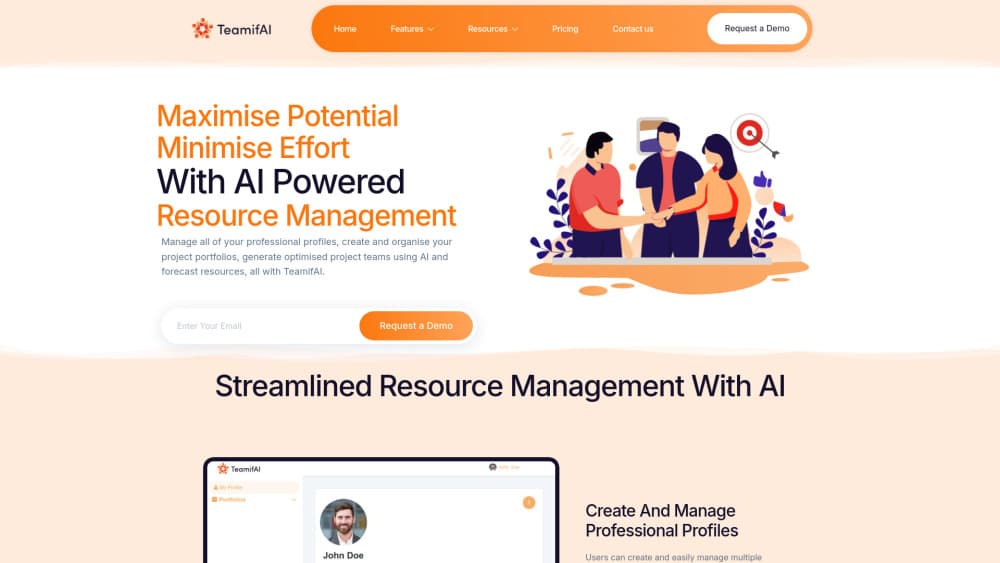
TeamifAI is a workforce network platform where AI agents score supplier candidates, rank internal bench staff, and track delivery from request to signed contract.
About TeamifAI
What Is TeamifAI
TeamifAI is a web platform built for two kinds of companies at once. On one side are organisations that buy professional services and need contractors, delivery teams, or specialist skills. On the other are consulting firms and recruitment agencies that supply those people. Both sides meet inside a single shared record that TeamifAI calls a request envelope, which carries the roles, skills, seniority, location, and commercial terms from first intake to signed agreement.
It calls itself an AI workforce matching platform, and the envelope is what makes that label more than branding. The AI layer sits on top of that record rather than beside it. Five agents cover separate jobs: one builds a request from earlier envelopes, one scores supplier candidates against the requirement, one ranks internal bench profiles, one drafts contracts, and one reads supplier performance over time. A company-wide model TeamifAI calls Company Brain ties them together and answers plain questions about customers, people, requests, and KPIs.
For agencies, the same setup doubles as bench management, since allocations, availability, and roll-off dates live in the People timeline. What separates it from a staffing spreadsheet is the reason trail. Every score arrives with a written explanation, and every recommendation waits for a person to approve it before it touches your data or your team. That design matters in hiring, where a bad automated decision is expensive to unwind.
Two limits are worth knowing before you book a demo. TeamifAI is not a public talent marketplace. Connections are one to one and invitation based, so the platform only works with suppliers you already have a relationship with. Pricing isn't published either, which means a sales conversation comes first.
Getting Started
- Book a demo on teamifai.com and get your workspace set up. There's no self-serve signup and no free tier, so access runs through the sales team.
- Connect your suppliers by private invitation. Each connection is one to one, and you control who joins your network.
- Create your first request envelope in the guided wizard. Add roles, required skills, seniority, location, and timeline, or let the Request Builder Agent prefill the form from past envelopes.
- Review proposals as they arrive. Each candidate shows a match score with reasoning, so you can shortlist across suppliers instead of reading CVs one by one.
- Approve the placement, sign the contract drafted on the envelope, and watch delivery metrics flow back from your connected systems.
Product Information
A quick look at TeamifAI's pricing, supported platforms, and performance.
Best for
The users, tasks, and scenarios where this tool fits best.
Users
- Procurement and vendor managers
- Resource managers at consulting firms
- Recruitment agency leads
- Delivery and PMO leads
Tasks
- Writing a staffing request from scratch
- Comparing proposals from several suppliers
- Checking bench capacity before opening a requisition
- Auditing a supplier before renewal
- Drafting master and engagement contracts
Scenarios
- A short-term role with a fixed start date
- Quarterly capacity planning
- Renewal season across a supplier portfolio
Key features
Company Brain Across Demand and Supply
Company Brain is the shared model that both sides of the network query. Ask it about a customer, a person, a past request, or a KPI, and it answers from your own tenant data, then keeps refining as new envelopes and outcomes land. It runs per customer, so one organisation's information never trains another's answers.
Structured Request Envelopes
A request envelope holds the whole engagement: roles, skills, seniority, location, rates, and later the contract itself. Both the requester and the supplier work from the same version, which removes the usual drift between a brief sent by email and the CVs that come back. Envelopes also act as the training source for the Request Builder Agent.
Candidate Scoring With Reasons
The Candidate Scoring Agent compares supplier profiles against the stated requirement and returns a confidence score with an explanation of what matched and what didn't. Requesters can shortlist across suppliers on comparable terms, and suppliers can see why a proposal ranked where it did instead of guessing.
Staffing Agent for Internal Bench
Before an agency gets involved, the Staffing Agent ranks internal profiles against the same requirement, with the same kind of score and reasoning. That gives resource managers a documented case for filling a role in house. The agent suggests only; it never adds a person to a team without someone clicking approve.
Supplier Intelligence and Renewal Signals
The Supplier Intelligence Agent watches delivery data from connected systems and surfaces trends in performance, relationship health, renewal timing, and risk. The practical value shows up at renewal, when you have a record of how the engagement actually went rather than a vague memory of it.
Contract Drafting on the Envelope
Contract Management Agent generates master and engagement agreements from the terms already captured in the envelope. Drafts arrive ready for review and signature rather than ready to send, which keeps legal in the loop where they belong.
Integrations With Your Existing Stack
TeamifAI connects to HubSpot, Loxo, SAP Ariba, Coupa, Workday, and ServiceNow. The point isn't a longer logo list. It's that utilisation, spend, and compliance numbers come from the systems that already record them, so nobody maintains a second copy by hand.
Pros and cons
Pros
- Demand and supply sit in one record, so a request, its proposals, its contract, and its delivery metrics stay linked instead of living in four tools.
- Every AI score ships with reasoning, which makes the output auditable and easier to defend in a procurement review.
- Human approval is a hard gate, not a setting, so no agent changes your team roster or supplier data on its own.
- Supplier performance tracking gives renewal conversations a factual base, which is the part most resource managers handle from memory.
- Integrations with Ariba, Coupa, Workday, and ServiceNow mean the platform can sit next to enterprise finance and HR systems rather than replace them.
Cons
- The invitation-only network is the biggest constraint. If your suppliers won't join, you're left with an internal bench tool and half the value.
- No public pricing means you can't budget from the website, and small firms may find the sales cycle heavier than the problem warrants.
- Match quality depends on the history in your account. A new workspace with no past envelopes gives the agents little to learn from.
- It's a browser product with no mobile app, so approving a placement on the move means opening a laptop.
Frequently asked questions
It runs the workflow between companies that buy professional services and the firms that supply them. You build a structured request, send it to connected suppliers, compare AI scored candidates, sign a contract, and track delivery in the same place.
Related content
Explore related tools, skills, and articles for TeamifAI.
TeamifAI Alternatives

Base Code
Base44 (Wix) · Coding · ProductivityBase Code is a shared cloud development environment from Base44. Teammates describe changes to an existing GitHub codebase in chat, preview them live and send them back as pull requests.

Knocket
Knocket (Tencent RTC team) · Productivity · Business · ChatbotKnocket is a free live chat and contact page tool that lets visitors message you from your website, app, or a shareable link, with every reply handled from Telegram or one inbox.

FloorGen
Vinit Kumar (FloorGen) · Productivity · China AIFloorGen is a browser-based floor plan maker that turns a sentence or a sketch into an editable 2D plan and a 3D walkthrough. Export to PDF, DXF or video, and draw without an account.