

Tendery.ai
Tendery.ai · Productivity
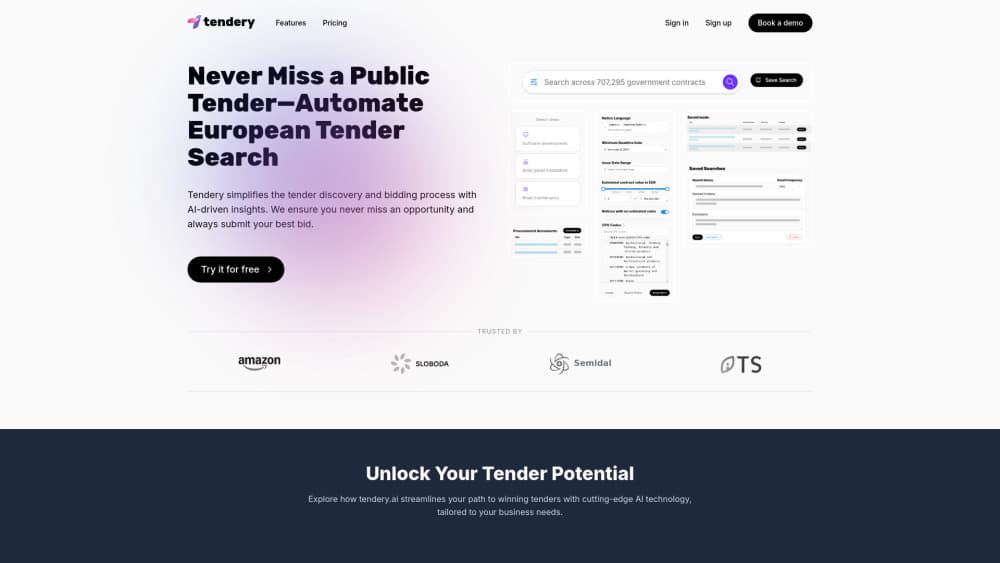
Tendery.ai was an AI tender search tool that pulled European public procurement notices into one place and matched them to a company profile. The service has been discontinued.
About Tendery.ai
What Is Tendery.ai
Tendery.ai was a web service for companies that bid on public contracts. Instead of checking one government portal after another, a user built a profile of what the business sold and what kind of contracts it wanted, and the tool watched a wide set of procurement sources for matches.
The appeal was the paperwork these teams live with. Public tenders sit scattered across national and regional portals, each with its own search box and its own way of naming the same category. Tendery.ai tried to fold that sprawl into a single feed and hand back only the notices worth a look.
The company later stopped offering the service. The tendery.ai domain now points visitors to Patterno, a separate German provider that runs a public procurement platform aggregating tenders from thousands of procurement portals, and openly markets itself as the replacement for people who were using Tendery. If you're comparing Tendery alternatives today, the realistic path is picking a live tool rather than signing up here.
Getting Started
- Open the official site to check its current status, since the original service is no longer active.
- If you used a paid Tendery.ai account, look for the provider's data export notice before the service winds down.
- Compare a live tender search platform, such as Patterno, against the features you relied on.
- Rebuild your search profile in the new tool and confirm your filters and email alerts still fire.
Product Information
A quick look at Tendery.ai's pricing, supported platforms, and performance.
Best for
The users, tasks, and scenarios where this tool fits best.
Users
- Bidding teams at small and mid-sized firms
- Sales staff in construction, IT and services
Tasks
- Finding public procurement notices
- Filtering by industry, region and budget
- Getting daily email alerts
Scenarios
- A firm tracking dozens of regional portals
- Market research on public spending
Key features
AI profile matching
Users described their business in plain language and what contracts they wanted, and the tool interpreted that context rather than demanding keyword strings. Matching ran against the profile, so a new tender was judged by relevance, not just whether certain words appeared. That approach cut noise for teams that dreaded long, unfiltered lists.
Multi-portal tender aggregation
Tendery.ai drew notices from a wide range of European procurement sources into a single search. Instead of a dozen logins, a buyer worked from one query. The value scaled with how many portals mattered to a given company, which is why coverage of the right countries was the deciding factor.
Saved search profiles and filters
Filters for industry, region and budget let a user narrow results to contracts that fit their reach and capacity. Saved profiles meant the same criteria ran again as new notices appeared, without rebuilding a search each time. For a firm with several business lines, running more than one profile kept the two from blurring together.
Email notifications
Matching tenders arrived by email, so the workflow fit teams that check inboxes rather than dashboards. A daily or scheduled digest put the new notices in front of people who would otherwise forget to log in. The catch is that the alerts are only as good as the profile behind them.
Tender document access
The platform let users reach the underlying documents attached to a notice, not just the listing. That matters because the real scope, deadlines and requirements sit in the files, and a buyer has to read them before deciding whether to bid. Direct access saved a step back to the original portal.
Pros and cons
Pros
- Assembled public tenders from many European portals in one interface, which reduced the manual sweep for bidding teams.
- Profile-based matching handled natural descriptions, so users didn't have to translate their business into exact keywords.
- Saved profiles and filters let the same search run continuously against new notices.
- Email alerts fit teams that work from an inbox, not a dashboard you have to remember to open.
Cons
- The service is discontinued, so you cannot buy it or rely on it for new tender monitoring.
- Coverage leaned toward European procurement, so buyers outside that region got little from it.
- Because the original product is gone, its exact pricing and limits are no longer published, which makes a like-for-like comparison hard.
Frequently asked questions
Tendery.ai was used to search public procurement notices. Users built a company profile, and the tool gathered tenders from multiple European portals and flagged the ones that matched, with email alerts for new results.
Related content
Explore related tools, skills, and articles for Tendery.ai.
Tendery.ai Alternatives

Udon
Udon · Coding · ProductivityUdon turns an Apple Silicon Mac into a home server you run from a browser, with container controls, file shares, and an optional AI sysadmin.

offstage
offstage cloud · Coding · Productivityoffstage gives AI coding agents and CI jobs a real Mac: a fresh macOS account on Apple silicon, driven over an API and billed by the second.

BotBus
Chengdu Tuyang Tusen Technology Co., Ltd. · Coding · ProductivityBotBus lets you control AI coding agents from your phone and watch: approve commands, start tasks and read results while the code stays on your desktop.