

Spiritual Personality Tests
The Spiritual Seek · Leaning
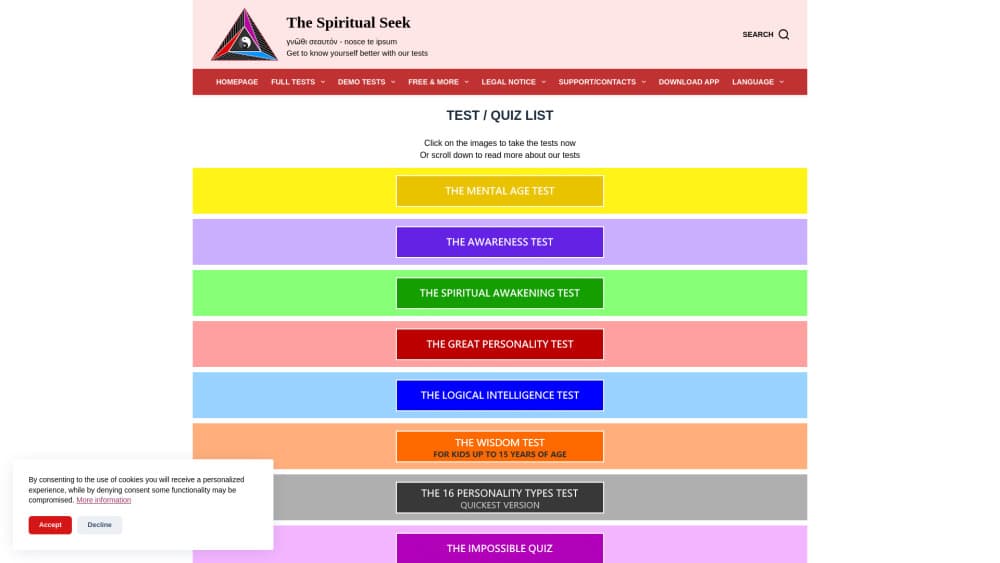
Spiritual Personality Tests is a self-discovery platform from The Spiritual Seek. It pairs scored spiritual assessments with free mini quizzes, guided meditations and 30-day practice guides.
About Spiritual Personality Tests
What Is Spiritual Personality Tests
Spiritual Personality Tests is the assessment side of The Spiritual Seek, a site that mixes psychology with contemplative traditions. Each main test turns a vague question about your inner life into a score, a level or an archetype you can actually look at.
The appeal is structure. Someone who wonders whether they're spiritually awake usually gets a horoscope and a shrug. Here they answer 20 to 33 questions and get a written report, a category and a few concrete practices to try next.
The limits matter too. These are self-report instruments, not clinical assessments, and no licensed psychologist reviews your answers. Treat the output as a mirror for reflection, not a diagnosis. Premium tests, guides and audio libraries are paid. The free tier is generous enough to sample the style first.
Getting Started
- Open spiritualseek.com or install the iOS or Android app.
- Pick a test from the homepage, or start with a free mini quiz if you want a short sample.
- Answer the questions honestly and in one sitting. The longer assessments take at least 25 minutes.
- Read your result, then decide whether to continue with a 30-day guide or the meditation library.
Product Information
A quick look at Spiritual Personality Tests's pricing, supported platforms, and performance.
Best for
The users, tasks, and scenarios where this tool fits best.
Users
- People exploring spirituality without a fixed religion
- Therapy clients who want reflection homework between sessions
- Journal keepers and note takers
Tasks
- Checking where you sit on a specific axis
- Finding a practice you'll actually keep
- Wind-down listening
Scenarios
- A quiet Sunday afternoon when you want to think about something bigger than your inbox
- A rough patch where you can't name what changed
- Curious friends comparing results
Key features
Scored Spiritual Assessments
The core library holds full-length tests that return a score and a category rather than a paragraph of vague praise. The spiritual awareness test is the most elaborate: 33 questions, seven answer options and a 0 to 200 scale that sorts you into one of seven awareness levels. The spiritual intelligence test takes a different route, mapping a spiritual quotient across ten dimensions such as meaning-making, compassion and comfort with mystery.
Free Mini Personality Tests
A separate section collects short self-scoring quizzes on traits, anxiety, relationships and thinking styles. You get quick formats like a Big Five mini test, an Enneagram mini test, a Jungian archetype quiz and a past life test, most of them a free personality quiz you finish in a few minutes. They're a low-commitment way to see how the site writes before you spend anything.
Written Reports and Certificates
Results arrive as an email with a detailed breakdown, and the longer assessments issue a certificate you can keep. That sounds like a gimmick until you compare it with competitors that dump three sentences on screen and ask for an email address. The reports explain the scale, name your level and suggest what to work on next.
Guided Meditations and Spiritual Tales
The audio side of the platform holds 50 narrated tales of 1,000 words each plus 10 guided meditations, all written and recorded in house. Tales run 6 to 20 minutes and lean on fantasy and science fiction to explore spiritual ideas, which suits listeners who find straight instruction dry. Access unlocks on both the website and the mobile apps.
30-Day Transformative Guides
Four interactive guides cover karmic awareness, radical awakening, the Stoic mindset and Gnostic ascension. Each one spreads a single theme across 30 daily lessons with exercises, prompts and a progress tracker. They cost $10 individually, or $30 for the bundle instead of $40, and the purchase unlocks permanently through a password.
PsycheBot Companion
PsycheBot is the site's built-in assistant, included with the premium tale and meditation collection. It's meant to keep the reflection going between tests, answering questions and pointing you toward material that fits what you're working through. Nothing here replaces a therapist, but it fills the gap between sessions of self-inquiry.
Pros and cons
Pros
- Every main test returns a numeric score plus named levels, so progress is comparable over months.
- The free tier is real: dozens of mini quizzes and test demos cost nothing and need no account.
- Results explain the scale instead of just flattering you, which makes the spiritual personality tests usable as journaling prompts.
- One purchase covers web and both mobile apps, with lifetime access rather than a subscription.
- Content breadth is unusual for the niche: assessments, meditations, narrated tales and structured courses sit in one place.
Cons
- No published validation studies back the scoring, so the spiritual intelligence test reads as a thoughtful framework rather than a measured instrument.
- Premium pricing isn't shown per test on the homepage, which means you click into a specific assessment before you learn the cost.
- Long assessments demand 25 minutes of undistracted attention, and abandoning halfway loses your answers.
- Interface copy leans poetic in places, so readers who want plain definitions have to dig for them.
Frequently asked questions
No peer-reviewed validation is published for the scoring models. The tests borrow from established psychology and from contemplative traditions, then combine them into their own frameworks. Use the results for reflection, not for decisions about treatment.
Related content
Explore related tools, skills, and articles for Spiritual Personality Tests.
Spiritual Personality Tests Alternatives

HireKey
HireKey · Voice & Language · Productivity · LeaningHireKey is an AI job search copilot built by a former tech recruiter. It checks role fit, tailors resumes, runs interview practice and tracks every application.
Lune
Retrograde Labs · Productivity · LeaningLune is a research search engine for scientific AI agents. It runs as an MCP server that lets Claude, ChatGPT and Cursor search peer-reviewed computer science papers and cite them.
Coddy
Coddy · Coding · LeaningCoddy is a gamified platform to learn to code through short interactive lessons in 20+ languages, with a browser editor, an AI tutor and free certificates.