

TheFluxTrain
TheFluxTrain · Image
TheFluxTrain is an AI film production studio plus LoRA training platform, turning story briefs into generated scenes you edit on a timeline while it builds a world model for film.
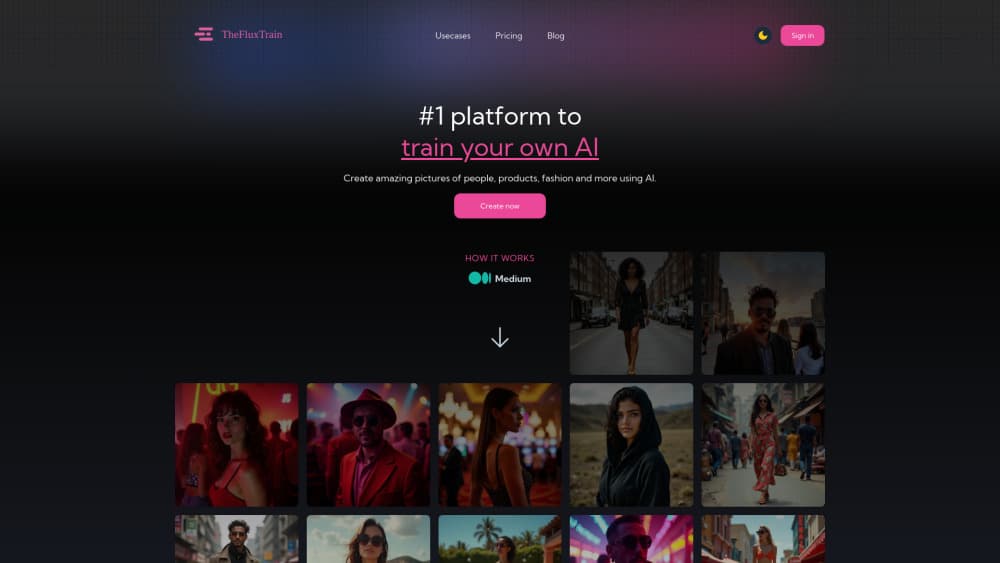
About TheFluxTrain
What Is TheFluxTrain
TheFluxTrain started as a platform for training image LoRA models, so you could keep a face, a product, or a character consistent without setting up your own training rig. From September 2024 onward it grew into an AI filmmaking platform: image, video, and voice models, then agentic flows that plan a film as a graph instead of a pile of one-off clips. Today the studio is live, and a world model for film is in the works.
The problem it targets is specific. Clip generators drift on character, struggle to stitch shots into a fluent sequence, and make you regenerate a whole scene to fix one beat. TheFluxTrain's answer is to treat film as a repeated structure: a story splits into scenes, each scene runs the same stages, and only the brief and assets change. You shape that pipeline once and duplicate it per scene.
The long-form continuity problem is not solved yet. The company is explicit that holding a film together across many minutes is the world-model research it is still doing. Right now you get brief-to-scenes generation and a timeline you can trim, subtitle, and export. Treat it as a fast production studio with a promising roadmap, not a finished film engine.
Getting Started
- Sign up at thefluxtrain.com and pick a plan or a one-off credit pass.
- Start from a story template, such as a personalized family story video or a product promo brief, so scenes and wiring load for you.
- Add your inputs: family photos, a product plate, or a plain-language brief.
- Generate the scenes, review them on the timeline, and trim, subtitle, and export the cut.
Product Information
A quick look at TheFluxTrain's pricing, supported platforms, and performance.
Best for
The users, tasks, and scenarios where this tool fits best.
Users
- Creators and short-form filmmakers
- AI-first agencies
- Families and casual makers
Tasks
- LoRA training
- Story-to-scenes generation
- Ad and SKU variants
Scenarios
- Product promos
- Family story videos
- Client handoffs
Key features
Agentic story to scenes
You describe the film or promo you want, and Director Zero builds the scenes, connects the pipeline, and runs generation. You start from a brief rather than an empty canvas, which cuts the setup that normally eats a first day.
Flow Studio graph pipelines
Flow Studio runs a film as a graph of nodes. A dedicated tab-group node folds repeated subgraphs, like the ten scenes of a story, into one bounded workspace, so shared references and prompts wire once instead of fanning into every copy. Nodes outside the group stay connected, so folding is for focus, not isolation.
Iteration sinks and in-node carousels
Iteration sinks route each output into the next command automatically, and can loop as long as you need, which removes long chains of one-off nodes when you step through variations. Generations show up as a carousel inside the generator node, so you browse results and promote keeps without leaving the graph.
LoRA training for consistency
The platform grew out of LoRA training, and it still trains custom models: Flux 1, Flux 2, Qwen Image, and an LTX video LoRA. Training a model on your subject is the route to keeping a character or product steady across scenes, which is exactly where clip generators tend to drift.
Multi-model generation and voices
Under the studio you can generate with a range of video models, which is what makes it more than a single AI video generator. The list includes Google Veo 3.1, Kling O3, Seedance, FLUX 3, and Gemini Omni Flash, plus image models like Nano Banana and GPT Image. Voices and audio add text to speech, voice changing, dubbing, and sound effects, so a cut can ship with sound.
Timeline editing and export
Scenes land on a timeline you can actually edit. Trim, subtitle, and export a family short or a promo cut, and hand off the pipeline as JSON. Long-form continuity across a whole film is the part still being built, and the studio covers the shorter pieces today.
CLI, REST API, and JSON handoff
A CLI (tft) and a REST API let you call generation, Flow Studio, and video-editor endpoints from your own tools, with API keys managed in the browser. Flow Studio graphs save to your account, so the same flow opens in the browser or from the terminal.
Pros and cons
Pros
- One place for training and generation, so character consistency and scene output do not live in two separate tools.
- Flow Studio's tab-group node keeps repeated scene pipelines readable, which matters once a story passes a few shots.
- Multi-model access means you can match the model to the shot, from cheap drafts to higher-quality video.
- CLI and REST API make it usable inside an existing workflow rather than only through the browser.
- Clear ownership: you keep full rights to the content you generate, per the terms of service.
Cons
- Long-form continuity is still research, so holding a feature film together across many minutes is not there yet.
- There is no free plan, only a credit-based subscription or one-off passes, so testing costs money.
- Plans differ mainly by credits, and heavier models drain them fast, which pushes serious use toward the higher tiers.
- Graph pipelines reward patience: tab groups and iteration sinks take time to learn if you are new to node editing.
Frequently asked questions
It is an AI film production studio that turns a brief into generated scenes you edit on a timeline, and it trains custom LoRA models for character and product consistency. A world model for longer film continuity is in development.
Related content
Explore related tools, skills, and articles for TheFluxTrain.
TheFluxTrain Alternatives

Google EmbeddingGemma 2
Google DeepMind · Writing · Image · CodingGoogle EmbeddingGemma 2 is a 740M-parameter open model that turns text, code, images, audio, and video frames into vectors in one 768-dimension space, running on phones and laptops.

Tractionwave
TractionWave · Image · MarketingTractionWave is an AI attention heatmap tool for static ads. Upload a PNG or JPG and it returns predicted attention, ranked hotspots, and fixes before you spend budget.

Imejis.io
Imejis.io · Image · MarketingImejis.io is an AI design studio for agents and marketing teams. Describe an image in plain words, and it writes the copy, builds the layout, reflows it to every size, then exports a finished file.