

Thunai
Thunai · Productivity · Leaning
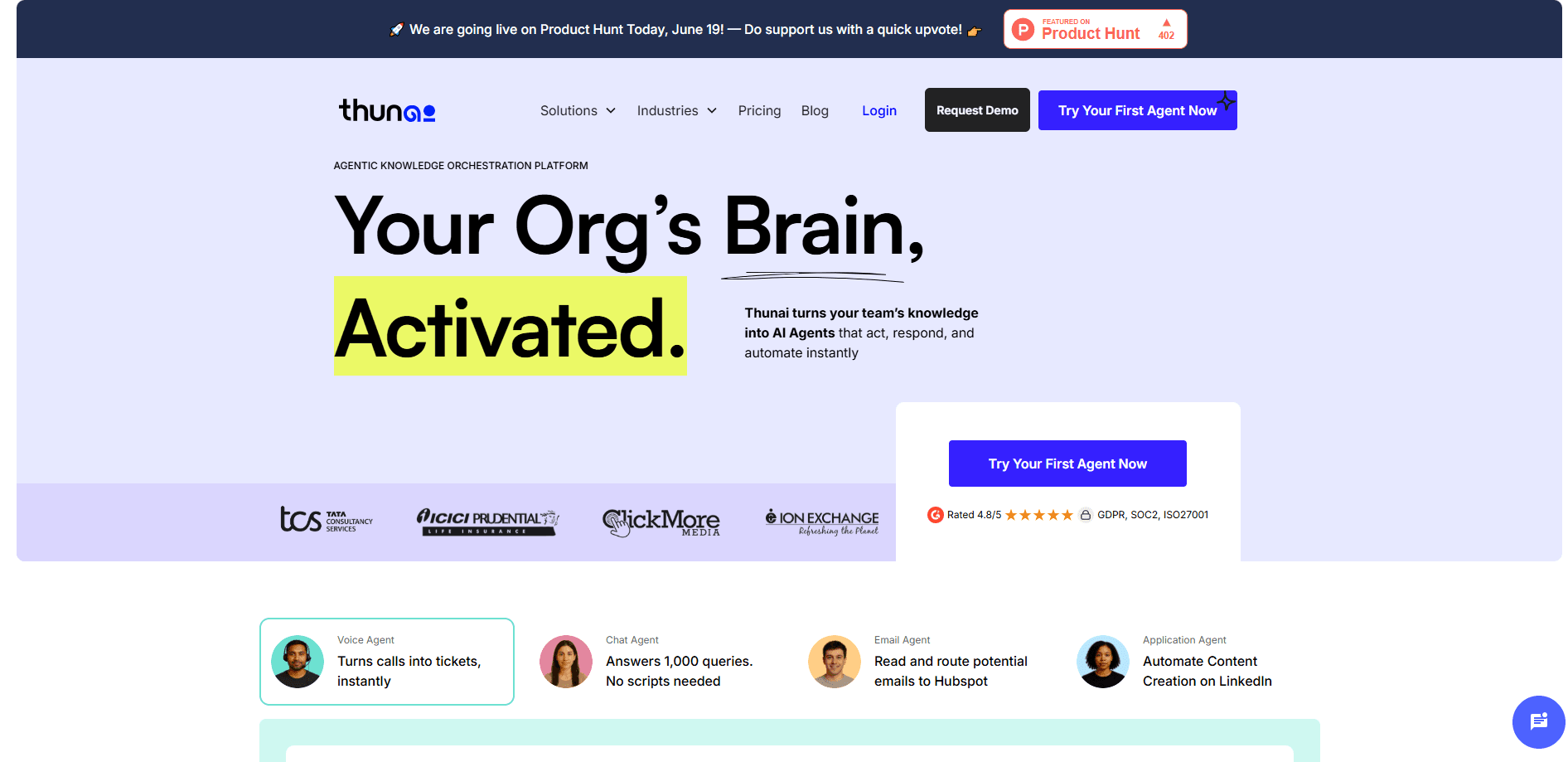
Thunai is an agentic customer experience platform that unifies voice, chat, email and CRM under one AI layer to auto-resolve L1 requests, assist live agents and automate post-call work.
About Thunai
What Is Thunai
Thunai is an AI customer service platform built for enterprise contact centers. It pulls voice, chat, email and CRM into a single orchestration layer, then lets autonomous AI agents and human reps work from the same pool of knowledge. It doubles as a knowledge orchestration platform, so the AI agents for support answer from one trusted source.
For enterprise contact center AI, the product targets the parts of support that quietly eat time. Post-call admin alone can take up to 40% of an agent's day, and Thunai automates those summaries, CRM updates and follow-ups the moment an interaction ends. Knowledge stays in one place, so the AI and the team answer from the same source instead of five outdated wikis.
The main limits are scope and price. Thunai sells to enterprises, not individuals, so there's no self-serve sign-up and no published price list. You book a demo, and a solutions engineer sizes the rollout against your ticket volume. Smaller teams will find it heavier than they need. Deployment is flexible: cloud, self-hosted or on-premise, with data residency by region.
Getting Started
- Book a 30-minute demo and share a sample of your real tickets and calls.
- Connect your channels and systems, such as voice, chat, email and your CRM, through the 50+ available integrations.
- Feed in your knowledge base so AI agents answer from your actual policies and product data.
- Review escalation rules and handoff logic so complex cases reach the right human with context attached.
- Go live, then track deflection rate, handle time and CSAT from the reporting dashboard.
Product Information
A quick look at Thunai's pricing, supported platforms, and performance.
Best for
The users, tasks, and scenarios where this tool fits best.
Users
- Enterprise contact center leaders
- Support operations and CX managers
- IT and security teams at regulated firms
Tasks
- Auto-resolving L1 requests
- Real-time agent assist
- Post-call workflow automation
Scenarios
- Contact centers with spiky seasonal volume
- Regulated industries such as finance, insurance and healthcare
- Multichannel support desks
Key features
Unified Knowledge Base
Thunai keeps your policies, product data and FAQs in one contradiction-free source. Both AI agents and human reps answer from it, so customers don't get two different stories depending on who picks up. The value shows up as fewer wrong answers and less time spent checking which document is current.
Autonomous L1 Resolution
AI agents understand intent and resolve high-volume, low-complexity requests on their own. What they can't finish gets routed to the right L2 or L3 stream with the context already attached. That means your people spend their time on judgment calls, not order lookups.
Real-Time Agent Assist
During a live conversation, the platform feeds agents answers and CRM data as the customer talks. Vendors report up to 3X productivity gains in the first week, and the mechanism is straightforward: the mid-call searching and manual lookups that stretch handle time simply stop happening.
Post-Call Workflow Automation
Once an interaction ends, Thunai writes the summary, updates the CRM and triggers follow-ups automatically. Since post-call admin can take up to 40% of an agent's day, this is where a lot of the reclaimed time comes from. Agents finish their shift on the work that actually needs a human.
Voice, Chat and Email in One Layer
Thunai runs the full ticket lifecycle across channels under a single orchestration layer, and connects to your CRM and existing tools through 50+ integrations. It layers onto what you already run, including setups built on Amazon Connect, instead of forcing a rip-and-replace.
Enterprise Trust Architecture
Deployments can be cloud, self-hosted or on-premise, with data residency by region and permission sets mapped to your existing roles. Thunai states it's ISO 27001 certified, SOC 2 Type II compliant and GDPR ready, and that customer data never trains a shared model. For regulated buyers, that's often the gate that decides whether a project moves forward.
Pros and cons
Pros
- Automates L1 requests and hands the rest to people with context attached, which cuts the volume that reaches reps.
- Real-time assist and post-call automation attack the two biggest time sinks in support, mid-call searching and admin.
- Runs across voice, chat, email and CRM from one layer, so you don't manage separate point tools per channel.
- Flexible deployment (cloud, self-hosted, on-premise) with regional data residency and role-based access.
- Company reports 1M+ interactions handled and go-live in under two days on average.
Cons
- No self-serve plan or public pricing, so you can't try it or budget without a sales conversation first.
- Built for enterprises with real ticket volume, which puts it out of reach for small teams and solo users.
- Performance depends on a clean, well-maintained knowledge base, and messy source docs will drag down answer quality.
- Pricing, API access and exact integrations aren't published, so evaluating fit takes extra back-and-forth.
Frequently asked questions
Thunai is an agentic CX platform that unifies voice, chat, email and CRM under one AI orchestration layer. It auto-resolves simple L1 requests, assists human agents in real time, and automates the admin that follows every interaction.
Related content
Explore related tools, skills, and articles for Thunai.
Thunai Alternatives

Udon
Udon · Coding · ProductivityUdon turns an Apple Silicon Mac into a home server you run from a browser, with container controls, file shares, and an optional AI sysadmin.

offstage
offstage cloud · Coding · Productivityoffstage gives AI coding agents and CI jobs a real Mac: a fresh macOS account on Apple silicon, driven over an API and billed by the second.

BotBus
Chengdu Tuyang Tusen Technology Co., Ltd. · Coding · ProductivityBotBus lets you control AI coding agents from your phone and watch: approve commands, start tasks and read results while the code stays on your desktop.