
V-estate
V-Estate Technology · Business
V-Estate is a real estate marketing platform that turns project drawings into interactive 3D digital twins and immersive sales galleries, so developers can sell homes that don't exist yet.
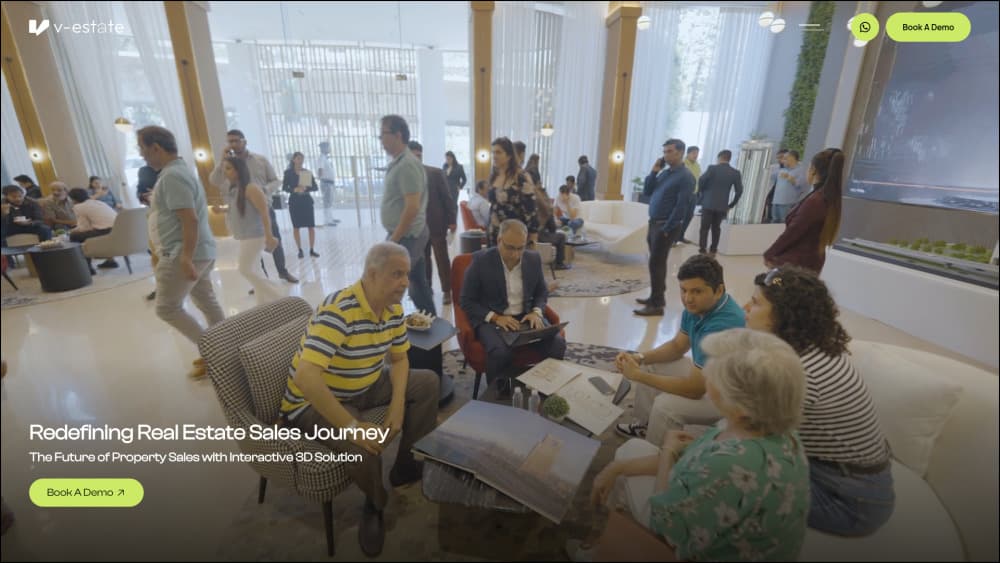
About V-estate
What Is V-Estate
V-Estate is a Mumbai-based company that sells real estate visualization software and the hardware that goes with it. Its software product is Spaci, an ArchViz software platform that builds a navigable real estate digital twin from a developer's architectural data. The rest of the offer is physical: curved LED walls, anamorphic screens, scale models wired with IoT sensors, and touchscreen discussion pods installed in an immersive sales gallery.
Buyers struggle with unbuilt space. A floor plan doesn't tell them how a 34th-floor window will look at 6pm in December, and a printed board can't answer a question about tower spacing. V-Estate answers both by letting a buyer move through the project in a 3D property walkthrough, on a wall-sized screen in the gallery or from a link in a browser.
Nothing here is self-serve. Pricing comes as a project quote, the scenes are produced by the vendor's team from your drawings, and a full deployment can include hardware installation. That makes V-Estate a poor fit for a broker with ten resale listings and a reasonable fit for a developer launching a tower.
Getting Started
- Book a demo through the site. Sessions run about 30 minutes over web conference, and the team walks through live tech, a plan for your project, and an ROI estimate.
- Send the project data: architectural drawings, masterplan, unit layouts, material specifications, and the marketing story you want the space to carry.
- The team builds the twin: geometry, materials, lighting, and the floor-by-floor window views that buyers will ask about.
- Choose where it runs. Spaci works in a browser, on an iPad, on touchscreen TVs, and on LED walls. Some developers start with the software and add the gallery later.
- Train the sales floor and go live. Staff run sessions from an iPad, switch views and lighting mid-conversation, and hand buyers a digital takeaway link at the end.
Product Information
A quick look at V-estate's pricing, supported platforms, and performance.
Best for
The users, tasks, and scenarios where this tool fits best.
Users
- Real estate developers with under-construction inventory
- Channel partners and sales teams
- Marketing teams building a site experience center
Tasks
- Selling apartments before handover
- Explaining daylight and shadow
- Presenting a masterplan at city scale
- Replacing static models and printed boards
Scenarios
- Launch week for a new tower
- Daily walk-ins at a site gallery
- Mixed-use projects with several phases
Key features
Spaci Digital Twin Engine
Spaci turns architectural data into a photorealistic model you can navigate in real time, floor by floor and wing by wing. Exterior, lobby, amenities, and interiors sit in one scene, so a session can move from the masterplan to a kitchen without loading another file. The engine also exports 1-click 4K renders, which the marketing team can reuse for brochures and listings.
Drone-Validated Window Views
Each floor level gets a view built from drone footage of the actual site, not a generic skyline. A buyer on the 22nd floor sees the horizon they'll get, and staff can jump between floors to show the difference. This is the feature that settles the "what will I actually see" question.
Day and Night Simulation
Coordinate-based sun mapping drives the lighting, so shadows fall where they would on a given date and hour. Buyers can watch a room move from morning light to evening, and the change renders live. It matters most for east and west facing units, where that difference often decides the sale.
iPad-Controlled IoT Scale Models
A physical model of the neighborhood carries addressable LED diodes that sync with the digital twin. One tap on an iPad lights a commute route, a landmark, or a zone, and the wall screen follows with matching visuals. Sales staff keep control in their hand instead of walking to a console.
Remote Assistant Guided Tours
Spaci runs in a browser with a remote assistant mode, so an agent can lead a live tour for a buyer who isn't in the city. The host controls the camera and the lighting while the buyer watches and asks questions. No headset or install is needed on the buyer's side.
Immersive LED and Anamorphic Displays
The hardware side covers curved LED volumes, immersive rooms, anamorphic 3D content, gesture-controlled walls, and amphitheatre AV. Content is built for the geometry of each screen, which is why the depth effect holds up from the viewing position. Developers buy this as a designed space, with content, installation, and live operations included.
Pros and cons
Pros
- Photorealistic output at 1:1 scale: buyers understand density, tower spacing, and ceiling height without translating a floor plan in their head.
- One vendor for software and hardware: screens, IoT models, iPads, content, and installation come from the same team, so there's no integration blame when something fails during a launch.
- View and light simulation covers the two questions that stall bookings, and staff can change both live in front of the buyer.
- The browser mode extends the same twin to remote buyers, which matters when the purchase is being decided from another country.
- Named references from large developers, including Rustomjee, Runwal, and Adani Realty, give you a way to check fit before the first call.
Cons
- No published pricing and no self-serve trial. You need a sales conversation and a project scope before you know the cost.
- Every scene is custom built from your drawings, so a late design change means rework on the vendor's side and a delay in your launch.
- Hardware-led deployments tie the experience to one venue. Buyers who never visit the gallery only get the browser version.
- The team works from Mumbai on Indian Standard Time, so demos and support for teams in the Americas need scheduling around that.
Frequently asked questions
Selling property that doesn't exist yet. Developers present a project as an interactive digital twin, then run the sales conversation inside that twin instead of around a brochure.
Related content
Explore related tools, skills, and articles for V-estate.
V-estate Alternatives

Reactive Resume v6
Amruth Pillai and contributors · Writing · Productivity · BusinessReactive Resume v6 is a free, open-source resume builder with 18 templates, live preview, ATS checks, job tracking and optional AI help through your own API key.

Oogwai Beacon
Oogwai · Marketing · BusinessOogwai Beacon is an answer engine optimization audit. It checks whether AI crawlers can read your site, then puts 20 buyer questions to ChatGPT, Gemini and Claude to see which brands get named.

Opengeni
Cloudgeni · Coding · Productivity · BusinessOpengeni is an open-source AI agent runtime that gives each agent its own cloud computer, with tools, encrypted credentials and shared team workspaces.