
Vantage Discovery
Vantage Discovery (acquired by Shopify in March 2025) · Coding · Business
Vantage Discovery is an AI search platform for online stores. It uses embeddings and LLMs to read shopper intent, rank products, and personalize results. Shopify bought the company in March 2025.
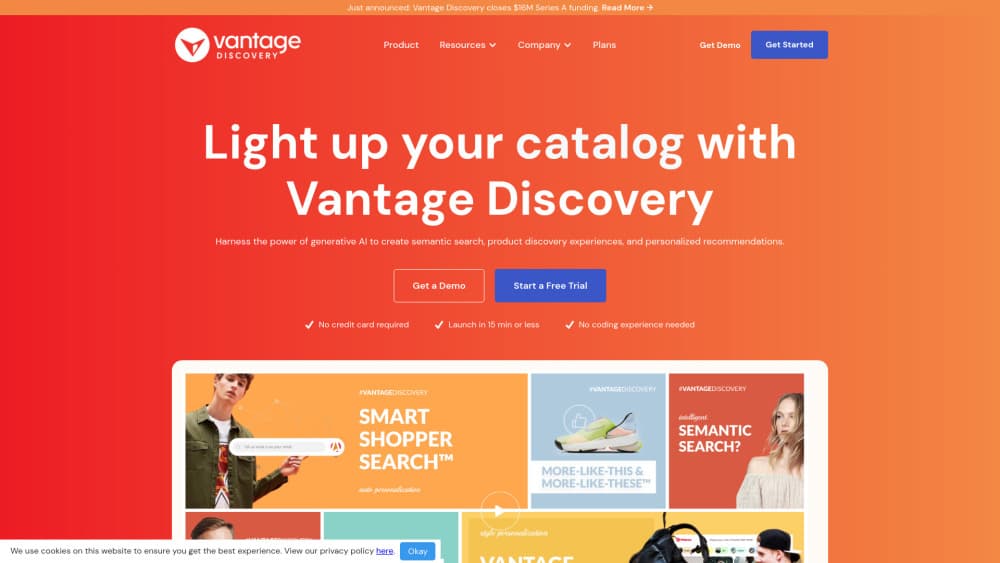
About Vantage Discovery
What Is Vantage Discovery
Vantage Discovery is an AI product discovery platform for online retailers. Lance Riedel and Nigel Daley, two engineers who worked on search at Pinterest, founded it in 2023. The company raised venture funding across seed and Series A rounds, then joined Shopify in March 2025. The product is infrastructure rather than a consumer app: a search layer that a store connects to its own catalog and storefront.
The gap it targets is the one between how shoppers write and how catalogs are indexed. A query like "lightweight rain jacket for a bike commute" fails on a keyword engine that only matches titles and tags. Vantage Discovery converts products and queries into vectors, which lets natural language product search return items that never contain the words the shopper typed. A language model stage reorders that shortlist by likely relevance before results reach the page.
Availability is the main limit now. Vantage Discovery isn't sold as a standalone service anymore, and the public pricing page and developer docs came down after the acquisition. Teams reading about it today are usually weighing what Shopify built with the same team, not buying the original platform. The second limit is effort. This is an API product, so someone has to model the catalog, wire the endpoints, and tune ranking over time.
Getting Started
- Talk to the team about catalog size and query volume. Access went through a sales conversation rather than a self-serve sign-up, and that conversation set the account up.
- Send the catalog. Products arrived as records with titles, descriptions, prices, and the attributes the search layer could use for matching.
- Connect the search endpoint to the storefront, then map filters such as category, price band, and stock status.
- Watch queries and clicks after launch, then adjust ranking weights and the weight given to personalization signals.
Product Information
A quick look at Vantage Discovery's pricing, supported platforms, and performance.
Best for
The users, tasks, and scenarios where this tool fits best.
Users
- Ecommerce engineering teams
- Merchandising leads at mid-size retailers
- Marketplace and B2B catalog owners
Tasks
- Rescuing zero-result queries
- Adding natural language product search to a live storefront
- Building personalized recommendations from behavior
Scenarios
- A catalog full of technical parts
- Heavy traffic with weak search conversion
- A store already running on Shopify
Key features
Semantic Matching Across the Catalog
Products and queries are embedded in the same vector space, so a search can match on meaning rather than shared words. A shopper asking for "cozy winter loungewear" can surface fleece sets that never use the word cozy. This is the core of the platform, and everything else builds on it.
LLM Reranking on Top of Vector Results
Vector similarity gets a shortlist, then a language model reorders it using signals like attribute fit and conversion likelihood. The practical effect is that the top few results look like what a good merchandiser would pick, not just what scores closest numerically. Ranking logic is where the founders claimed their main differentiation.
Search Personalization from Shopper Behavior
The platform reads clicks, saves, and purchases to adjust results per visitor. Someone who keeps browsing wide-fit jeans sees those ranked higher on the next visit. Stores that already collect behavioral data get more from this, since the model has history to work with.
Vector Search API for Developers
Everything runs through a vector search API that a store calls from its own front end. Teams keep their existing UI and checkout flow and swap the query layer underneath. No theme rebuild is required, which shortens the path from evaluation to production.
Attribute and Metadata Filtering
Products carry metadata such as category, price, and availability, and queries can filter on it before ranking. That keeps a semantic match from returning an out-of-stock item in the wrong size. Filters also give merchandisers a way to enforce business rules that pure similarity would ignore.
Catalog Ingestion Workflow
Getting products in is a defined step rather than an afterthought: records go in with the fields the model needs, and updates flow as the catalog changes. Clean titles and attributes matter here, because weak product data produces weak matches no matter how good the ranking model is.
Pros and cons
Pros
- Descriptive, multi-attribute queries return usable results, which is exactly where keyword search on retail catalogs breaks down.
- API-first design means a store keeps its own front end and checkout instead of migrating to a new commerce platform.
- The founding team shipped search at Pinterest, so the ranking work reflects real high-traffic retail experience.
- Personalization builds on behavior data most stores already log, so there's no new tracking layer to deploy.
Cons
- You can't buy it anymore. Since the Shopify acquisition, Vantage Discovery isn't offered as a standalone service, which rules it out for anyone shopping for a search vendor in 2026.
- No public pricing exists, and the old pricing page is gone, so there's no way to budget against published tiers.
- It needs engineering ownership. Catalog modeling, endpoint integration, and relevance tuning are all on your side, and a marketing team can't run this alone.
Frequently asked questions
It powered search and product discovery on retail storefronts. Stores sent their catalog in, then called an API to return semantic matches and personalized results instead of keyword hits.
Related content
Explore related tools, skills, and articles for Vantage Discovery.
Vantage Discovery Alternatives

Udon
Udon · Coding · ProductivityUdon turns an Apple Silicon Mac into a home server you run from a browser, with container controls, file shares, and an optional AI sysadmin.

offstage
offstage cloud · Coding · Productivityoffstage gives AI coding agents and CI jobs a real Mac: a fresh macOS account on Apple silicon, driven over an API and billed by the second.

BotBus
Chengdu Tuyang Tusen Technology Co., Ltd. · Coding · ProductivityBotBus lets you control AI coding agents from your phone and watch: approve commands, start tasks and read results while the code stays on your desktop.