

VC Boom
VC Boom · Business
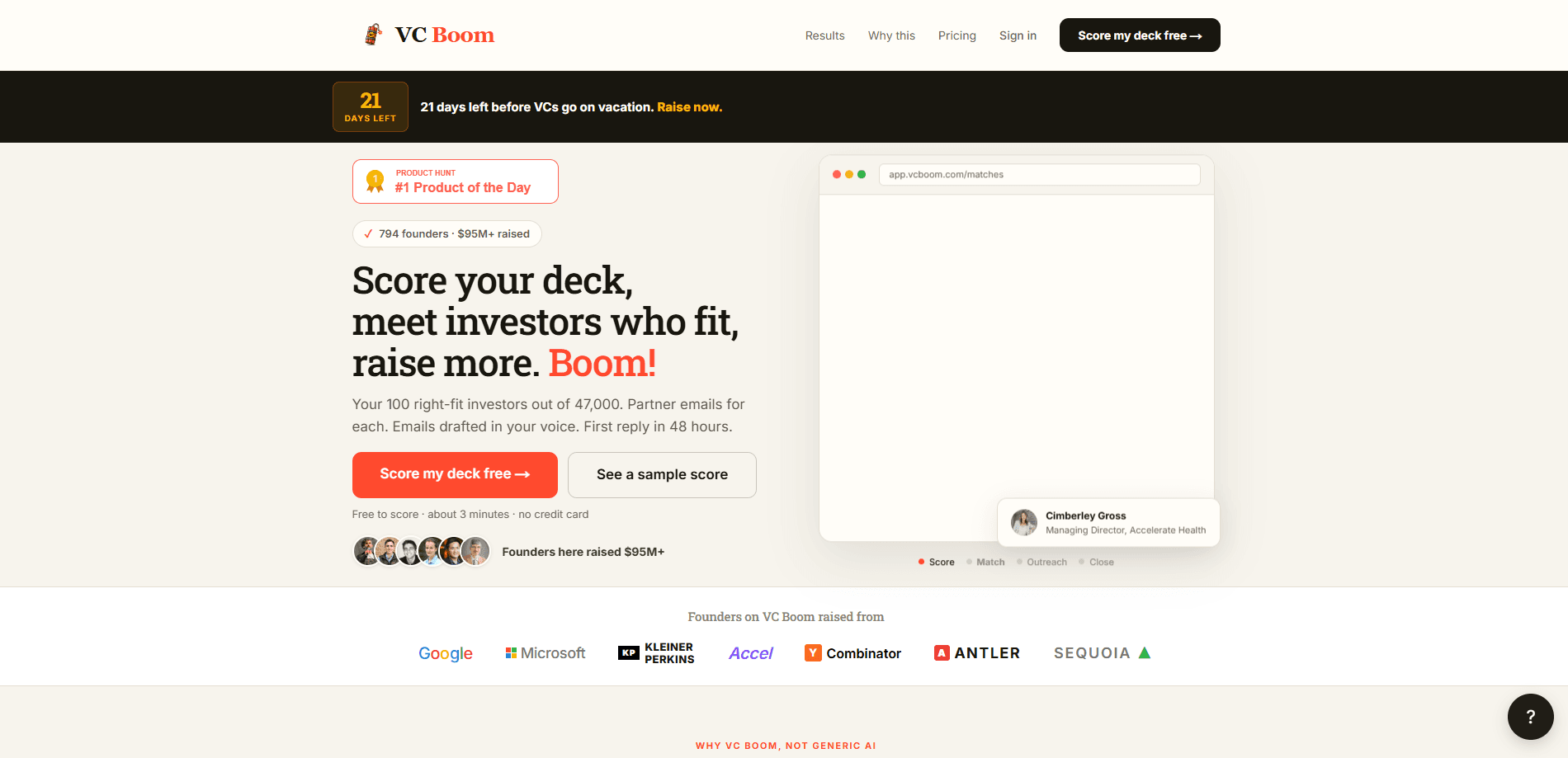
VC Boom is a stack of three tools bolted to one outcome: a better raise. Pitch deck scoring, investor matching, and cold email outreach, all in one place. Generic AI gives you generic advice; this is built for your round. It runs in the browser. Nothing to install.
About VC Boom
What Is VC Boom
VC Boom is a web-based fundraising assistant built around three jobs that stall most founders: fixing the deck, finding the right investors, and starting outreach. Most founders can do one of those well and let the other two slide for weeks, which is usually where a raise quietly dies. Instead of handing you generic advice, this tool reads your slides and returns a scored breakdown you can act on.
Does startup fundraising actually reward polish, or does it reward founders who can defend their numbers under questioning? Investors size up your deck in about 90 seconds, and they judge the same seven dimensions every time. So VC Boom scores it on those axes, including traction, team credibility, market opportunity, and how clearly you frame the ask. Each one gets a number plus written notes on what's landing and what isn't. That turns a vague sense that the deck feels off into a concrete list you can actually work through before anyone sees it. From there, the matching engine ranks investors by vertical, funding stage, check size, and recent deal activity. You get a shortlist instead of a directory dump. Cold email outreach is where it lands hardest: every draft opens with something specific to that investor, so it doesn't read like a template.
The main limit is scope. VC Boom handles the early, mechanical part of a raise: deck polish, investor research, and first-contact emails. It won't negotiate terms, build your financial model, or replace the judgment calls that only you can make. That's still your job. It's also web only, so there's no mobile app and no way to fire off a follow-up from your phone while you're waiting for coffee.
Getting Started
- Create a free account at vcboom.com and upload your pitch deck as a Figma export or slide file.
- Run the deck score and read the seven-dimension breakdown, noting the gaps flagged on each slide.
- Review your ranked investor matches, filtered by stage, sector, and check size, then pick your first batch.
- Generate a drafted email for each investor and edit it before sending so it still sounds like you.
- Send from your own Gmail or Outlook and track opens and replies from the dashboard.
Product Information
A quick look at VC Boom's pricing, supported platforms, and performance.
Best for
The users, tasks, and scenarios where this tool fits best.
Users
- First-time founders
- Repeat founders running a seed or Series A
- Solo founders
Tasks
- Pitch deck review
- Investor prospecting
- Cold email drafting
Scenarios
- Pre-seed outreach sprints
- Warm-up before a fundraise
- Re-running a stalled raise
Key features
Deck scoring across seven dimensions
VC Boom scores your deck on the same axes investors use, including traction, team, market, and ask clarity. Each dimension returns a number and a written breakdown. No vague encouragement. It's closer to a red-team review than a spell-check, and the deck can be re-scored after you make changes.
Investor matching from a 47,000+ database
The matching engine ranks investors by vertical, funding stage, check size, and recent deal activity. You get a shortlist ordered by fit rather than a raw list you have to qualify yourself. The full database only opens up on the top tier, so the size of your shortlist depends on your plan and how much you're willing to spend before you know if the raise will land.
Cold emails drafted in your voice
Every email opens with something specific to that investor, such as a recent portfolio bet or a focus area they've written about. The goal is a first impression that reads as hand-written, not templated. You edit before sending. Worth doing, if you want the tone to hold up on a call.
Follow-up sequences and send tracking
On the mid tier and up, VC Boom builds day-3 and day-7 follow-ups and sends from your own Gmail or Outlook. Open tracking shows whether a message was read. It's a blunt signal. Still useful when you're deciding who to chase and who to stop emailing.
Pitch Coach and Deck Tune
Pitch Coach is a chat that knows your deck, so you can pressure-test your answers before a call with an investor who's already read your traction slide. Deck Tune rewrites slides one at a time. Both sit on the mid tier, and together they cover the gap between spotting a weak slide and actually fixing it.
Investor Brief generator
The mid tier adds an Investor Brief generator that produces a one-pager per VC, pulling together what you know about the fund before you reach out. It saves the research step that eats the most time when you're contacting dozens of people, and it keeps you from opening with a detail the investor has heard a hundred times already.
Trackable deck links
The top tier gives you trackable links. You can see who opened your deck and how long they read. That tells you which investors to follow up with and which to leave alone. It's the closest thing here to reading the room from a distance.
Pros and cons
Pros
- Deck scoring gives concrete, dimension-level feedback instead of generic encouragement.
- Investor matching filters by stage, sector, and check size, which cuts research time.
- Drafted emails reference each investor's actual activity, so they don't read as boilerplate.
- One-time pricing rather than a subscription, with a 7-day refund window.
- Free account covers three investor contacts, enough to test whether the matches are useful.
Cons
- The full 47,000+ investor database sits behind the $1,497 tier, so lower plans see a smaller slice of the list.
- Web only. No mobile app. Outreach happens at a desk rather than on the move.
- The highest tier is a real cost for a solo founder before a round has closed, and if the raise stalls the money's already spent.
- Matching quality depends on the data behind the database, which you can't inspect before paying for a plan.
Frequently asked questions
It scores your pitch deck, matches you to investors, and drafts cold emails for outreach. The flow runs from deck to first contact in one place, which is the part of a raise that eats the most founder time.
Related content
Explore related tools, skills, and articles for VC Boom.
VC Boom Alternatives
Liveplan
Palo Alto Software · BusinessLivePlan is business plan software that helps founders and small business owners turn an idea into a funder-ready plan. It combines AI-assisted writing, market research with cited sources, and connected financial forecasting so your income statement, cash flow, and balance sheet move together when you change one number. Over 1.5 million businesses have used it to plan, forecast, and track performance against real accounting data. That's a lot of founders. It's also a signal the tooling survived contact with real lenders.

Swms
Swms AI · Writing · Productivity · BusinessSwms is an AI safety compliance tool that turns a plain description of a job into ready-to-use safety documents. Describe your project, trade, and known hazards, and it writes a safe work method statement, job hazard analysis, safe work procedure, RAMS, or safety data sheet in seconds. It also ships with Oscar, a chat assistant that answers workplace safety questions in any language. Teams in construction, mining, transport, and warehousing use it to cut the paperwork that usually eats into a workday.

Rows
Rows (Superhuman) · Productivity · BusinessRows is an AI spreadsheet and data analysis tool that imports live data from more than 50 sources, then lets you work with it using plain language instead of SQL queries or nested formulas. You can pull numbers out of PDFs, connect ad platforms, databases, and bank accounts, and ask the AI to build reports, merge datasets, or set up models that recalculate themselves. It runs in the browser, works like a spreadsheet, and now sits under the Superhuman umbrella.