

Veltos.ai
Veltos.ai · Image
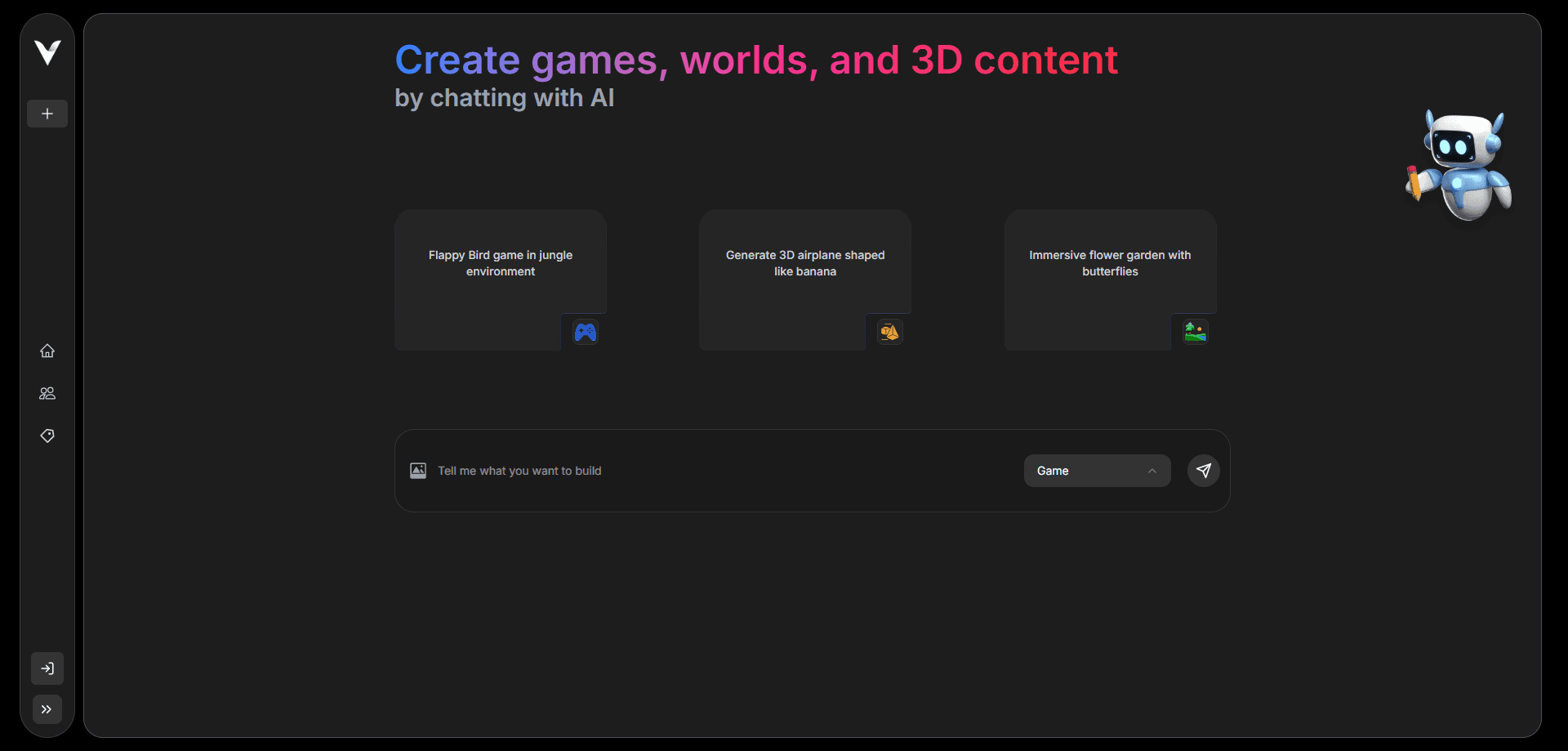
Veltos.ai is an AI game creation platform that turns plain text prompts into playable 2D games and interactive 3D worlds, with no coding needed.
About Veltos.ai
What Is Veltos.ai
Veltos.ai is a prompt-driven game engine aimed at people who have an idea but not a dev team. You describe the game or the 3D scene you want, the built-in agent plans the project and builds it, and you get something you can play in the same session. As an AI game generator, it targets hobbyists, indie creators, and educators rather than studios with an existing pipeline.
The pitch is speed. Traditional game work means months of modeling, coding, and testing before anything is playable. Veltos.ai compresses that into a conversation: type a concept, watch an agent assemble scenes and mechanics, then tweak by talking to it. The company frames the goal as going from idea to game in minutes instead of months, which is the kind of claim you should verify with your own prompts before trusting.
The catch is control. A prompt-first workflow trades fine-grained tuning for speed, so teams that need precise physics, shaders, or asset pipelines will hit limits fast. Output quality also swings a lot with how you phrase the prompt, and the platform is still young, with the docs and public track record thinner than what you get from mature engines like Unity or Unreal. Treat it as a fast prototyping and imagination tool, not a replacement for a full production stack.
Getting Started
- Go to the Veltos.ai site and create an account through the sign-up form.
- Pick a mode, then type the game or 3D world you want in plain language.
- Let the agent build the first playable version and open it to test.
- Refine the result with follow-up prompts, adjusting scenes, mechanics, or visuals.
- Play the finished build from the platform or share it with others.
Product Information
A quick look at Veltos.ai's pricing, supported platforms, and performance.
Best for
The users, tasks, and scenarios where this tool fits best.
Users
- Hobbyist game makers
- Indie creators and prototypers
- Educators and workshop hosts
- 3D and simulation tinkerers
Tasks
- Turning a written idea into a playable game
- Generating 3D worlds and models
- Prototyping game concepts fast
- Building without code
Scenarios
- Testing a game idea before investing
- Teaching game design basics
- Generating 3D scenes for demos
- Weekly game jams
Key features
Prompt to game
You type a description of the game you want, and the platform turns it into a fully playable title. There's no editor to learn and no code to write, which is the whole point for people who stall at the blank-page stage. The agent handles the assembly so you can judge the result by playing it.
Agent mode
The agent works through your request on its own, planning the project and building it before handing back something you can run. That makes it useful for longer or more complex asks where you don't want to make every small decision by hand. You steer with language instead of menus.
3D world and model generation
Beyond flat 2D games, Veltos.ai works as a 3D world generator, producing worlds and models you can explore. The company positions this as content for learning, research, and creative experiments, so it suits people who want an environment to walk through rather than a rules-driven game.
No-code build flow
Everything runs from natural language, so a no-code build process is the default and no prior programming or engine experience is needed. That removes the usual barrier of installing Unity or Unreal and learning their interfaces before you can see anything move. It's the shortest path from idea to something interactive.
Fast iteration with prompts
You refine a build by describing what to change rather than digging through settings. Each round of feedback reshapes the scene or the mechanics, so testing and adjusting happen in the same conversation. The loop is quick, which is what makes prompt-first tools feel closer to play than to production.
Web-based access
The platform runs in a browser, so there's nothing to download and no local setup. You can start from any modern machine and share a build by sending a link. That low entry cost matters when the whole appeal is trying an idea on a whim.
Pros and cons
Pros
- You can go from a written idea to a playable build without any coding, which fits non-developers who still want to make games.
- The agent mode handles a whole request on its own, so longer builds don't stall on every small choice.
- Aside from 2D games, it generates explorable 3D worlds and models that suit demos, lessons, and experiments.
- Everything runs in a browser, so there's no engine to install and no toolchain to maintain.
- Credit-based pricing keeps the entry cost low, and the base tier is $10 a month instead of a large upfront license.
Cons
- There's no free plan, so anyone who wants to try it before paying has to commit to a subscription first.
- Prompt-first control is coarse: fine physics, shaders, and precise asset work are hard to tune, which pushes real production work back to traditional engines.
- Output quality depends heavily on how you phrase the prompt, so results vary and you may spend credits on less useful tries.
- The platform is young and its documentation and public track record are thin, so support material and community examples are limited.
- It doesn't publicly document a developer API, so wiring outputs into your own tooling isn't possible right now.
Frequently asked questions
It's an AI platform that turns text prompts into playable 2D games and interactive 3D worlds. You describe what you want, an agent builds it, and you test the result without writing code.
Related content
Explore related tools, skills, and articles for Veltos.ai.
Veltos.ai Alternatives

Google EmbeddingGemma 2
Google DeepMind · Writing · Image · CodingGoogle EmbeddingGemma 2 is a 740M-parameter open model that turns text, code, images, audio, and video frames into vectors in one 768-dimension space, running on phones and laptops.

Tractionwave
TractionWave · Image · MarketingTractionWave is an AI attention heatmap tool for static ads. Upload a PNG or JPG and it returns predicted attention, ranked hotspots, and fixes before you spend budget.

Imejis.io
Imejis.io · Image · MarketingImejis.io is an AI design studio for agents and marketing teams. Describe an image in plain words, and it writes the copy, builds the layout, reflows it to every size, then exports a finished file.