

Veriom
Veriom · Coding
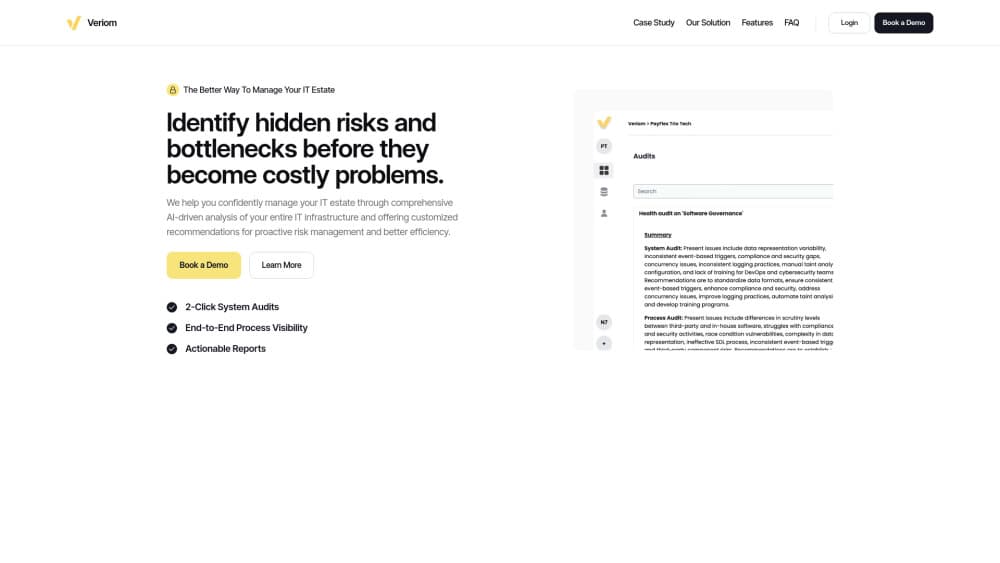
Veriom builds a current, evidence-backed model of a software system from repository, cloud and CI/CD evidence, so security and engineering teams can see what changed and why it matters.
About Veriom
What Is Veriom
Veriom is an architecture intelligence platform for security and engineering teams. It pulls evidence from repositories, cloud accounts, CI/CD pipelines, scanners and uploaded artifacts, then reconciles all of it into one model of the system: services, data stores, identities, network paths and the relationships between them.
The difference from a diagram is that every material entity and relationship in that model can carry provenance, observation time, confidence, contradictions and history. You can click a service and see which commit defined it, which cloud inventory job observed it, and where two sources disagree. That is the core of what the company calls evidence-backed architecture.
Veriom sits in private beta. Access goes through a request form, and pricing is not published. The product is aimed at teams already running scanners, not at teams looking for their first security tool.
Getting Started
- Request access through the Veriom site and book an introductory call. The company is onboarding private-beta workspaces rather than offering self-serve signup.
- Connect a repository. GitHub, GitLab and Bitbucket connections start with explicit project selection, and audit credentials are read-scoped.
- Install the managed collector for AWS, Azure or Google Cloud so account-bound inventory arrives with visible completeness and freshness.
- Run an architecture audit, open a finding and follow the evidence back to the source. From there you can generate a report or a remediation pull request for a human to approve.
Product Information
A quick look at Veriom's pricing, supported platforms, and performance.
Best for
The users, tasks, and scenarios where this tool fits best.
Users
- Security architects
- Application security engineers
- Platform and infrastructure teams
- AI engineering leads
Tasks
- Change impact analysis
- Trust boundary and blast radius questions
- Structural weakness review
- Report and remediation preparation
Scenarios
- A quarterly security architecture review is coming up and the current diagram is two years old
- A scanner flags a dependency deep in a service
- An internal agent needs to answer architecture questions
Key features
Evidence Graph With Provenance
Every material entity and relationship can record where it came from, when it was observed, how confident the system is, and which other source contradicts it. That turns an architecture claim into something a reviewer can check. When two sources disagree, the conflict stays visible instead of being averaged away.
Repository and Cloud Reconciliation
Veriom reads GitHub, GitLab and Bitbucket repositories plus inventory from AWS, Azure and Google Cloud. Repository access is read-scoped, project selection is explicit, and exact revisions stay attached to the evidence. Cloud collectors report completeness and freshness, so you know when a picture is partial.
Change Impact and Trust Boundary Analysis
The model supports path questions: what did this change touch, which identities can reach this store, where does a public endpoint lead. Answers come with evidence identifiers rather than prose alone. This is the part that separates architecture intelligence from a static diagram tool, because the question can be re-asked every time the code moves.
Deterministic Merge Checks
Architecture gates can run against an exact commit on GitHub, GitLab and Bitbucket. The check produces a fixed result from the same evidence, and it has no authority to write to your repository. Teams use it to stop a structural regression before merge without handing an agent commit rights.
Agent and Developer Interfaces
A typed OpenAPI 3.1 contract, scoped workspace tokens, structured problem responses, rate limit headers and a Streamable HTTP MCP gateway make the platform usable from code. Every agent output is a typed artifact with evidence identifiers, confidence and a recorded decision. The official CLI covers doctor, scopes, openapi and bounded request commands.
Human-Approved Remediation
Veriom can draft reports and remediation pull requests, and a person has to approve both. Pull requests are never merged automatically. Ticket creation, ownership routing and policy exceptions each need capability-specific authorization plus approval from a different human, which keeps an audit trail on every consequential action.
Pros and cons
Pros
- Provenance and confidence sit on the model itself, so architecture claims can be audited instead of trusted.
- Repository code is treated as untrusted input and audits do not run builds, tests, hooks or package scripts.
- The API, CLI and MCP gateway make it practical to connect an internal agent without giving it broad source access.
- Remediation stays behind human approval, with separate authorization for tickets and policy exceptions.
Cons
- It is a private beta with no published pricing and no self-serve free tier, so evaluating cost takes a sales conversation.
- Veriom reconciles scanner evidence but does not replace your scanners, which means another line item if you don't already own one.
- Knowledge connectors and MCP-aware workspace agents are still listed as roadmap items, so some integration work waits.
- Useful output depends on how much evidence you connect, and a partial repository or cloud scope produces a partial picture.
Frequently asked questions
It builds and maintains a model of a software system's architecture from repository, cloud, CI/CD, scanner and uploaded evidence. Each part of that model can show its source, observation time and confidence, so a review can check the claim instead of accepting a diagram.
Related content
Explore related tools, skills, and articles for Veriom.
Veriom Alternatives

Udon
Udon · Coding · ProductivityUdon turns an Apple Silicon Mac into a home server you run from a browser, with container controls, file shares, and an optional AI sysadmin.

offstage
offstage cloud · Coding · Productivityoffstage gives AI coding agents and CI jobs a real Mac: a fresh macOS account on Apple silicon, driven over an API and billed by the second.

BotBus
Chengdu Tuyang Tusen Technology Co., Ltd. · Coding · ProductivityBotBus lets you control AI coding agents from your phone and watch: approve commands, start tasks and read results while the code stays on your desktop.