
Visage Technologies
Visage Technologies AB · Image
Visage Technologies builds visage|SDK, a face tracking, analysis and recognition toolkit for developers. It runs on device or in the cloud and ships with sample apps.
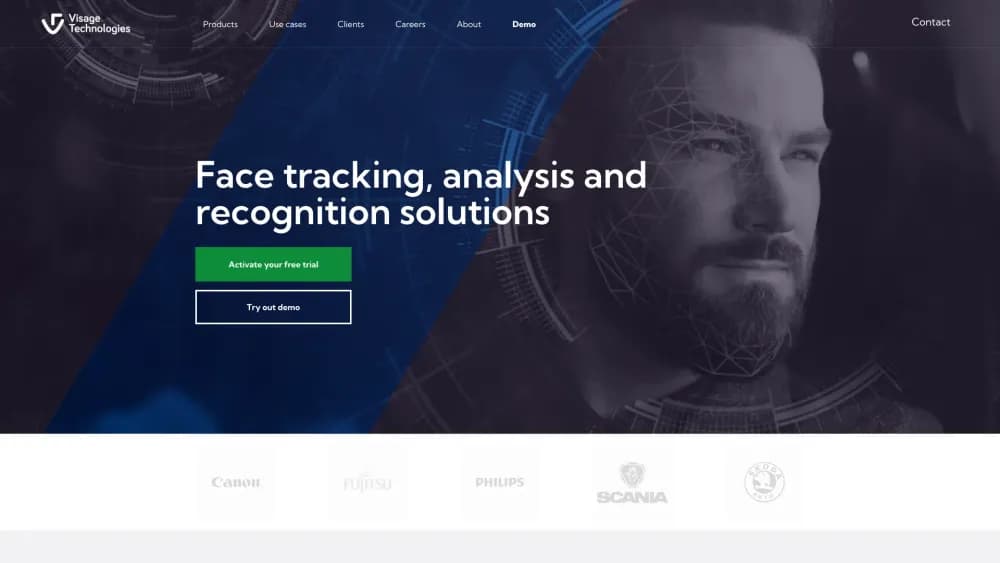
About Visage Technologies
What Is Visage Technologies
Visage Technologies is a Swedish computer vision company founded in 2002. Its core product is visage|SDK, a software development kit that lets a team add face tracking, facial analysis, and face recognition to its own apps instead of building those models from scratch. The company also sells custom development work, and its engineers have contributed to perception systems for automotive brands.
The SDK is split into modules you license separately: FaceTrack for head pose, facial points, and gaze; FaceAnalysis for age, gender, and emotion estimates; and FaceRecognition for identifying or verifying a person. One license covers a specific mix of modules and platforms, which is why the company quotes prices per project instead of publishing a rate card.
Two constraints matter before you commit. The licensing model is commercial and negotiated, so a hobby project or a small pilot needs a budget conversation rather than a credit card. And the toolkit is built for engineers: you need a development team that can work with native code, Unity, or a web wrapper.
Getting Started
- Open visagetechnologies.com and pick the modules you need: FaceTrack, FaceAnalysis, or FaceRecognition.
- Request a free trial through the contact form, and the team activates a time limited license with the downloads and sample projects.
- Build a test app from the samples for your target platform, whether that's Android, iOS, HTML5, Windows, Ubuntu, or a board like Raspberry Pi.
- Tune the configuration file for face size range, tracking speed, and image source, then check accuracy against your own footage.
- Agree on commercial terms if the trial works, and keep the R&D team on call for custom modules or edge deployment help.
Product Information
A quick look at Visage Technologies's pricing, supported platforms, and performance.
Best for
The users, tasks, and scenarios where this tool fits best.
Users
- App development teams
- Automotive and robotics engineers
- Beauty and cosmetics brands
- Security and access control vendors
Tasks
- Adding head pose and expression tracking to a game or filter
- Measuring viewer attention
- Estimating age, gender, and emotion for audience insight
- Identity verification at a door or a desk
- Running vision on low power hardware
Scenarios
- A driver monitoring feature
- A virtual makeup or eyewear try on in a shopping app
- A privacy sensitive audience study
- A proof of concept for a new product line
Key features
Real Time Face Tracking With 151 Points
FaceTrack locates and follows up to 151 facial feature points on one or more faces, in images and video, from any standard camera or video file. You get 2D and 3D head pose, the fitted 3D face model, and coordinates for landmarks like the chin tip, lip corners, and irises. It starts tracking as soon as a visible face shows up, and it recovers after occlusions or when someone turns away.
Eye Gaze and Iris Tracking
The tracker reports eye closure, eye movement, a 3D gaze vector, and pupil coordinates. Pair it with age and gender estimation from the analysis module and you cover most of the attention metrics a study needs. With a short calibration it also outputs screen space gaze, which is the point on the monitor a person is looking at. That covers attention studies and control schemes that follow the eyes, and it pairs with the iris radius data for distance estimates.
Face Analysis For Age, Gender, and Emotion
FaceAnalysis estimates age to within about five years under decent lighting, classifies gender, and returns a probability distribution across happiness, sadness, anger, fear, surprise, disgust, and neutral. The vendor notes that accuracy depends on lighting and head pose, so slightly turned faces give shakier numbers. More complex emotion sets are available on request.
Face Recognition With Liveness Detection
FaceRecognition turns a face into a numeric descriptor, then compares it against enrolled descriptors to score similarity. Because only mathematical templates get stored, images and names stay out of the system, and the templates can't be reversed into a photo. Optional liveness detection blocks a printed photo or a phone screen held up to the camera.
A Wide Platform and Hardware Range
The same SDK runs on Windows, macOS, Linux distributions like Ubuntu and RedHat, Android, iOS, and HTML5, plus embedded targets including Raspberry Pi, Xilinx, and Ambarella. Most modules work fully offline, which matters for cars, factory floors, and anywhere a stable connection is a luxury. A Unity plugin covers game and AR projects.
Privacy by Default and Modular Licensing
FaceTrack and FaceRecognition don't store images, names, or other personal data unless a client builds that layer. The toolkit ships as separate modules, so you can license tracking alone, or add recognition and analysis when the product needs them. Configuration files expose speed, face size range, and search limits, which lets a team trade accuracy for frame rate on weaker hardware.
Pros and cons
Pros
- The face tracking SDK runs fully offline on phones, desktops, and embedded boards, so a product keeps working without a network.
- Modules are small and fast, which keeps mobile battery drain and edge hardware costs down compared with heavier models.
- Face tracking, analysis, and recognition share one codebase, so adding a second capability means licensing another module rather than integrating a new vendor.
- Widely used platforms and a Unity plugin shorten the integration work, and sample projects cover the first build.
- Privacy defaults minimize stored biometric data, which helps with compliance reviews in regulated industries.
Cons
- There's no public price list. You request a quote, which slows down budgeting and makes comparison shopping hard.
- The free trial is time limited and requires a sales conversation, so you can't download the SDK and start experimenting today.
- The SDK targets native and Unity development, and there's no hosted API you can call from a plain web front end.
- Accuracy for age, gender, and emotion drops under poor lighting or steep head angles, so results need checking against your own footage.
Frequently asked questions
It builds visage|SDK, a commercial software development kit for face tracking, facial analysis, and face recognition. Developers license it to add camera driven features to their own apps on mobile, desktop, web, and embedded hardware.
Related content
Explore related tools, skills, and articles for Visage Technologies.
Visage Technologies Alternatives

Google EmbeddingGemma 2
Google DeepMind · Writing · Image · CodingGoogle EmbeddingGemma 2 is a 740M-parameter open model that turns text, code, images, audio, and video frames into vectors in one 768-dimension space, running on phones and laptops.

Tractionwave
TractionWave · Image · MarketingTractionWave is an AI attention heatmap tool for static ads. Upload a PNG or JPG and it returns predicted attention, ranked hotspots, and fixes before you spend budget.

Imejis.io
Imejis.io · Image · MarketingImejis.io is an AI design studio for agents and marketing teams. Describe an image in plain words, and it writes the copy, builds the layout, reflows it to every size, then exports a finished file.