

VisibleThread
VisibleThread · Productivity · Marketing · Leaning · AI Detection
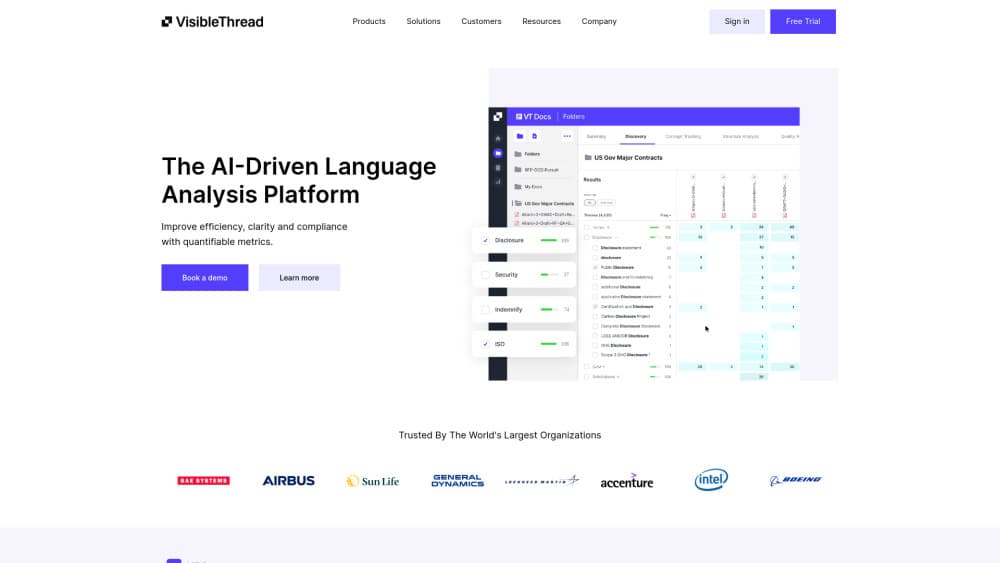
VisibleThread is RFP software for government contractors. It pairs deterministic document analysis with AI to find opportunities, build compliance matrices, draft proposals and review contracts.
About VisibleThread
What Is VisibleThread
VisibleThread is a platform for the teams that chase government contracts: business development, capture, proposals and contracts. This proposal management software covers the full bid cycle in one place. It has been sold to that market since 2008, and the company says 11 of the top 15 US federal contractors run on it. The pitch is narrow on purpose. Instead of promising a general writing assistant, it handles the documents that decide whether a bid wins or loses.
The core of the product is a deterministic engine. It shreds a solicitation into individual requirements, builds a compliance matrix, compares document versions and flags risk language through dictionaries you control. Every match runs the same way each time, which matters when an auditor asks how a requirement was missed. A second layer adds generative AI for drafting and analysis, with answers tied back to your own approved content.
The limits are worth knowing up front. Pricing is quote based, so you can't check a number on the site and sign up in five minutes. The product assumes a formal bid process with reviewers and deadlines. A solo consultant who writes two proposals a year will find the workflow heavier than the job requires. Deployment inside classified or air-gapped networks is possible, but it takes an IT project, not a browser tab.
Getting Started
- Book a demo or start a free trial, then confirm your deployment model: public cloud, GovCloud, private cloud or on-premises.
- Set up workspaces for each team, program or security level, then connect reference material such as existing SharePoint folders.
- Import an opportunity from SAM.gov, eBuy or Find a Tender, run the bid decision analysis and shred the solicitation into requirements.
- Build the compliance matrix, draft responses with approved prompts, run the readability and quality checks, then move the package through review to submission.
Product Information
A quick look at VisibleThread's pricing, supported platforms, and performance.
Best for
The users, tasks, and scenarios where this tool fits best.
Users
- Bid and capture managers at federal contractors
- Proposal coordinators and writers
- Contracts and legal reviewers
Tasks
- Building a compliance matrix from a long solicitation
- Scoring and fixing proposal readability
- Comparing an amendment against the original RFP
- Drafting first-pass content with AI
Scenarios
- A short-turnaround task order where the team has ten days from release to submission
- A defense program that can't use public SaaS
- A contract renewal where the customer wants evidence of past performance
Key features
Opportunity Search and Bid Decisions
The platform imports solicitations from SAM.gov, eBuy and Find a Tender, then ranks them against your past contracts. Alignment scores show which opportunities match work you have already delivered. Capture teams get a defensible reason to walk away from a bad fit, which is often worth more than another bid.
Requirement Shredding and Compliance Matrices
Upload an RFP and the deterministic engine breaks it into discrete requirements, each with a location and an owner. The output becomes a compliance matrix your team can work through in a Kanban board. Because the engine is rules based, the same document produces the same matrix on every run, and that consistency is what auditors and reviewers ask for.
Readability and Writing Quality Scoring
VisibleThread started as a clarity tool, and that heritage still shows. Readability assessment scores grade level, flags long sentences, catches passive voice and applies your style guide across a document. Acronym extraction keeps a 60 page response from inventing three spellings of the same program name. One-voice checks help when five authors write five sections.
Grounded AI Drafting
AI proposal writing starts with a prompt library organized by job, such as competitive intel, win themes and past performance, which gives writers a starting draft. Prompts pull variables from the live opportunity, so nobody retypes the customer name and deadline. Every answer cites the source material it came from, which is the difference between a draft you can defend and one you can't.
Contract Risk and Amendment Review
Contract analysis software gets the same treatment as proposals. Search dictionaries flag liability, warranty and data rights language, and the tool extracts FAR and DFARS clauses for review. Amendment handling compares versions and marks material changes, so legal spends time on judgment instead of hunting for edits.
Secure Deployment and Workspaces
Workspaces partition data by team, program or security level, and the company says a commercial team never grounds AI on classified content. Deployment runs from multi-tenant public cloud to AWS GovCloud, customer-managed private cloud, on-premises Windows or RHEL, and fully disconnected SCIF environments. An MCP server exposes the platform's tools to external AI assistants.
Pros and cons
Pros
- Deterministic engine produces the same compliance output every run, which holds up under audit review.
- Opportunity data comes from live sources such as SAM.gov and eBuy, so bid decisions rest on current listings.
- Deployment range covers public cloud through air-gapped networks, a real differentiator for defense work.
- Readability and style checks target proposal writing specifically, not general purpose editing.
- AI answers stay grounded in approved content and cite their sources, which reduces review friction.
Cons
- No published pricing. Budget approval takes a sales conversation, and small teams may lose weeks to procurement.
- The workflow assumes a formal bid process. Low volume bidders pay for structure they won't use.
- Setup takes real effort: workspaces, dictionaries and prompt libraries need an owner before the tool earns its keep.
- On-premises and SCIF deployments depend on your IT team, so the timeline is outside the vendor's control.
Frequently asked questions
It manages the government bid lifecycle. Teams use it to find opportunities, decide whether to bid, shred requirements into a compliance matrix, draft and quality check proposals, and review contracts after award.
Related content
Explore related tools, skills, and articles for VisibleThread.
VisibleThread Alternatives

Base Code
Base44 (Wix) · Coding · ProductivityBase Code is a shared cloud development environment from Base44. Teammates describe changes to an existing GitHub codebase in chat, preview them live and send them back as pull requests.

Knocket
Knocket (Tencent RTC team) · Productivity · Business · ChatbotKnocket is a free live chat and contact page tool that lets visitors message you from your website, app, or a shareable link, with every reply handled from Telegram or one inbox.

FloorGen
Vinit Kumar (FloorGen) · Productivity · China AIFloorGen is a browser-based floor plan maker that turns a sentence or a sketch into an editable 2D plan and a 3D walkthrough. Export to PDF, DXF or video, and draw without an account.