

VisionSync
VisionSync · Productivity
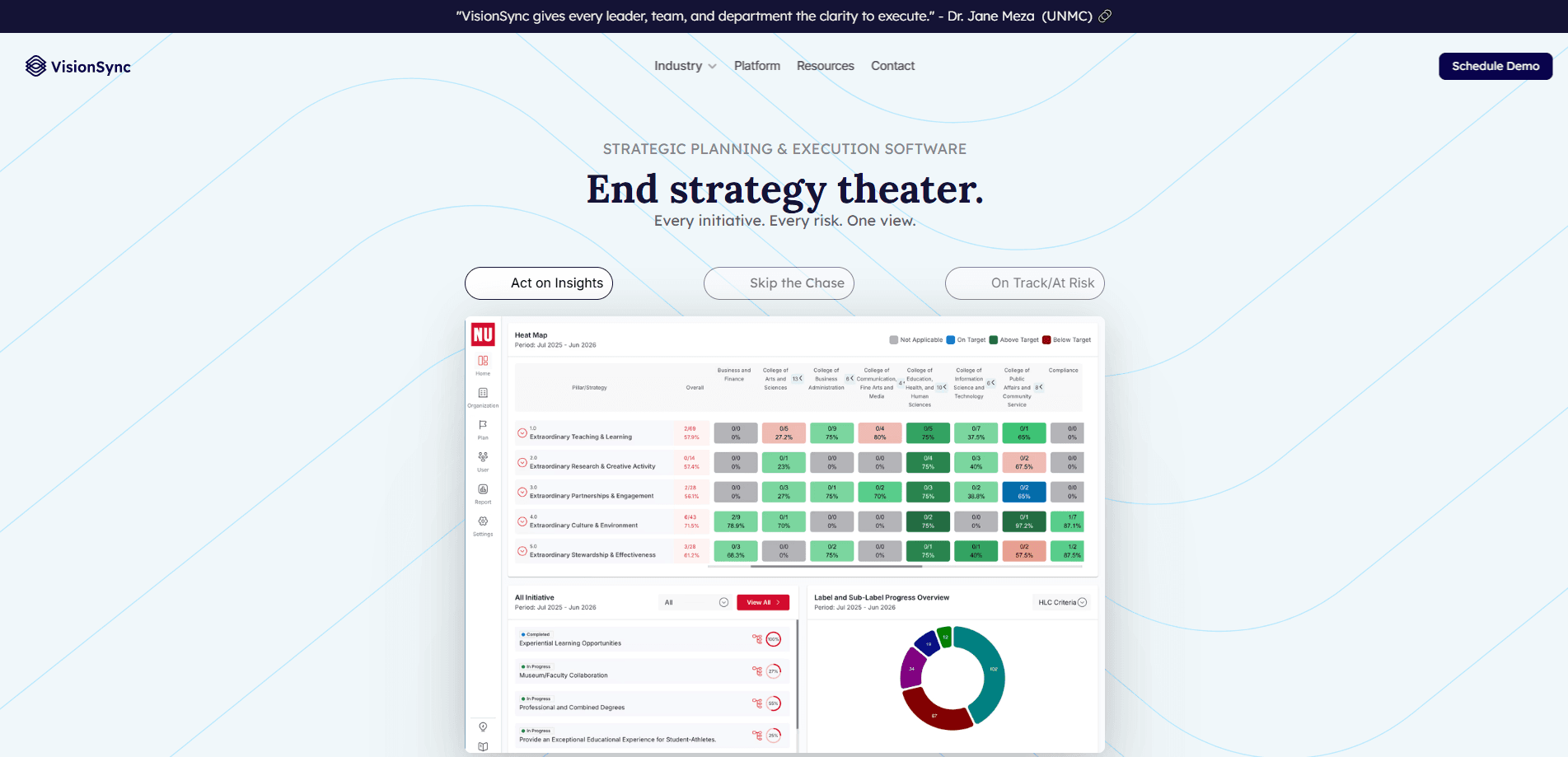
VisionSync is a web-based strategy execution platform for organizations that need one shared view of their strategic plan. It connects high-level objectives to departmental goals and individual KPIs, tracks progress across every initiative, and generates board-ready reports instead of leaving the work scattered across spreadsheets. It's built for leadership teams running anywhere from a handful of goals to thousands of initiatives. Most strategic planning software stops at the plan. This one keeps going until the work is done.
About VisionSync
What Is VisionSync
VisionSync is strategy execution software that came out of a real institution rather than a pitch deck. The University of Nebraska Medical Center built it to run its own planning process, refined it over roughly a decade, then licensed the technology in 2023 so other organizations could use it. Today it serves universities, hospitals, non-profits, and city governments.
The problem it addresses is visibility. When a strategic plan lives in a document while the actual work lives everywhere else, progress goes invisible. That makes it hard to support, report on, or defend. VisionSync puts owners, metrics, and reporting rhythms into one workspace, so leaders can see what's moving and what's stalled.
Is it a goal tracking tool or something bigger? Both. Goals and KPIs sit inside the platform, but so does the reporting layer, which is what separates it from a plain KPI dashboard.
The main limit is that it isn't a self-serve product. There's no checkout page. No free tier to poke at on your own. Pricing is scoped per engagement, and access is sold in annual or multi-year terms with an implementation fee attached, so it suits organizations ready to commit rather than individuals testing a tool.
Getting Started
- Book a demo call with the VisionSync team to walk through your rollout and get real figures for your size.
- Sign a scoped agreement covering implementation, training, and platform access for everyone who needs a login.
- Work with your named implementation lead to migrate your existing plan, name owners, and configure goals, KPIs, and initiatives.
- Complete the group training session so admins and plan owners are certified before launch.
- Publish your first progress update and generate a board-ready report from the dashboard.
Product Information
A quick look at VisionSync's pricing, supported platforms, and performance.
Best for
The users, tasks, and scenarios where this tool fits best.
Users
- Leadership teams at universities and academic medical centers
- Department heads and initiative owners
- Non-profit and public-sector teams
- Operations and strategy staff who chase updates
Tasks
- Cascading objectives from the executive level down to individual KPIs
- Tracking a 70-initiative strategic plan
- Generating board and stakeholder reports
- Tracking risk and on-track status across departments
- Replacing a spreadsheet-based operating rhythm
Scenarios
- A 30-day rollout after contract signing
- Multi-campus systems where each unit plans differently
- Accreditation and evidence gathering
- Quarterly board meetings
Key features
Cascade Strategy Across Every Level
You can connect C-suite objectives to departmental goals and individual KPIs using visual mapping that shows exactly how work ladders up. Every goal carries a name. Ownership is explicit. That's the core of the platform, and everything else feeds into it.
Built-In Reporting Insights
The platform produces executive summaries, leadership reports, and board-ready documents without you building them by hand. No export. No deck assembly. One institution described its first board report as showing progress "in a new light," which is the point: the report is a byproduct of the work, not a separate project.
Smart Progress Updates
Automated reminders and progress prompts keep owners accountable without a manager chasing them. That sounds minor. It isn't. Most strategy plans die in the update cycle, when asking six departments for status becomes a full-time job for whoever runs the process.
Visibility Across Departments
On-track and at-risk states are visible across the whole organization in one view. Not a snapshot. A live picture. Leaders can see which initiatives are slipping while there's still time to act, rather than discovering the problem at the end of the year.
Adaptation by Organization Size
VisionSync scales from teams tracking 5 goals to systems tracking 500 or more, with seat tiers that roughly match your structure: Team, Department, Institution, and System. Tiers are set once a year rather than metered month to month, so you're not punished for a busy quarter.
Single Sign-On and Enterprise Access
SSO and SAML integration is offered as an optional add-on, usually folded into the implementation so it shows up as one line on a purchase order. For IT groups with strict access policies, this is often the difference between approved and blocked.
Implementation and Training Included
A named implementation lead runs the rollout with you, covering configuration, plan migration, admin certification, and workshops for the people who'll use it daily. The company's claim is that you don't get a login and a good-luck message. Based on published case studies, that holds up. No guessing.
Pros and cons
Pros
- Purpose-built for strategy execution rather than adapted from a generic project management tool, so goals, KPIs, and reporting share one data model.
- Does more than a KPI dashboard: goals, initiatives, risk status, and reporting all live in the same system.
- Scoped onboarding with a named implementation lead, which shortens the gap between purchase and actual adoption.
- Nonprofit and public-sector rates plus annual or multi-year terms make budgeting predictable for institutions.
- Board-ready reporting is native, not something you assemble from exports.
- Scales from small departments to multi-entity systems without migrating to a different product.
Cons
- No free plan and no self-serve signup, so you can't evaluate it without a demo call and a quote. That's a real cost if you're still comparing options.
- Pricing isn't published. You'll need to talk to sales before you know whether it fits your budget, which slows down any comparison shopping.
- Access is annual or multi-year only. No monthly option means a small team can't try it for a quarter.
- Everything is web-based. There's no desktop or mobile app, so updates happen in a browser.
Frequently asked questions
It's a platform for running a strategic plan: you define objectives, goals, KPIs, and initiatives, assign owners, track progress, and generate reports from the same system. Think of it as one workspace replacing the spreadsheet, the status email, and the board deck.
Related content
Explore related tools, skills, and articles for VisionSync.
VisionSync Alternatives

Base Code
Base44 (Wix) · Coding · ProductivityBase Code is a shared cloud development environment from Base44. Teammates describe changes to an existing GitHub codebase in chat, preview them live and send them back as pull requests.

Knocket
Knocket (Tencent RTC team) · Productivity · Business · ChatbotKnocket is a free live chat and contact page tool that lets visitors message you from your website, app, or a shareable link, with every reply handled from Telegram or one inbox.

FloorGen
Vinit Kumar (FloorGen) · Productivity · China AIFloorGen is a browser-based floor plan maker that turns a sentence or a sketch into an editable 2D plan and a 3D walkthrough. Export to PDF, DXF or video, and draw without an account.