

Voxel51
Voxel51 · Image · Marketing
Voxel51 is a multimodal data platform for physical AI teams. It helps you search, visualize, curate, and label image, video, and 3D data, then find where models fail.
About Voxel51
What Is Voxel51
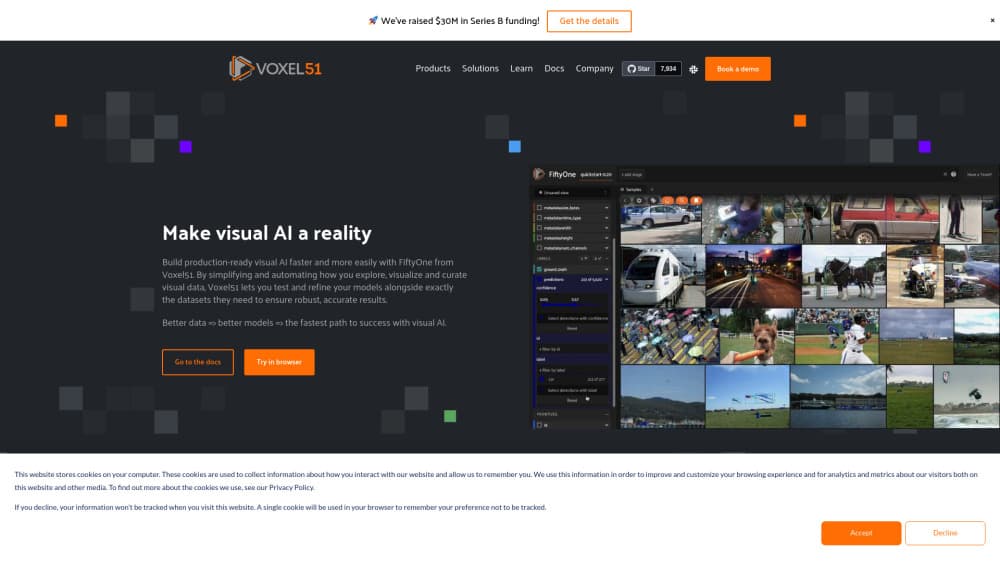
Voxel51 builds software for teams that train models on images, video, and sensor streams. Its early product, FiftyOne, is an open source Python library that turns a folder of files into a dataset you can query, filter, and inspect in a browser. The paid platform adds deployment, governance, labeling tools, and an agent that handles repetitive data work.
Most vision projects fail on data, not architecture. Duplicate frames, boxes drawn around the wrong object, a rare weather condition that shows up in 12 samples out of 400,000. Voxel51 indexes every sample so you can slice by behavior, search with plain language, or pull up frames that look like the ones your model gets wrong.
The tradeoff is setup cost. You need Python skills and a pipeline that can feed data in. A team that only wants to draw boxes on 2,000 photos will spend more time wiring things up than labeling.
Getting Started
- Install the library with pip, or request access to the hosted platform.
- Load a dataset from disk, a cloud bucket, or a common format such as COCO or YOLO.
- Open the app in your browser, browse samples, and save views for the slices you care about.
- Add model predictions, run evaluation, tag the failures, and export the cleaned slice for the next training run.
Product Information
A quick look at Voxel51's pricing, supported platforms, and performance.
Best for
The users, tasks, and scenarios where this tool fits best.
Users
- Computer vision engineers
- Annotation and data ops leads
- Robotics and automotive perception teams
Tasks
- Curating a dataset before a training run
- Debugging a model that regressed
- Label QA at scale
- Moving from open source FiftyOne to a governed deployment
Scenarios
- Sorting eight hours of driving footage down to the 400 clips worth labeling
- Answering a procurement review about data residency
- Giving several teams one shared dataset workspace
Key features
Natural Language and Similarity Search
Voxel51 indexes samples so you can type a description and get matching frames back. Search works across samples, episodes, and behaviors, which matters when a single recording holds several distinct scenes. You can also start from one example and ask for visually similar results, a faster route than writing filter logic for every edge case.
Synchronized Multimodal Playback
Dataset visualization gets hard once a sample carries images, 3D scenes, sensor streams, maps, and annotations at the same time. Voxel51 plays them in sync on one timeline, so a lidar spike lines up with the camera frame that explains it. Reviewers can scrub through an episode and see what the model saw at each step.
Curation at Billions of Samples
The platform is built to hold datasets far larger than a laptop can open. You slice, filter, and tag views, then keep those views versioned as the dataset changes. Removing weak samples early cuts storage and training cost, and the saved views give you a record of what changed and why.
Labeling With Automated QA
Teams can create labels for images, video, 3D, and multimodal data inside the same tool they use for review. Automated QA catches inconsistent classes and geometry problems before a batch reaches training. VLM-assisted labeling and active learning let annotators spend their time on the samples a model finds confusing, instead of on frames it already handles.
Model Evaluation and Failure Slices
This is where computer vision dataset curation pays off. Add predictions from one or more models, then compare them on the same view. Embeddings, uniqueness, and mistakenness scores surface the samples most likely to expose a weakness, so model evaluation points at a short list instead of a dashboard of averages.
Voxel51 Agent for Repeatable Data Work
The agent reads across a dataset and takes action on it. Ask for duplicates to be grouped, a class to be rebalanced, or a report on label drift, and it runs the steps rather than walking you through menus. The point is to remove the small chores that eat a data team's week, not to replace the engineer's judgment.
Pros and cons
Pros
- The open source core means you can test the workflow on real data before talking to sales.
- Search and similarity queries replace hand written filter scripts that break every time a schema changes.
- One workspace covers review, labeling, and evaluation, which keeps context from getting lost between tools.
- On-prem and private cloud deployment fits regulated industries where footage can't leave the building.
- Dataset versioning and role-based access make a visual AI data platform defensible in an audit.
Cons
- Setup assumes Python and a working data pipeline, so nontechnical teams will need help.
- Pricing above the free tier goes through sales, which slows down a small team trying to budget.
- The platform wants large datasets to justify itself, and the interface feels heavy for a few thousand images.
- Feature names and packaging have shifted as the company moved from FiftyOne toward the Voxel51 Platform, so older tutorials may not match what you see.
Frequently asked questions
Voxel51 is used to curate the data behind computer vision models. Teams load images, video, or 3D sensor data, search and filter it, fix labels, and check where a model fails before spending more on training.
Related content
Explore related tools, skills, and articles for Voxel51.
Voxel51 Alternatives

Google EmbeddingGemma 2
Google DeepMind · Writing · Image · CodingGoogle EmbeddingGemma 2 is a 740M-parameter open model that turns text, code, images, audio, and video frames into vectors in one 768-dimension space, running on phones and laptops.

Tractionwave
TractionWave · Image · MarketingTractionWave is an AI attention heatmap tool for static ads. Upload a PNG or JPG and it returns predicted attention, ranked hotspots, and fixes before you spend budget.

Imejis.io
Imejis.io · Image · MarketingImejis.io is an AI design studio for agents and marketing teams. Describe an image in plain words, and it writes the copy, builds the layout, reflows it to every size, then exports a finished file.