
Webposter Lab
Pau Kraft · Image · Coding
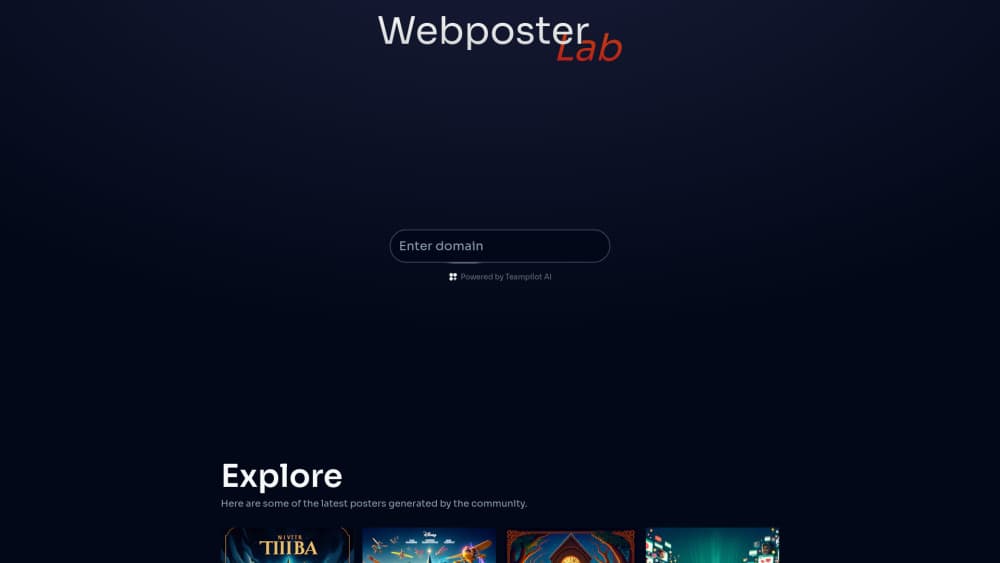
Webposter Lab is a free AI web poster generator that turns any website into a movie-style poster, and it publishes the results in a public poster gallery.
About Webposter Lab
What Is Webposter Lab
Webposter Lab does one thing. You give it a domain, and it hands back a movie poster built around that site's identity: the name, the mood, the visual language, arranged like a film one-sheet. The project calls these web posters, and the format is the whole point. It's a way to turn a website into a poster you'd hang on a wall, and a way to see a site as a cultural artifact instead of a product page.
The tool is a small Next.js app built on Teampilot AI, the platform behind the image generation and the agent that writes the poster. Pau Kraft made it as a side project to test what Teampilot could do, and the source code sits on GitHub for anyone who wants to run their own copy. That matters if you care about the long-term: a hosted service can vanish, and a repo you can clone at least keeps the idea alive.
The limits are real. There are no style controls. You can't pick a color palette, a genre, a typeface, or a canvas size, and you can't edit text after the fact. A poster either lands or it doesn't, and the only lever you get is a regenerate button that disappears when the notification closes. Think of it as a slot machine with good taste, not a design tool.
Getting Started
- Open webposterlab.com and enter the domain you want to see as a poster.
- Wait for the generation to finish. The model reads the site, picks an angle, and renders the artwork in one pass.
- Check the result. If a "Regenerate" button is still showing in the toast, use it before the notification closes. The option is gone once the page reloads.
- Share the poster page at webposterlab.com/yourdomain, or open the image URL directly if you need the file.
Product Information
A quick look at Webposter Lab's pricing, supported platforms, and performance.
Best for
The users, tasks, and scenarios where this tool fits best.
Users
- Designers who need a fresh angle on a brand
- Developers shipping a side project
- People learning how image models read a web page
- Anyone with a domain and five spare minutes
Tasks
- Making a launch or changelog graphic
- Testing how a rebrand reads
- Filling a mood board
- Showing a client what their site feels like
Scenarios
- A weekend hackathon
- A portfolio page
- Teaching a workshop on AI image tools
Key features
Domain to Poster in One Step
The input is a URL, not a brief. Webposter Lab fetches the site, works out what it's about, and writes a poster concept before rendering anything. You never fill in a form, choose a category, or answer questions about tone. That single field is the whole interface, and it's why the tool takes seconds to understand.
Movie Poster Art Direction
Output follows film poster conventions rather than social media templates: a dominant hero image, a title treatment, credits at the bottom, and a vertical composition. The result reads as a parody of a movie one-sheet, which is the joke, and it also happens to be a web poster design style that stands out in a feed full of square graphics.
Shareable Poster Pages
Every poster lives at a URL built from the domain, so webposterlab.com/nba.com is a page you can send to someone. Each one also ships Open Graph tags and a generated preview image, which means the link unfurls properly in Slack, Discord, or X instead of showing a blank card.
Community Poster Gallery
The Explore section collects posters other people made and approved, and it doubles as a browsing experience: sixteen domains on the homepage, each one a different industry and a different visual take. It's the fastest way to judge whether the AI poster maker fits what you have in mind, because you see real outputs instead of marketing samples.
Regenerate While the Session Lasts
If a poster misses, a toast offers one more attempt. The catch is timing: close the tab, dismiss the notification, or load a cached poster and the option is gone. It's a deliberately cheap second chance rather than an editor, and it keeps the app from turning into a settings panel.
Self-Hosted Setup
The repo includes everything needed to run your own instance: a Teampilot AI launchpad for the generation logic, Prisma with SQLite on Turso for storage, an admin page for approving gallery entries, JWT for the regenerate flow, and rate limiting. You can swap the database or host it on any Node platform that runs Next.js.
Pros and cons
Pros
- Free with no tiers, no credits, and no upsell in the flow.
- The output is genuinely designed, not a template with your logo dropped in the middle.
- Shareable pages and Open Graph images come built in, so the poster works as a link as well as a picture.
- Source code is public, which means the tool can outlive the hosted version.
- The gallery shows real results across industries, so you can judge quality before you type your own domain.
Cons
- No export button. You get the image URL and the page, so saving a file means opening the image and using your browser's save command.
- Zero creative control. Style, palette, copy placement, and aspect ratio are the model's call, and a near miss can't be nudged.
- The regenerate option only exists during the session that created the poster. Reload the page and you're stuck with the version you have.
- No API and no batch mode, so agencies that want fifty posters for fifty clients have to sit through fifty generations.
- Self-hosting depends on a Teampilot launchpad and model access, which is the part most likely to change without notice.
Frequently asked questions
Webposter Lab is a free open source AI poster generator that turns a website into a movie-style poster. You enter a domain, an AI model reads the site and generates a one-sheet with the site's name and visual character, and the result gets its own shareable page.
Related content
Explore related tools, skills, and articles for Webposter Lab.
Webposter Lab Alternatives

Storytailor®
Storytailor Inc. · Writing · Image · LeaningStorytailor is an AI story generator for kids that turns a drawing or a small idea into a personalized children's book you can read, listen to, and play out together.

X Ray Interpreter
X-ray Interpreter · ImageX Ray Interpreter is a web-based AI radiology tool that turns X-rays, CT scans, MRI, ultrasound, and PET images into plain-language reports. You upload a scan, get a preliminary X-ray interpretation in moments, then ask follow-up questions if something needs explaining. It works as a second opinion and a learning aid, not as a medical diagnosis.

Aieasypic
AIEasyPic · ImageAIEasyPic is an AI image generator that turns plain text prompts into finished artwork in seconds. You can also train custom models on your own photos, swap faces in existing images, and create short video clips from text, all from a browser. It suits casual creators who want quick visuals and hobbyists who want to build a personal model without touching any code.