

X Ray Interpreter
X-ray Interpreter · Image
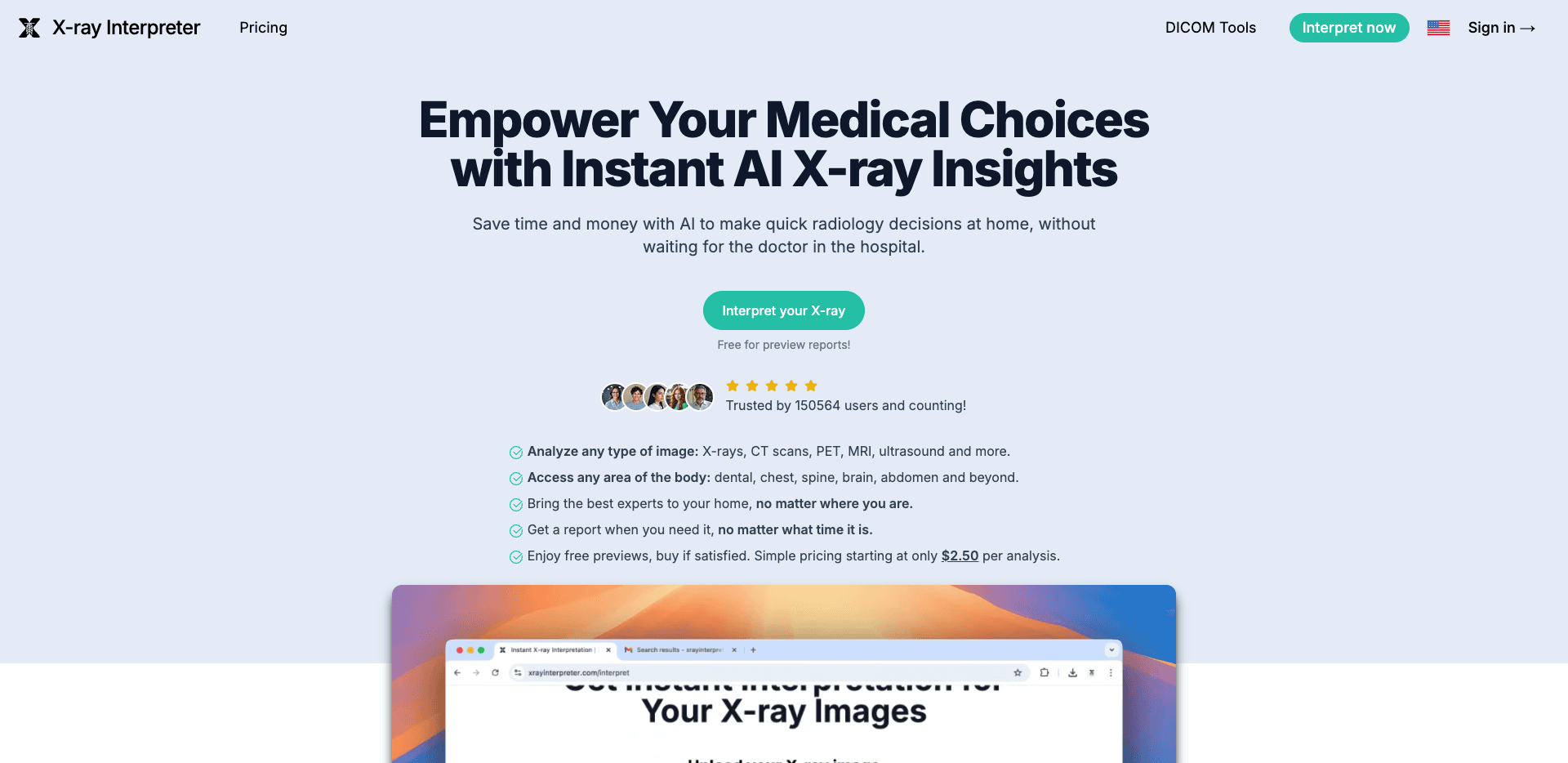
X Ray Interpreter is a web-based AI radiology tool that turns X-rays, CT scans, MRI, ultrasound, and PET images into plain-language reports. You upload a scan, get a preliminary X-ray interpretation in moments, then ask follow-up questions if something needs explaining. It works as a second opinion and a learning aid, not as a medical diagnosis.
About X Ray Interpreter
What Is X Ray Interpreter
X Ray Interpreter is an online service that reads medical images for you. You sign in with a Google account, upload a scan in a common format, and the platform returns a structured medical imaging analysis with a layman-friendly summary of what the AI sees. It handles chest X-rays, spine MRI, CT studies, PET imaging, ultrasound, and nuclear medicine, so you're not locked into one scan type.
The people behind it built it for patients, families, pet owners, students, and working radiologists. A patient waiting on hospital results can get a fast read of an image at home. A student can see how findings get described. A clinician can sanity-check a tricky case. Simple as that. The reports are written so a non-specialist can follow them, which is the whole point.
The biggest limitation is legal, not technical. Every report comes with the same warning: this is an AI-generated interpretation for educational purposes only, not a medical diagnosis. It won't replace your doctor, and you shouldn't make treatment decisions on it alone. That part is non-negotiable. The image processing for DICOM files happens locally in your browser, and the company says it doesn't collect personally identifiable health information.
Getting Started
- Sign in with your Google account to open X Ray Interpreter and access your upload history.
- Go to the Interpret page, then upload one or more images using the Upload image(s) button. JPG, PNG, WebP, PDF, and DICOM files all work.
- If you have a DICOMDIR folder with hundreds of slices, click Select DICOM directory and let Auto Select pick representative key images, then adjust them.
- Buy credits if your balance is low, or request a free preview report while your balance sits at zero.
- Click Interpret, wait a few moments for the report, then download, print, or email it and ask follow-up questions as needed.
Product Information
A quick look at X Ray Interpreter's pricing, supported platforms, and performance.
Best for
The users, tasks, and scenarios where this tool fits best.
Users
- Patients waiting on hospital results
- Medical students
- Radiologists and clinicians
- Pet owners
Tasks
- Reading a chest X-ray
- Interpreting a large MRI or CT study
- Asking follow-up questions
Scenarios
- A late-night worry about a wrist X-ray after a fall
- A pre-appointment review
- Family health checks
Key features
Multi-Modality Image Support
X Ray Interpreter reads more than X-rays. It handles CT scans, MRI, PET imaging, ultrasound, and nuclear medicine in one place. You don't need separate tools for a chest film and a spine MRI. The same upload flow covers each scan type.
DICOM Auto Select
DICOM is the standard file format radiology departments use, and a full study can hold hundreds of slices. The Auto Select feature scans a DICOMDIR folder, picks a representative set of key images across views, and lets you adjust the selection before you submit. No more manual scrolling. It saves you from hunting for the slice that matters.
Plain-Language Reports
The report pairs clinical findings with a summary a non-specialist can actually read. Instead of handing you jargon and stopping there, the AI X-ray reader explains what each observation means. That's rare. This is the feature that makes the tool useful to patients and not just to professionals.
Follow-Up Questions
After the report lands, you can ask the tool to explain a term, clarify a finding, or go deeper on one part of the image. It behaves like a conversation about your scan rather than a static document. Ever stared at a radiology term and given up? This is where that changes.
Free Preview Reports
When your credit balance is zero, you can request a free preview report and see the AI's initial analysis before buying anything. You get unlimited previews while your balance is empty, capped at 5 requests per day to stop abuse. No card needed. It's a low-risk way to judge output quality first.
Report Delivery and Sharing
Once you buy a full report, you can send it to your email, download it, or print it. Previews stay viewable only inside your account, but full reports travel with you for sharing with a doctor or saving for your records. Easy. Every report lives in your My X-rays history too.
Transparent Credit System
One credit equals one image analysis, and credits never expire. You're charged only when a successful interpretation comes back. Unreadable images cost nothing. Fair enough. But three straight uploads of unclear or non-X-ray images cost one credit to cover system costs.
Pros and cons
Pros
- Works across X-rays, CT, MRI, PET, ultrasound, and nuclear medicine, so one account covers most scan types you'll meet.
- Native DICOM support is rare for a consumer tool and lets you work with the same files hospitals produce.
- Free preview reports let you test output quality before spending anything.
- Plain-language summaries make the reports readable without a medical background.
- Credits never expire, and you're only charged for successful analyses.
Cons
- It's explicitly a preliminary tool, not a diagnosis, so it can't stand in for a doctor's read.
- Full reports are priced in bundles starting at $9.9, and each image in a multi-image study costs its own credit.
- DICOM processing runs locally, so the company says it can't debug a specific file that fails to load.
- There's no public API, and no mobile app, which limits use for developers or on-the-go access.
Frequently asked questions
No. The report is an AI-generated interpretation meant for educational purposes only. It isn't a medical diagnosis, and you should always talk to a qualified healthcare professional before making any medical decision.
Related content
Explore related tools, skills, and articles for X Ray Interpreter.
X Ray Interpreter Alternatives

Aieasypic
AIEasyPic · ImageAIEasyPic is an AI image generator that turns plain text prompts into finished artwork in seconds. You can also train custom models on your own photos, swap faces in existing images, and create short video clips from text, all from a browser. It suits casual creators who want quick visuals and hobbyists who want to build a personal model without touching any code.

Chargen
Chargen · ImageChargen is an AI character generator and worldbuilding toolkit built for Dungeons & Dragons and other tabletop RPGs. It turns a one-line idea into a painted character portrait, spins up NPCs, monsters, maps and encounters from the same session, and keeps every creature's details close at hand. The tabletop RPG art side runs on a credit system called Gold, while the text generators stay free for everyone.

On Model
On Model · Image · MarketingOn Model is an AI fashion model tool that places your clothing on virtual models so online stores can get on-model product photos without booking a photoshoot. It runs as a Shopify app, letting you swap the model in an existing image, change backgrounds, and generate faces for cropped or headless shots. The goal is simple: match your product photos to your customers and stand out from competitors using the same supplier images.