

ZeroGPU
ZeroGPU.ai · Productivity
ZeroGPU is an edge AI inference platform that runs high-volume AI workloads on specialized small and open-weight models instead of pricey frontier GPUs. It targets the repetitive tasks that make up most production traffic, such as support ticket sorting, spam flagging, and AI content moderation. The pitch is simple. Pay less per call. Because it exposes an OpenAI-compatible API, teams can swap it into an existing pipeline and pay per token, which makes low latency inference affordable at production scale.
About ZeroGPU
What Is ZeroGPU
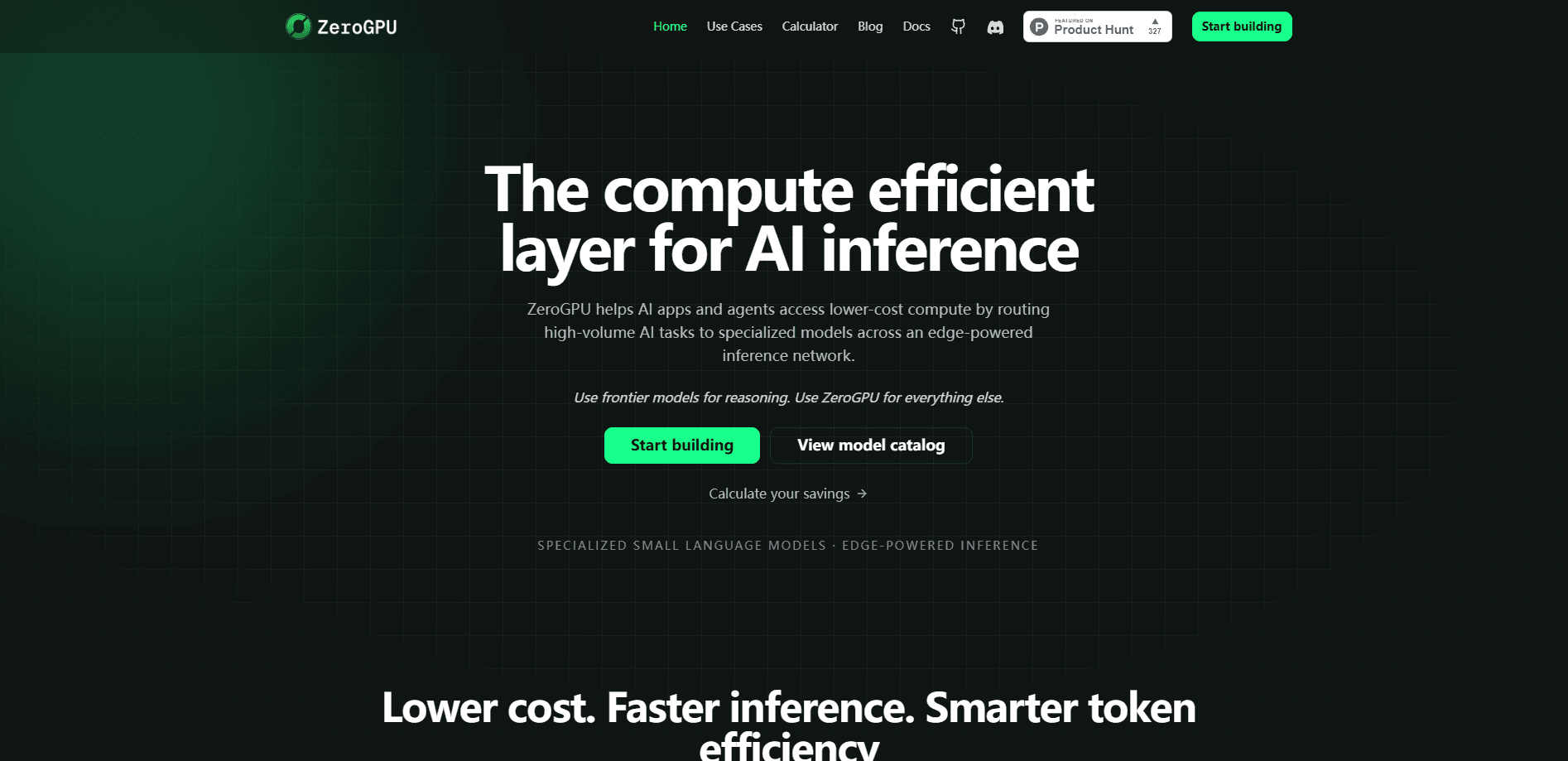
ZeroGPU is the compute efficiency layer for AI inference. The idea behind it's blunt: most AI workloads don't need a frontier model. Sorting a support ticket or flagging a spam comment doesn't demand the same reasoning horsepower as solving a multi-step coding problem. ZeroGPU routes that kind of repeatable work to small and nano language models, then runs them across a network of edge devices instead of centralized GPUs. The company claims 50-70% lower inference cost versus traditional GPU clouds and up to 10x faster inference on specialized workloads. It does note performance varies by workload, model, and configuration.
The main problem it solves is economics. If you're paying frontier-model prices to classify millions of items, the bill scales with volume in a way that gets painful fast. Smaller models on edge hardware cut both cost and latency for the focused tasks that dominate production traffic. The trade-off is capability. ZeroGPU isn't built for complex reasoning, long-context analysis, or open-ended generation. Those still belong to frontier models. ZeroGPU sits alongside them, handling the high-volume execution layer.
Another limit worth knowing: the platform leans on open-weight models, so output quality depends on the specific model a workload is matched to, and you won't get the same flexibility as a fully custom-trained model. Newer or niche tasks may not have a matching small model yet.
Getting Started
- Sign up at the ZeroGPU platform and find your API key and project ID in the dashboard.
- Point an existing OpenAI SDK client at
https://api.zerogpu.ai/v1, or send a request with thex-api-keyandx-project-idheaders. - Pick the model that fits your task from the model catalog, for example a classification or moderation variant.
- Send your first request to the responses endpoint and confirm the output matches what your pipeline expects.
- Roll the call into production and track usage against your plan's balance.
Product Information
A quick look at ZeroGPU's pricing, supported platforms, and performance.
Best for
The users, tasks, and scenarios where this tool fits best.
Users
- Backend and ML engineers
- AI product teams
- Startups on tight margins
Tasks
- Support ticket routing
- Content moderation
- Data extraction
- Sentiment analysis
Scenarios
- Running daily batch classification over a large item set
- Enriching customer profiles with lead scoring and behavioral signals
- Screening user-generated content before it goes live
Key features
OpenAI-Compatible API
ZeroGPU exposes an OpenAI-compatible endpoint at https://api.zerogpu.ai/v1. If you already use the OpenAI SDK, you can point it at ZeroGPU and keep most of your code. Authentication runs through x-api-key and x-project-id headers rather than the standard bearer token. It's a small config change, not a rewrite. This is the feature that makes adoption cheap for existing pipelines. Less friction, faster switch.
Specialized Small and Nano Models
The platform matches each workload to a small or nano model chosen for the task. A dedicated model for classification or extraction can beat a larger general-purpose model on that focused job while running cheaper and faster. A model catalog lets you pick the right one, and the system handles the routing under the hood. Right model, right job.
Edge-Powered Inference Network
ZeroGPU runs workloads across a network of edge devices rather than one centralized GPU cluster. The company cites 100K+ edge devices and frames the network as the reason latency stays low at production scale. Why does that matter? For repetitive tasks, getting compute physically closer to the request cuts round-trip time.
Cost and Latency Savings
The headline pitch is 50-70% lower inference cost versus traditional GPU clouds and up to 10x faster inference for specialized workloads. Translation: cheap and quick. The company is clear that results vary by workload, model, and configuration, so the numbers are a starting expectation rather than a guarantee. A savings calculator on the site lets you estimate impact before committing. For AI content moderation and bulk classification, that math is where the platform earns its keep.
Broad Use-Case Coverage
The use-case catalog spans ad intent classification, email triage, content moderation, support automation, data enrichment, translation across 100+ languages, personalization, document OCR, fraud detection, PII redaction, jailbreak detection, and multimodal inference. That range matters because it shows the platform targets the execution layer of many different products, not one niche.
Agent-Friendly Purchasing
ZeroGPU sells directly to AI agents. An agent storefront publishes prices and payment instructions, and an agent can register a credential and buy a plan without a signup flow or a human step. Payments settle by wallet through x402 or MPP, or by card with a human's help. It's an unusual setup aimed at autonomous pipelines.
Pros and cons
Pros
- OpenAI-compatible API keeps migration to a config change for teams already using the OpenAI SDK.
- Per-token pricing makes cost scale with actual usage rather than fixed GPU reservations.
- Reported 50-70% cost reduction and up to 10x latency gains target the high-volume tasks that dominate production traffic.
- Agent storefront and autonomous purchasing suit automated pipelines that can't wait on a human signup.
- Wide use-case catalog covers moderation, classification, extraction, OCR, and translation.
Cons
- Small and open-weight models won't match frontier models on complex reasoning or long-context work, so you still need a second provider for those.
- Savings figures vary by workload and configuration, so real gains need your own benchmark before you commit.
- Output quality depends on which small model a task is matched to, which limits flexibility for unusual tasks.
- Authentication via custom headers differs from the standard bearer flow, so some SDK integrations need adjustment.
Frequently asked questions
ZeroGPU runs high-volume, repetitive AI tasks on small and nano models across an edge network. Typical jobs include classification, content moderation, data extraction, translation, and support ticket routing. It's built for the execution layer of a pipeline, not for complex reasoning.
Related content
Explore related tools, skills, and articles for ZeroGPU.
ZeroGPU Alternatives

Udon
Udon · Coding · ProductivityUdon turns an Apple Silicon Mac into a home server you run from a browser, with container controls, file shares, and an optional AI sysadmin.

offstage
offstage cloud · Coding · Productivityoffstage gives AI coding agents and CI jobs a real Mac: a fresh macOS account on Apple silicon, driven over an API and billed by the second.

BotBus
Chengdu Tuyang Tusen Technology Co., Ltd. · Coding · ProductivityBotBus lets you control AI coding agents from your phone and watch: approve commands, start tasks and read results while the code stays on your desktop.