

Zyng Ai
Zyng Ai · Image
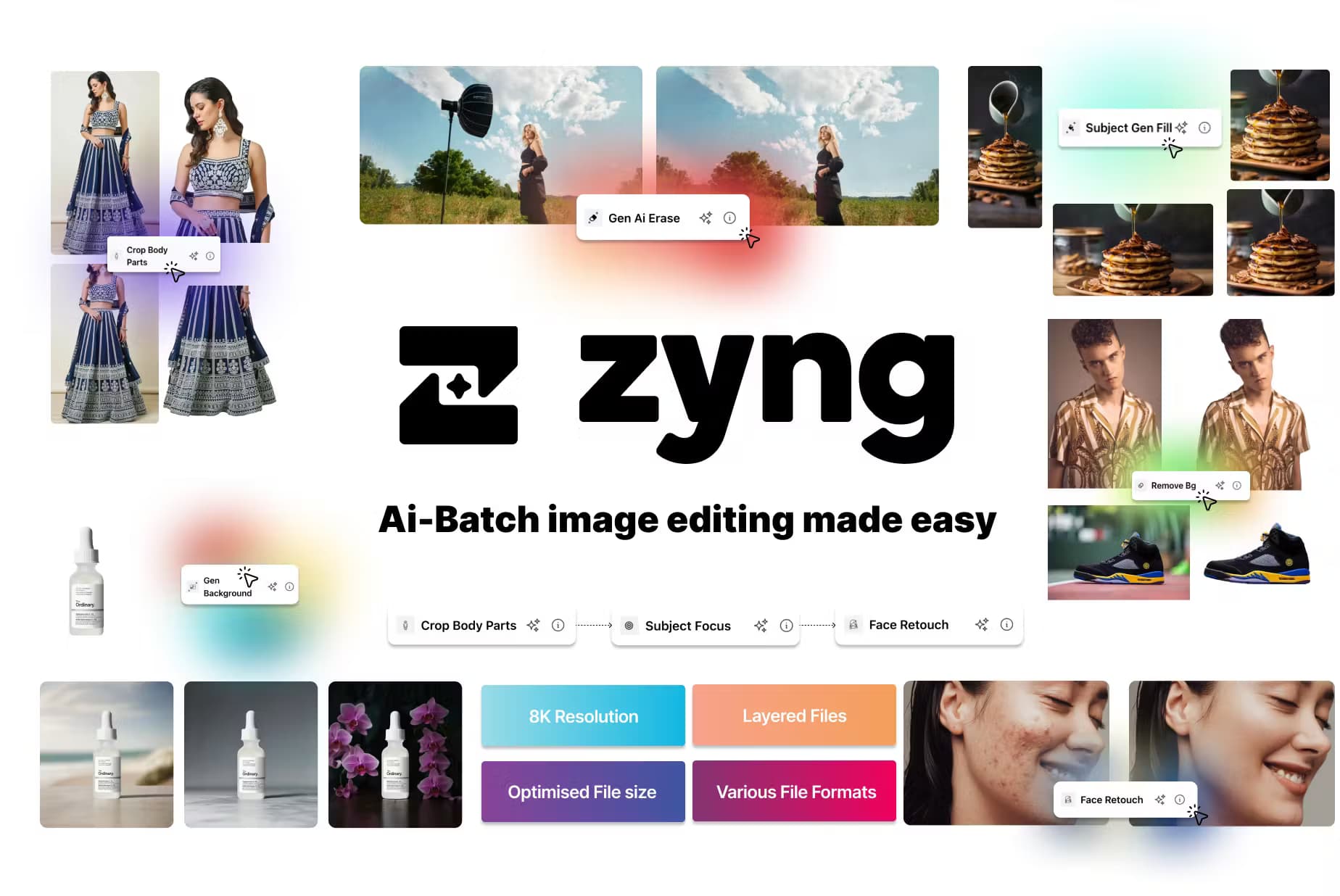
Zyng Ai is an AI bulk image editing platform for commerce teams. It automates background removal, retouching, and virtual try-on across thousands of images.
About Zyng Ai
What Is Zyng Ai
Zyng Ai, shipped as ZYNG OS, is an AI bulk image editing platform built for commerce and fashion companies that produce product imagery at volume. Instead of editing photos one by one, teams feed raw shots into a single pipeline and get channel-ready assets back: cropped, recolored, background-swapped, and prepped in every aspect ratio a marketplace or social channel asks for. The pitch is simple. The bottleneck in catalog work was never creativity. It was operations. Simple as that. That framing is why ecommerce image automation has become a category of its own.
The product grew out of hands-on work with diffusion models for creative agencies starting in 2023. That experience kept surfacing the same wall: at high volume, manual editing multiplies cost, latency, and inconsistency in ways that a growing catalog just can't absorb over a full season. Zyng Ai moved from being an editing tool to what the company calls an image infrastructure layer, adding automated quality control, generated look combinations, and low-latency virtual try-on on top of standard editing, so one pipeline carries a whole catalog all the way to channel-ready output. It's, in short, an attempt to absorb the operational tax that every catalog team pays.
So who is this actually for? The most important limitation is fit. That comparison matters. It's an enterprise platform priced per image credit, not a casual editor for a single product photo. Some capabilities, including visual similarity search and image-to-product search, are still marked coming soon, so you can't count on them yet. The virtual try-on and wardrobe features suit apparel and accessories best; companies outside fashion get less from those pieces.
Getting Started
- Create an account through the Zyng Ai app and pick the resolution tier you need, whether HD, 4K, or 8K.
- Estimate your monthly image volume; pricing drops sharply as your volume rises, so it's worth doing before you commit.
- Upload raw photography in bulk or connect the platform to your existing image links for large catalogs.
- Configure your output specs, including crop rules, margins, aspect ratios, and file formats for each channel.
- Run the pipeline and route flagged assets through quality control before they reach your storefront.
Product Information
A quick look at Zyng Ai's pricing, supported platforms, and performance.
Best for
The users, tasks, and scenarios where this tool fits best.
Users
- Ecommerce and fashion teams
- Marketplace sellers
- Retail brands without a studio budget
- Developers integrating imagery at scale
Tasks
- Bulk background removal and retouching
- Multi-channel resizing
- Virtual try-on and outfit combinations
- Quality control at ingestion
Scenarios
- A fashion catalog with tens of thousands of SKUs that needs consistent imagery before a seasonal launch.
- A marketplace seller prepping a few hundred wildly different products to meet strict listing guidelines.
- A brand wanting fresh outfit combinations on product pages without paying for another round of studio photos.
- A platform team embedding automated quality checks into an existing asset-management system.
Key features
Bulk batch processing
The core of Zyng Ai is volume. You feed in raw photography and the pipeline standardizes, retouches, and exports every asset on its own. The company's own case studies cite catalogs in the tens of thousands of SKUs processed in a single day or a few days. That matters most when a deadline is close and a manual team simply can't scale. Upload once, ship everywhere. For a studio mid-season, that difference is the whole point.
Virtual try-on
Lock one selfie and map any garment onto it, with photoreal results in seconds rather than hours. The try-on engine renders outfits in under about two seconds per batch, which makes it practical for showing a garment on a range of body types or models. No model booking, no studio time. This is the feature most tied to apparel and accessories, so other categories get less from it.
Infinite combinations
The wardrobe matrix mixes and matches garments to create multiple looks from assets you already own, no reshoot needed. A brand can generate thousands of new outfit combinations and push them straight to product pages. It's a cheaper way to enrich a catalog than booking fresh studio time for every pairing. Not bad.
Vision QC at ingestion
Rather than cleaning up problems after the fact, Zyng Ai checks assets on the way in. It flags blur, incorrect cropping, IP infringement, hallucinated text, and missing subjects against rules you configure. Bad assets never ship. You can route flagged images to a re-shoot workflow automatically, so bad assets never reach the storefront.
Smart standardization
Body-aware and margin-aware cropping resizes assets for every channel while keeping the subject framed correctly. The system supports all major aspect ratios and formats, including PNG, JPG, JPEG, WEBP, AVIF, and TIFF. A single base image can become a feed post, a portrait print, and a story format in one pass. Zero rework.
Studio toolkit endpoints
Beyond the automated pipeline, Zyng Ai exposes individual vision endpoints through its API and a sandbox. These cover model swap, subject focus, color shift by SKU, swatch extraction, magic resize with outpainting, and precision cropping for macro shots like shoes or collars. Flip through them and you can see the intent: it's aimed at teams that want granular control rather than one-click automation alone. Fine-grained control rarely comes cheap, and Zyng Ai bundles it with the automated pipeline so you're not choosing one over the other.
API-first integration
The platform is built to plug into existing systems. Server-side processing means you can ingest images via links with no manual file transfers, which is how one case study processed a full catalog without a single human touching a file. The API-first design suits enterprise teams embedding imagery into a larger commerce stack.
Custom-trained vision models
Every capability runs on models and pipelines the company builds and trains itself, tuned for ecommerce and fashion vision. That specialization shows in features like body-aware cropping and garment try-on, which general-purpose editors handle poorly. Teams outside fashion still get solid bulk editing, but the deep work is fashion-specific.
Pros and cons
Pros
- Handles true bulk volume, with case studies citing tens of thousands of SKUs processed in a day.
- Combines editing, resizing, try-on, and quality control in one pipeline instead of four separate tools.
- Volume-based pricing drops steeply as you scale, from $0.063 per image down to $0.016 at the 20K-100K tier.
- Vision QC at ingestion catches problems before assets reach your catalog, not after.
- API-first design and image-link ingestion fit existing enterprise systems without manual file transfers.
Cons
- No free plan, so you pay per image credit from the first upload, which rules out casual testing.
- Visual similarity search and image-to-product search are still coming soon, so don't plan around them yet.
- The strongest features, like virtual try-on and the wardrobe matrix, are fashion-specific and add little for other categories.
- Pricing is credit-based and can be hard to predict; you need a solid volume estimate before committing.
Frequently asked questions
It automates bulk image editing for commerce. You upload product photography and Zyng Ai standardizes, retouches, removes backgrounds, resizes for every channel, and runs quality checks, all in one pipeline. It's built for teams handling thousands of product images rather than one-off edits.
Related content
Explore related tools, skills, and articles for Zyng Ai.
Zyng Ai Alternatives

Google EmbeddingGemma 2
Google DeepMind · Writing · Image · CodingGoogle EmbeddingGemma 2 is a 740M-parameter open model that turns text, code, images, audio, and video frames into vectors in one 768-dimension space, running on phones and laptops.

Tractionwave
TractionWave · Image · MarketingTractionWave is an AI attention heatmap tool for static ads. Upload a PNG or JPG and it returns predicted attention, ranked hotspots, and fixes before you spend budget.

Imejis.io
Imejis.io · Image · MarketingImejis.io is an AI design studio for agents and marketing teams. Describe an image in plain words, and it writes the copy, builds the layout, reflows it to every size, then exports a finished file.