Google's Gemini just got a promotion from answering questions to finishing work. Businesses get it first, and the model picker reaches outside Google on day one.
Google Cloud's Gemini Agent Goes From Answers to Actions
At its Gemini at Work 2026 event on October 8, Google Cloud launched the Gemini Agent, a single interface that takes a request and carries it through to a finished result. The pitch is a shift in what an AI assistant is for: instead of chatting and handing you an answer, it plans the work and does it. Google is starting with businesses and says a consumer rollout comes later.
The scale behind the launch is real. Google CEO Sundar Pichai said Gemini passed a billion monthly active users, and that close to 90% of Fortune 100 companies already use Gemini Enterprise. That corporate base is why Google is testing the agency-heavy version where the money and the risk sit first. Enterprise AI agents are a crowded field now, which pushes Google to prove the setup holds up under real workloads.
Thomas Kurian, who runs Google Cloud, described the core idea in a line worth remembering: the agent can be given "objectives, not just instructions." Hand it a goal and it works out the steps, pulls in tools, and reaches into the systems a company already runs.
What the Gemini Agent Does With an Objective, Not an Instruction
The difference between an instruction and an objective sounds like wordplay until you use it. An instruction is one step. An objective is the whole job.
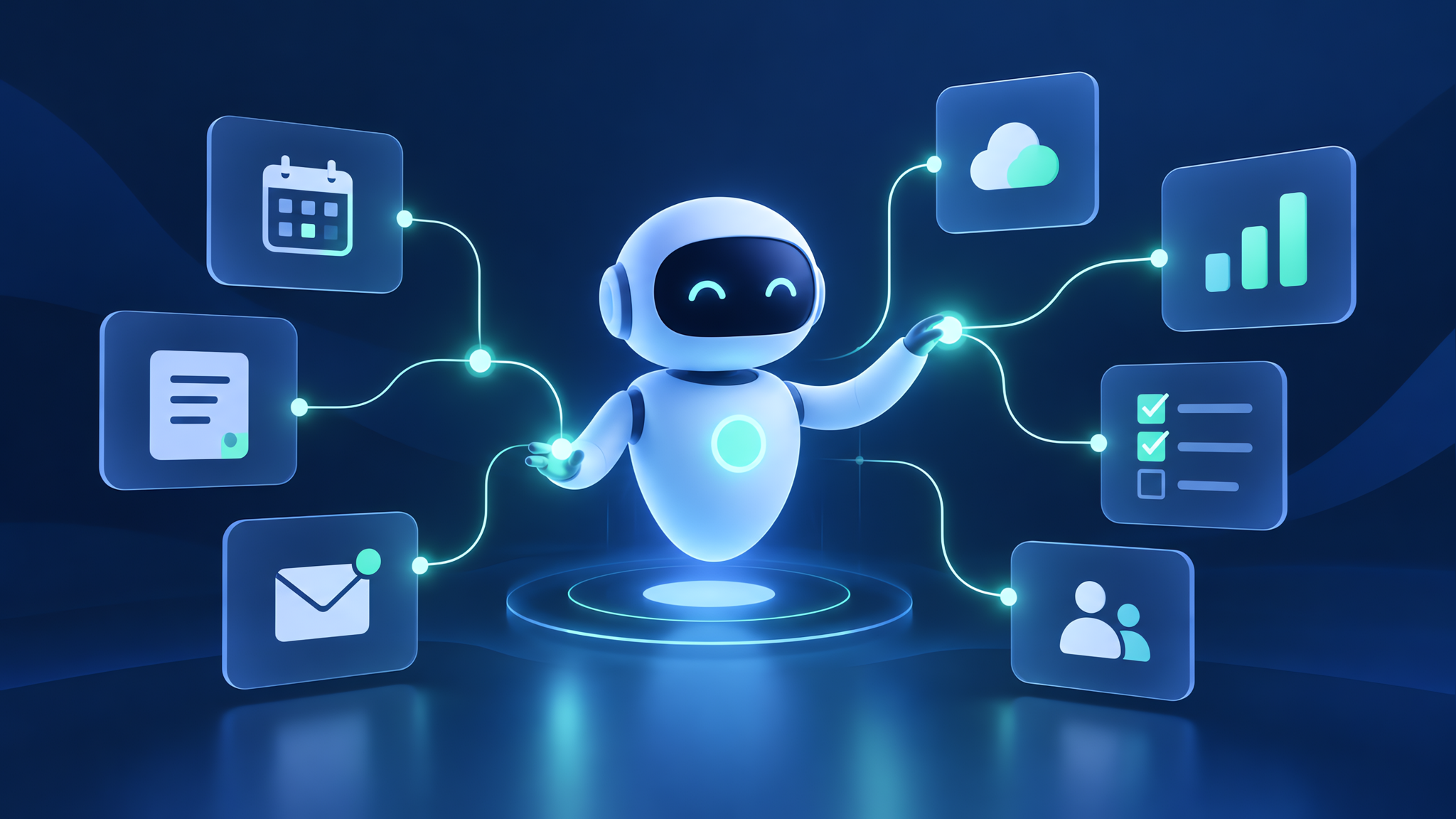
Give the Gemini Agent a goal, and it builds a plan, loads the skills and tools it needs, and connects to a business's internal systems to finish. A request can carry attachments, like files, folders, or a bundle that pairs specific files with specific skills.
The connections matter as much as the reasoning. The agent plugs into Google Workspace, Microsoft 365, Slack, Jira, Git, BigQuery, Databricks, Postgres, and Snowflake. That's most of the modern work stack. It also talks to any Model Context Protocol (MCP) server, the open standard for wiring AI tools into outside data, whether that server sits inside the company's network or beyond it. If your stack already has an MCP bridge, the agent can reach through it.
One detail stands out for anyone who has tried to track an AI assistant mid-task. The agent runs its own "tasks inbox" where you can watch its thinking, see it hand work to subagents, watch skills load, and follow the code and progress. Watching the machine work is the whole point, because you're supposed to trust it to keep going without you hovering. That's a big ask.
Why Gemini Agent Gets Its Own Workspace Account
The design choice that best explains how Google sees the agent isn't a feature. It's an account.
The Gemini Agent has its own Workspace identity, with a separate email address and its own context, as if it were another employee. It knows who's on which team, their time zones, who approves what, and what's on people's calendars. You can tag it, email it, share a doc with it, or drop it into a group chat. When it acts, the audit trail is attributed to the agent, not to a person.
That last part is the quiet one that matters for regulated teams. If an action is logged as the agent's, a company can trace what happened and who asked for it, instead of guessing which employee triggered a change. For finance, legal, and healthcare work, that traceability is often the difference between piloting an agent and banning it.
Google said early testers included sportswear brand On, Shopify, and PayPal, and named large Gemini Enterprise customers like BNP Paribas, Bradesco, Merck, and Ulta Beauty. That's a real roster.
Gemini Agent's Model Picker Opens the Door to Claude and Beyond
An AI agent is only as good as the model under it, and Google isn't insisting it be a Google model.
By default, the Gemini Agent picks the best model for the task on its own. Users can override that choice and pick a model by hand, and the list includes third-party options, starting with Anthropic's Claude models. Google said it plans to widen the picker to open source and other private models down the road.
So why would Google open its own agent to a rival's model? That's a notable concession for a company that competes with Anthropic head-on. Letting enterprise customers route a task to Claude inside Google's own agent front end signals that Google would rather keep the workflow than lock the model. For a business weighing agents, it lowers the risk of betting on one vendor, because the brain can change without ripping out the setup around it.
The model picker also pairs with new spend controls. Google rolled out flexible spending options, including multi-model routing and real-time spend caps, aimed at keeping enterprise AI bills from running away.
Where You Can Run the Gemini Agent
Availability is broad from the start, which fits a work tool that's meant to live where employees already are.
The Gemini Agent works across iOS and Android phones, Windows and Mac desktops, the command line, Google Workspace, Microsoft 365, ServiceNow, and Slack. Cross-platform reach matters here, because an agent that only lives in one app can't follow the work across the tools a team actually uses.
For a business, the sensible first move is a low-stakes workflow with a clear trail: a recurring report, a triage queue, or a research task where you can compare the agent's output against a human's for a week. Watch the tasks inbox, check the audit entries, and see whether the plan holds up when the task doesn't go cleanly. The consumer version is still coming, and Google hasn't said when.