

AdminForth
Devforth · Image · Leaning
AdminForth is an open source Node.js admin panel framework that turns your existing database into a self-hosted back office with Vue 3 screens, 29 plugins and MCP access for agents.
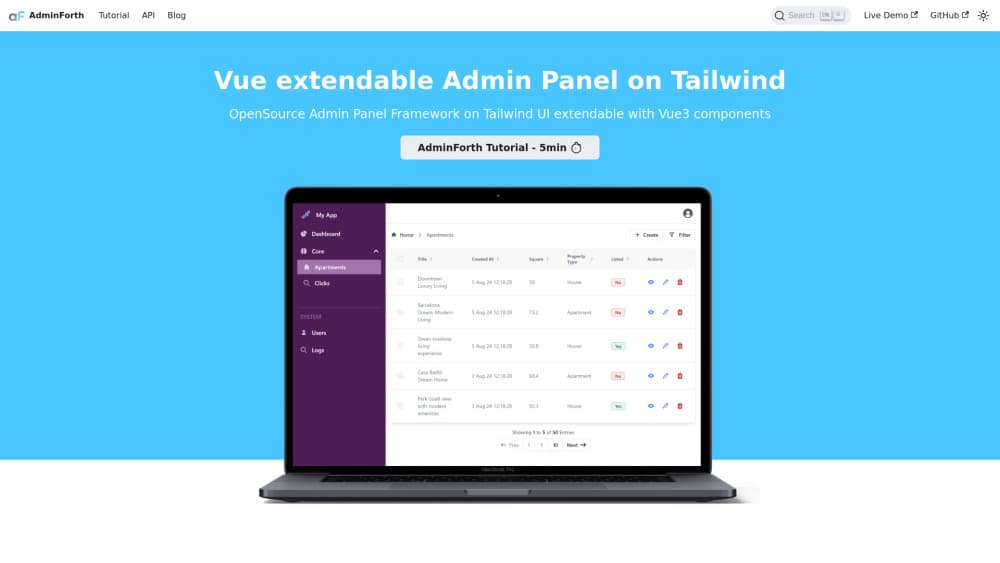
About AdminForth
What Is AdminForth
AdminForth is a framework for turning a database you already run into a working back office. You describe a table as a resource in a config file, and the framework generates list, view, create and edit screens for it. There's no separate admin product to host beside your app, because the panel is an ordinary Node.js app that lives in your own repository.
That last detail matters more than it sounds. Because the panel is plain code, a reviewer can read the diff when someone adds a column or a permission rule. Coding agents can do the same, which is why the generated project ships AGENTS.md, CLAUDE.md, llms.txt and a skills folder out of the box. The company behind it, Devforth, pitches this as an "agent-first" admin panel framework, and the framing holds up in the file layout.
The stack is Node.js with TypeScript on the server and Vue 3 with Tailwind CSS in the browser. It connects to Postgres, MySQL, SQLite or MongoDB and works against the schema you already have, so you don't copy data into a proprietary store. The obvious limit: this is a developer tool. If nobody on the team writes JavaScript, AdminForth won't get you a panel, and a hosted no-code builder will.
Getting Started
- Run
npx adminforth create-appin an empty folder and answer the prompts for your database connection. - Open the generated resource file and declare your first table: columns, types, which fields appear in list and edit views.
- Start the dev server, sign in with the admin account you created, then check that filters, sorting and the edit form behave the way you expect.
- Add plugins for login, uploads, audit history or agent access by installing the npm package and adding a line to the config.
- Deploy the app like any other Node service, behind your own domain and TLS certificate.
Product Information
A quick look at AdminForth's pricing, supported platforms, and performance.
Best for
The users, tasks, and scenarios where this tool fits best.
Users
- Node.js and TypeScript developers
- Small product teams without a platform engineer
- Agencies building internal tools for clients
Tasks
- Replacing spreadsheet workflows
- Standing up CRUD for a Postgres or MySQL schema
- Giving an AI agent scoped write access
- Building internal reporting screens
Scenarios
- Launching a back office for an MVP this week
- Keeping customer data on your own infrastructure
- Handing a finished admin to a non-technical operator
Key features
Declarative Resource Configuration
A resource is a plain object: data source, table name, and a list of columns with flags for required, unique, enum options and which views they show up in. That object is the whole admin panel definition for that table. Because it's ordinary code, it goes through review and version control like everything else in the repo, and an agent can extend it without learning a proprietary DSL.
Existing Schema, No Data Copy
AdminForth points at the database you already run: Postgres, MySQL, SQLite or MongoDB. It reads the schema instead of importing rows into its own storage, so migrations, backups and access policies stay where your team already manages them. The tradeoff is that unusual column types or heavy trigger logic may need a custom field component.
MCP Server for Agent Access
The MCP server plugin turns your resources into tools that Claude Code, Codex, Gemini CLI or any MCP client can call. Each agent gets its own secret, revocable on its own, and every call runs as the user who issued it. Permissions, validation and hooks still apply, so an agent can't quietly do more than the person it acts for.
Authentication and Access Control
Sign-in, roles and permissions ship with the framework. On top you can add OAuth2 and OpenID SSO for Google, GitHub, Microsoft, Keycloak or a custom provider, TOTP and passkey two-factor auth, session revocation per device, captcha and password reset flows. All of it arrives as npm plugins with a line of config each.
29 Plugins as npm Packages
The plugin catalogue covers the chores that usually eat a week: CSV and XLSX import and export, S3 uploads, rich text and Markdown editors, many-to-many fields, background jobs that survive a restart, bulk AI fills, dashboards, LLM translation of the interface. Each is a separate package, so you install only what the project needs.
Custom Pages and Vue 3 Components
When config runs out, you write Vue 3 components and mount them as pages, dashboard widgets or column renderers. Any npm package works inside them, and Tailwind keeps the styling consistent with the built-in screens. This is where an admin dashboard builder stops being a template and starts being your product's internal tool.
Pros and cons
Pros
- Free and open source under MIT, with no paid tier holding features back.
- The panel is a normal Node.js app in your repo, so changes show up as reviewable diffs.
- Works on top of an existing database without copying or reshaping your data.
- Auth, 2FA, SSO, audit log and uploads are plugins rather than custom work.
- The MCP server gives agents real access with per-agent secrets and the same permission rules.
Cons
- You need JavaScript and TypeScript skills. There's no drag-and-drop builder for non-developers.
- Anything past config-level theming means writing Vue 3 code yourself.
- Self-hosting puts deployment, backups and upgrades on your team, and there's no vendor to call.
- Record-level rules beyond the built-in permissions require hooks you maintain.
Frequently asked questions
Yes. The framework is MIT licensed, self-hosted and has no paid edition. You pay for your own server and, if you use the AI plugins, for the model calls your provider bills.
Related content
Explore related tools, skills, and articles for AdminForth.
AdminForth Alternatives

Tractionwave
TractionWave · Image · MarketingTractionWave is an AI attention heatmap tool for static ads. Upload a PNG or JPG and it returns predicted attention, ranked hotspots, and fixes before you spend budget.

Imejis.io
Imejis.io · Image · MarketingImejis.io is an AI design studio for agents and marketing teams. Describe an image in plain words, and it writes the copy, builds the layout, reflows it to every size, then exports a finished file.

Layoutr
Van Dijk Ontwikkeling · Image · China AILayoutr is a browser floor plan tool that scales your own plan, places furniture at true size, shows the room in 3D and renders it with AI.