

Agentmemory
rohitg00 · Coding
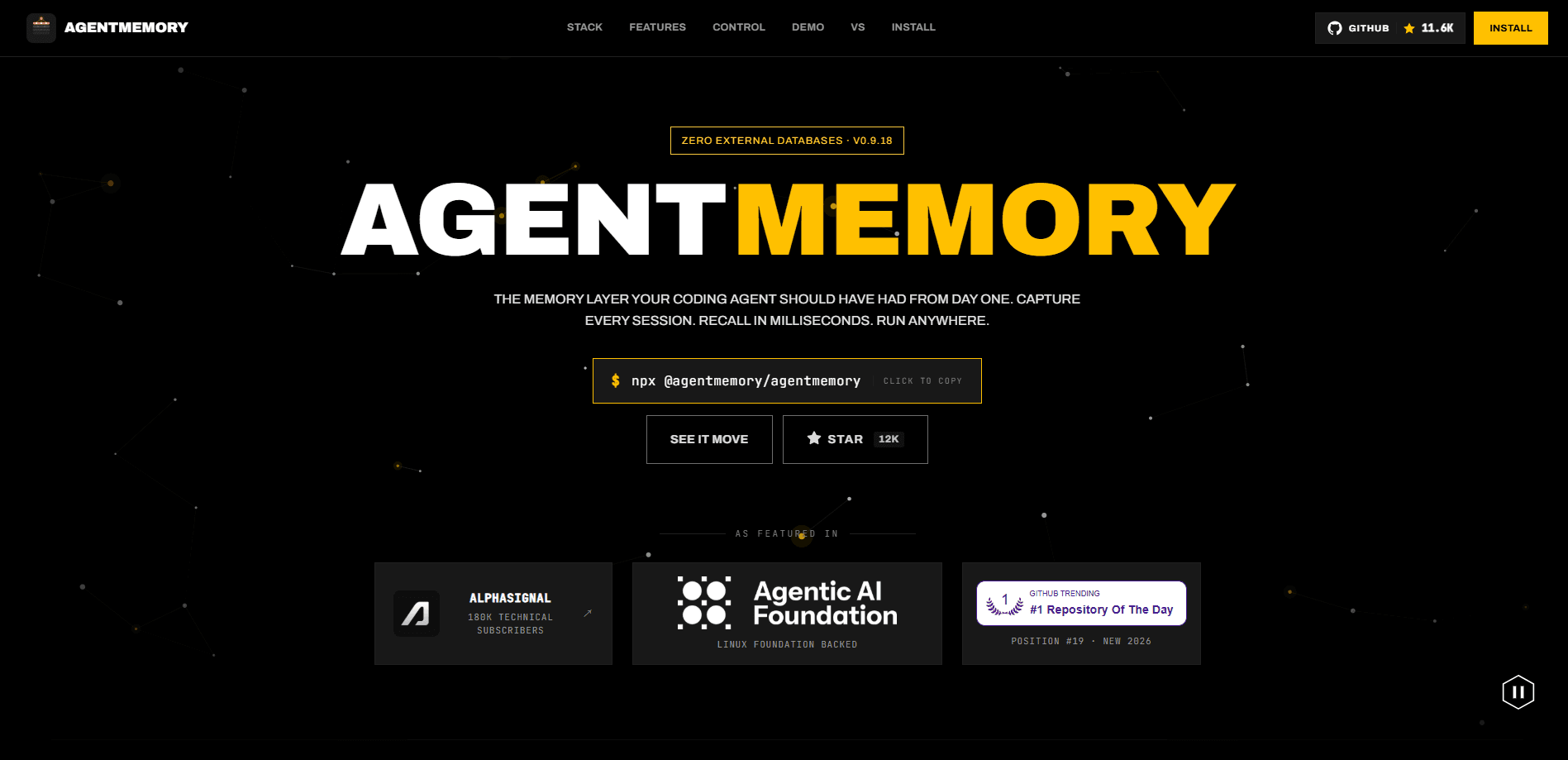
Agentmemory is a local-first memory runtime that gives your AI coding agent a memory surviving past the end of a session. Think persistent memory for coding agents, minus the cloud. It captures what the agent does through hooks, distills raw logs into durable memories, and recalls the right context in milliseconds. Everything runs on your machine. No external database, vector store, or queue has to sit between your code and the agent working on it.
About Agentmemory
What Is Agentmemory
Agentmemory is a memory layer for AI coding agents, built for developers who are tired of re-explaining the same project to a fresh session every morning. It watches what the agent does, turns those observations into typed memories, and hands the relevant ones back when the next task starts. Think of it as the long-term memory your coding agent never shipped with.
The project is open source and local-first. Your agent's observations, memories, lessons, and graph data stay in one runtime on your own hardware. No account to create. No cloud vector store to pay for. No external database to keep alive.
The biggest limitation is scope. This is a developer tool, not a plug-and-play product for a casual chat user. It assumes you're wiring up your own agent workflow. Capture and recall work without an LLM key, but compression, summarization, consolidation, and graph extraction only switch on once you connect your own LLM provider key.
Getting Started
- Install the runtime with
npx @agentmemory/agentmemory, or install it globally through npm and runagentmemory. - Start the process. It brings up the engine, the REST API on port 3111, and a viewer on port 3113 in one shot.
- Wire your agent with
npx @agentmemory/agentmemory connect, which detects agents on your machine and writes the right hooks or MCP config for each one. - Restart the agent or open a fresh session so it picks up the new wiring.
- Run a prompt to generate memory, then search it or open the viewer to watch observations arrive live.
Product Information
A quick look at Agentmemory's pricing, supported platforms, and performance.
Best for
The users, tasks, and scenarios where this tool fits best.
Users
- Solo developers running Claude Code, Codex, or Cursor
- Small teams sharing one codebase
- Privacy-conscious builders
Tasks
- Resuming a long project after a break
- Debugging recurring issues
- Onboarding an agent to an existing codebase
Scenarios
- Picking up yesterday's work in a new chat
- Switching tools mid-project
- Cutting token spend on repeated context
Key features
Hook-Based Auto Capture
Agentmemory wires twelve auto-capture hooks into your coding agent. Every session start, prompt, tool call, and stop lands in the memory pipeline without glue code. Each event becomes a compressed observation stamped with its origin and the agent that produced it. Install the plugin and capture begins. That's it.
Hybrid Recall That Stays Fast
Agent memory recall here isn't one lookup. The primary recall path ranks BM25, vector, and knowledge graph scores together, then reranks on device. That knowledge graph retrieval angle is what catches both exact keyword matches and meaning-based ones. A plain vector store often misses the second kind. Superseded versions stay out of results while their history stays queryable.
Automatic Consolidation
Once you supply an LLM provider key, consolidation runs at session stop. Raw observations compress into semantic memories, duplicates merge, stale rows decay with retention scoring, and audit rows record the whole sweep. This is what keeps the store from turning into an unsearchable pile of logs.
Native MCP Surface and REST Twins
This is a full MCP memory server, not a thin wrapper. Fifty-four MCP tools cover saving, recall, smart search, sessions, governance, audit, and export behind a single server. Every one has a REST twin under /agentmemory/*, so you can curl it, fetch it from a browser, or proxy it from your own agent. Saving a near-duplicate returns a similarTo hint instead of a second copy.
Knowledge Graph and Provenance
With an LLM key set and graph extraction enabled, entities and relations extract from observations, including temporal edges. Every record carries write-time provenance, so you can tell whether a memory came from the user, the agent, a tool, an import, or a shared source.
Lessons and JSONL Replay
Lessons live in a dedicated BM25 index with confidence and recency reranking, so a rule you save once comes back when it's relevant. Point the runtime at a Claude Code JSONL transcript and it rehydrates the session, indexes it, and derives crystals and lessons from what it finds.
Built-In Viewer
A local viewer on port 3113 lets you watch observations arrive in real time and inspect the graph your agent has built. It's the quickest way to confirm capture, indexing, and recall are all working before you trust the store with real project memory.
Pros and cons
Pros
- Zero external databases means nothing extra to run, patch, or pay for alongside your agent.
- Local-first design keeps all memory on your own machine, which is a real win for private codebases.
- Hybrid recall works without an LLM key, so you can try it before attaching a provider.
- Fifty-four MCP tools plus REST twins give it a wide surface for custom workflows.
- Shared memory across different agents lets you switch tools without losing project context.
Cons
- It's an early-stage developer tool, so expect rough edges and a smaller community than mature memory services.
- Consolidation, summarization, and graph extraction stay off until you connect your own LLM provider key, which adds setup and cost.
- The CLI-and-config workflow assumes comfort with a terminal, so non-technical users will find it hard going.
Frequently asked questions
It stores five kinds of records: raw observations from hooks, durable typed memories with version chains, short lessons, frozen session crystals, and a knowledge graph of entities and relations. Memories and lessons are the parts you'll query most.
Related content
Explore related tools, skills, and articles for Agentmemory.
Agentmemory Alternatives
Forefront
Forefront · CodingForefront is a web platform for building with open-source AI. It lets you fine-tune leading open-source language models on your own data, evaluate how they perform, and run them through an API or export them to host yourself. Developers who want the convenience of a closed-source platform but insist on owning their models and data are the target audience here.

Startkit
StartKit.AI · CodingStartkit is a boilerplate for building AI SaaS and AI wrapper products. Think of it as an AI startup boilerplate with the boring parts already wired up: authentication, Stripe and Lemon Squeezy payments, usage limits, transactional email, and an AI API starter that talks to OpenAI, Anthropic, Groq, or Llama. You clone the repo, set your price, and start on the part of your product that people actually pay for. It's Next.js under React and Tailwind, so most of the boilerplate code already feels familiar.
Testim
Tricentis · CodingTestim is an AI-powered test automation platform for building and running end-to-end tests across web, mobile, and Salesforce applications. It leans on machine learning to keep tests stable when an interface changes, so teams spend less time fixing broken selectors. Not bad for an automated testing tool you can start using today. You create tests by recording actions in a browser, then optionally add JavaScript when you need more control. It's a solid pick for busy QA teams.