

Agent Memory System
RAVBYTE TECHNOLOGIES PRIVATE LIMITED · Coding
Agent Memory System is an open-source memory layer that gives every repository in a workspace a durable, readable record of project context, execution history, and handoffs. Run one command and it scans your folders for manifests, routes, APIs, configs, and tests, then writes Markdown and JSON indexes that Codex, Claude, Cursor, and other coding agents can read. It's built for developers who are tired of re-explaining their codebase to a fresh assistant every time a session ends. Sound familiar?
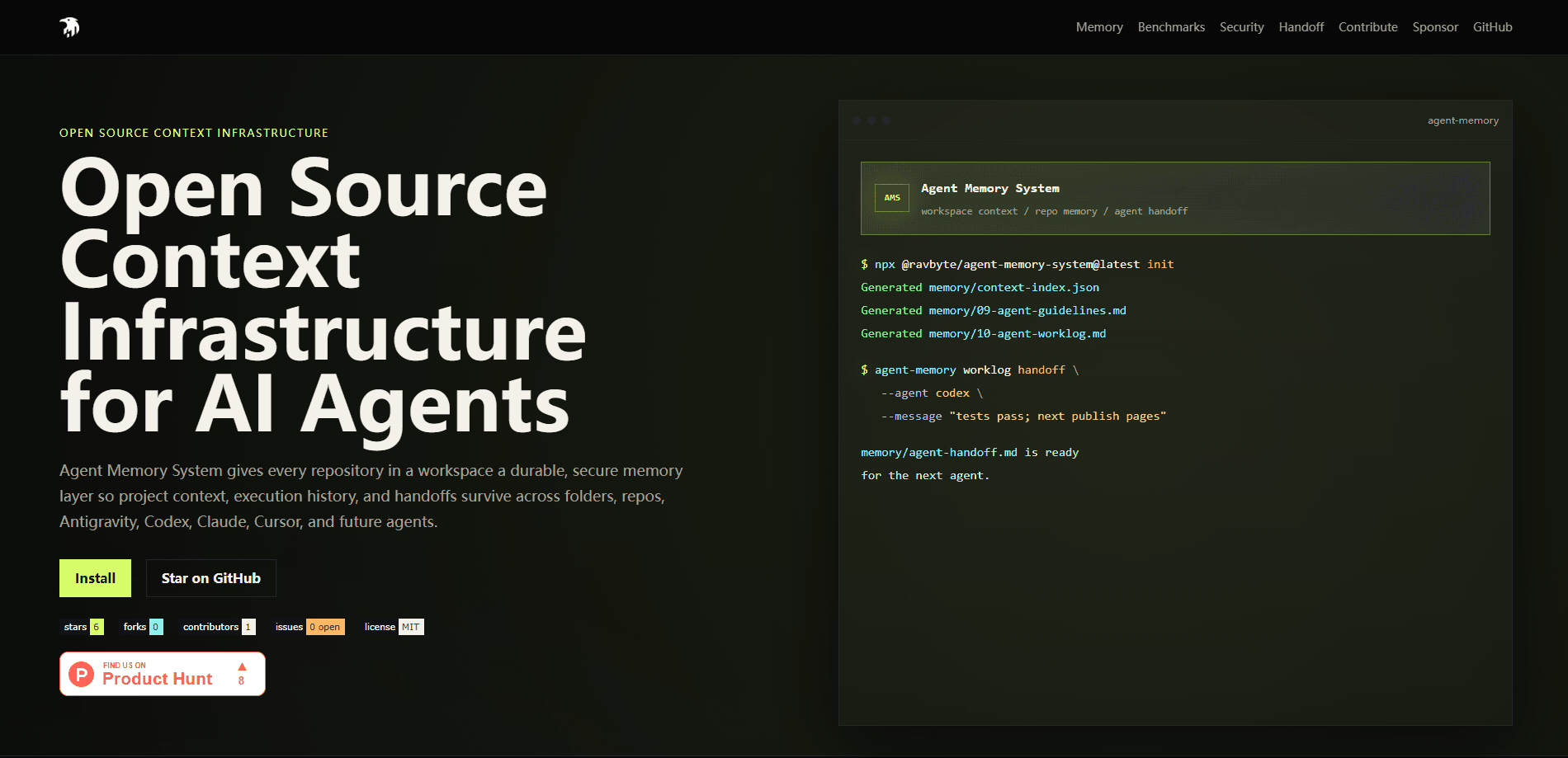
About Agent Memory System
What Is Agent Memory System
Agent Memory System (AMS) is context infrastructure for AI coding agents. Instead of letting an agent rediscover your project from scratch each session, it maps the workspace once and keeps that map in files the agent already knows how to open. The maintained version lives on npm as @ravbyte/agent-memory-system and is owned by RAVBYTE TECHNOLOGIES PRIVATE LIMITED.
The problem it solves is continuity. A single repo often spans many folders, and a workspace can hold several repos at once. Switching between Antigravity, Codex, Claude, or Cursor usually means losing whatever the last assistant understood. AMS writes that understanding down. The next agent starts informed rather than blank.
The main limit is that it's a CLI tool, not a hosted service. There's no dashboard and no account, so setup happens in your terminal and upkeep depends on running the maintain command when your code shifts. You'll also need Node.js available, since installation goes through npx.
Getting Started
- Open a terminal in the workspace you want mapped and run
npx @ravbyte/agent-memory-system@latest init. - Let the scanner walk your folders; it detects manifests, routes, APIs, configs, tests, storage hints, and generated directories.
- Review the generated
memory/folder, which holds a context index plus Markdown files for guidelines and worklogs. - Hand work to the next agent with
agent-memory worklog handoff --agent codex --message "tests pass; next publish pages". - Keep the memory current by running
agent-memory maintain --since mainafter structural Git changes.
Product Information
A quick look at Agent Memory System's pricing, supported platforms, and performance.
Best for
The users, tasks, and scenarios where this tool fits best.
Users
- Solo developers juggling several side projects
- Teams handing work between people and assistants
- Engineers testing multiple coding agents
Tasks
- Onboarding a new AI agent onto a large codebase
- Tracking what changed after a refactor
- Finding the blast radius of an API change
Scenarios
- Resuming a project after a two-week break
- Passing a half-finished task to a different agent overnight
- Running a security-conscious repo
Key features
Repository scanning
A single command maps every repo in a workspace. The scanner reads manifests, routes, APIs, configs, tests, storage hints, and documentation, then writes Markdown alongside a JSON topic index. The output is plain text, so any agent with file access can use it without a plugin.
Git-aware auto upkeep
Memory drifts when code moves, and AMS tries to prevent that. Running agent-memory maintain --since main detects structural changes in Git, refreshes the memory folder, and validates the result. The point is to stop outdated context from quietly showing up in a code review. Not ideal otherwise.
Cross-agent handoffs
The worklog command lets one agent leave a note for the next. You can tag the recipient, pass a short message, and the tool writes a handoff file the following assistant reads on startup. Claude context and Cursor agent memory both persist this way. Switching agents stops feeling like starting over.
Dependency graph intelligence
Built-in static analysis maps dependencies and architectural layers. Agents query the graph to find out which files break if an API changes, which turns a guessing game into a lookup. The project advertises O(1) graph queries and zero missing imports. Handy for big repos.
Secret-aware memory
Memory files should explain a system, not expose credentials. AMS records the names of environment variables, blocks obvious secret patterns, avoids generated and vendor directories, and labels inferred content so agents know what was guessed versus confirmed. Review the folder before you commit it.
Open benchmark tooling
An open-source benchmark tool compares cold-start agent workflows against AMS-guided runs across repository understanding, debugging, recovery, and multi-agent continuity. The maintainers are upfront that current numbers are their own measurements and still need independent reproduction. Good to know before you quote them.
Pros and cons
Pros
- Free and MIT licensed, so there's no pricing tier to weigh and you can read the source.
- Memory lives in plain Markdown and JSON, which means it's portable and works across Codex, Claude, Cursor, and Antigravity.
- Git-aware maintenance keeps the index close to the real state of the code instead of a snapshot from months ago.
- Security defaults block obvious secrets and skip vendor paths, which matters for shared repos.
Cons
- No hosted service or dashboard means upkeep is a command you have to remember to run.
- Benchmark results are maintainer-run and not independently verified yet, so treat the performance claims as provisional.
- You need Node.js set up, which adds a step for teams working purely in Python or Go environments.
Frequently asked questions
It scans your repositories into durable Markdown and JSON indexes that give AI coding agents a shared record of project context, history, and handoffs. Think of it as a notebook your agents read from instead of rediscovering your code every session.
Related content
Explore related tools, skills, and articles for Agent Memory System.
Agent Memory System Alternatives
Forefront
Forefront · CodingForefront is a web platform for building with open-source AI. It lets you fine-tune leading open-source language models on your own data, evaluate how they perform, and run them through an API or export them to host yourself. Developers who want the convenience of a closed-source platform but insist on owning their models and data are the target audience here.

Startkit
StartKit.AI · CodingStartkit is a boilerplate for building AI SaaS and AI wrapper products. Think of it as an AI startup boilerplate with the boring parts already wired up: authentication, Stripe and Lemon Squeezy payments, usage limits, transactional email, and an AI API starter that talks to OpenAI, Anthropic, Groq, or Llama. You clone the repo, set your price, and start on the part of your product that people actually pay for. It's Next.js under React and Tailwind, so most of the boilerplate code already feels familiar.
Testim
Tricentis · CodingTestim is an AI-powered test automation platform for building and running end-to-end tests across web, mobile, and Salesforce applications. It leans on machine learning to keep tests stable when an interface changes, so teams spend less time fixing broken selectors. Not bad for an automated testing tool you can start using today. You create tests by recording actions in a browser, then optionally add JavaScript when you need more control. It's a solid pick for busy QA teams.