

AgentReady
AgentReady · Coding · Business
AgentReady is a developer toolkit that prepares websites and text for AI consumption. It packs seven API endpoints, led by TokenCut, a prompt compression service built for token cost reduction. It trims 40-60% of tokens before a request ever reaches GPT-4, Claude, or Gemini. The service also turns a webpage into clean Markdown, generates AI-friendly sitemaps, audits how readable a site is to language models, and validates structured data. That makes AI-ready content out of pages that were never built for it. It suits developers wiring RAG pipelines and agents together, and it runs free while in open beta.
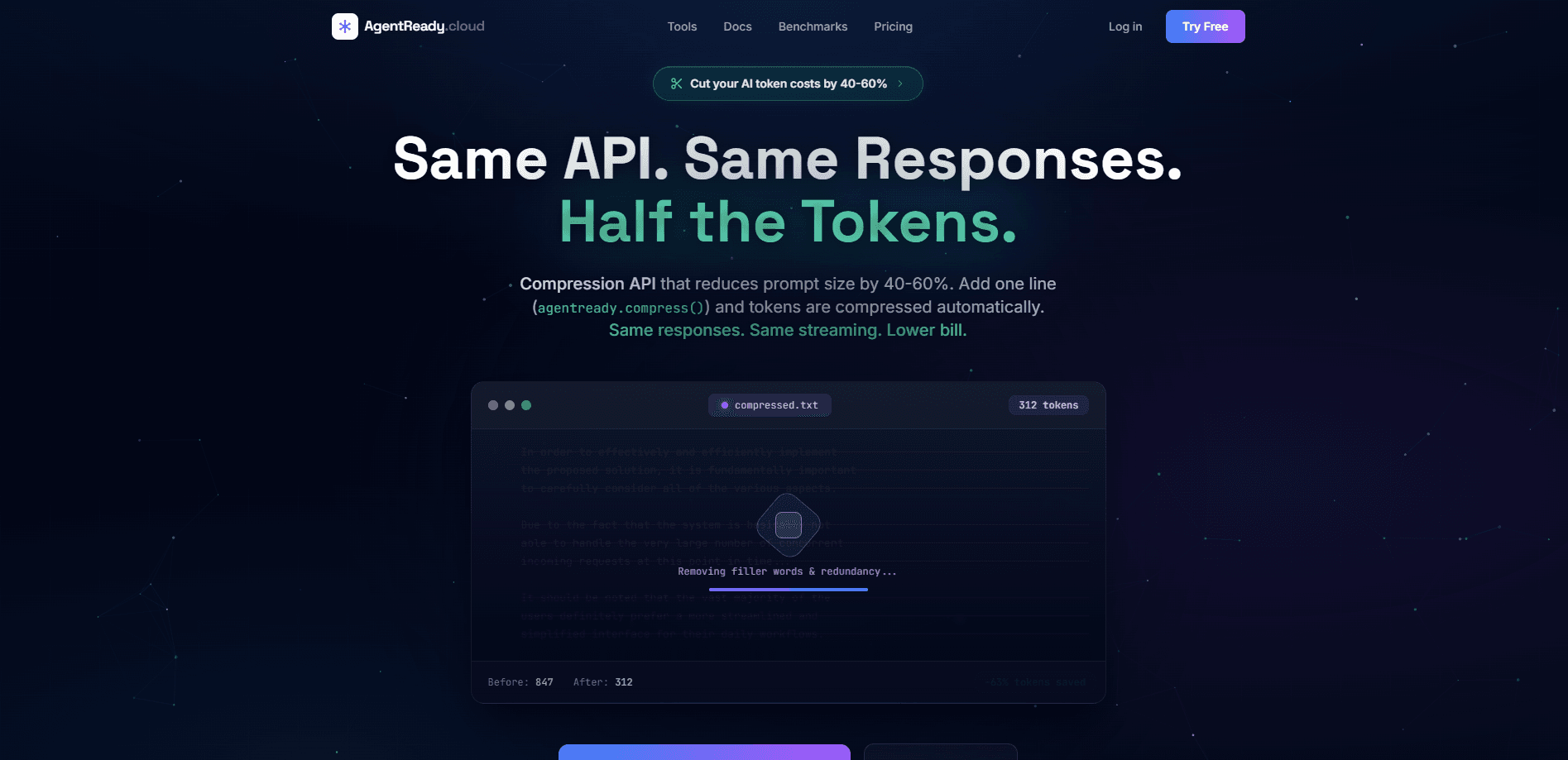
About AgentReady
What Is AgentReady
AgentReady is a compression and content-prep layer that sits between your app and whatever large language model you call. The pitch is simple: most of what you send to an LLM is noise. Navigation bars, ads, scripts, and styling can make up more than 90% of a webpage's HTML, and verbose prompts carry filler the model never needs. Cutting that stuff before the request goes out shrinks your bill.
The team behind it says it started in 2024, after building agents that kept hitting token limits and cost ceilings. What began as an internal converter turned into a public API, and the site now claims it powers thousands of pipelines, from solo RAG developers to teams processing millions of pages a day.
The main limit to know: AgentReady doesn't replace your LLM. It compresses input and hands it back, so you still call OpenAI or Anthropic directly with your own key. That's a privacy plus. Your provider key never touches AgentReady servers. But it does mean you're managing two integrations instead of one. It also only shrinks input tokens, so long model outputs won't get any cheaper.
Getting Started
- Sign up and create an API key in the dashboard. Free accounts start with 100 credits, and keys begin with
ak_. - Install the SDK with
pip install agentready-sdkor usenpx agentready-sdk initfor Node projects. - Call
agentready.compress()on your text or use the MD Converter endpoint on a URL to get clean Markdown back. - Send the compressed result to your LLM provider as usual. Your provider key stays on your machine.
- Check the benchmarks page or LLMO Auditor to see how much you saved and how readable your content is.
Product Information
A quick look at AgentReady's pricing, supported platforms, and performance.
Best for
The users, tasks, and scenarios where this tool fits best.
Users
- Solo RAG developers
- AI agent builders
- SEO and content teams
Tasks
- Compressing long prompts
- Scraping pages for a knowledge base
- Building an AI-readable sitemap
- Auditing AI readiness
Scenarios
- Running a chatbot on a fixed budget
- Feeding a support agent live docs
- Shipping a product with AI search in mind
Key features
TokenCut Compression
TokenCut is the flagship tool. It removes filler words, simplifies wordy constructions, and normalizes whitespace while keeping semantic meaning, code blocks, URLs, and numbers intact. You pick a level: light for whitespace only, standard for filler removal, and aggressive for stop-word pruning that saves the most but risks losing nuance. According to AgentReady, standard compression shows a 0.4% average accuracy delta in its own benchmarks, which is the kind of number worth testing yourself before you trust it in production.
Webpage to Markdown Converter
This endpoint works as a webpage to Markdown API. It turns any URL into clean, LLM-ready Markdown. Navigation bars, ads, and clutter get dropped automatically. You can also strip comment sections, keep image references, pull metadata, and auto-generate a table of contents. A batch endpoint handles up to 20 URLs at once, one credit each. That suits teams building knowledge bases instead of scraping pages one at a time.
AI-Friendly Sitemap Generator
Agents don't read sitemaps the way humans or classic crawlers do. This tool crawls a domain and builds a sitemap shaped for AI consumption, so an agent can find your important pages without wading through a directory tree built for search engines.
LLMO Auditor
The LLMO Auditor scores how well a page can be parsed and understood by a language model. It flags the things that trip models up, such as heavy scripting, thin text, or ambiguous structure, so you can fix content before an AI assistant misreads it. For anyone chasing AI search visibility, this is the closest thing to a diagnostic tool.
Structured Data and Robots.txt Tools
Two smaller endpoints round out the set. The Structured Data Validator checks schema markup for problems that break machine reading, and the Robots.txt Analyzer shows whether your crawler rules are blocking the AI agents you actually want to show up. Both are quick checks that catch issues before they cost you visibility.
Open API and SDKs
Everything runs through a documented REST API at /api/v1/, with Python, Node.js, and MCP SDKs plus a Chrome extension. It's OpenAI-compatible in the sense that you compress, then call your usual model endpoint with the result. Overhead is roughly 5ms per compression call. Latency isn't the tradeoff you're making.
Pros and cons
Pros
- Cuts LLM input token costs by a reported 40-60% with a single API call, no proxy in the path.
- Keeps your LLM provider key on your own machine, which sidesteps a common privacy worry.
- Seven tools in one API, covering compression, scraping, sitemaps, auditing, and validation.
- Free with no usage caps during open beta, and SDKs exist for Python, Node.js, and MCP.
- Roughly 5ms overhead keeps compression from slowing down live requests.
Cons
- It only shrinks input tokens, so long model responses stay just as expensive.
- The beta pricing is temporary. AgentReady hasn't confirmed what paid plans will cost once it ends, so budget accordingly.
- You still wire up your own LLM provider separately, which means two integrations to maintain.
- Accuracy tradeoffs on the aggressive compression level aren't fully documented yet, so heavy pruning needs your own testing.
Frequently asked questions
It's an API toolkit that makes text and websites easier for large language models to process. Its main job is LLM token compression: shrinking prompts so they cost less to run. It also converts pages to Markdown, builds sitemaps, and audits AI readiness.
Related content
Explore related tools, skills, and articles for AgentReady.
AgentReady Alternatives
Forefront
Forefront · CodingForefront is a web platform for building with open-source AI. It lets you fine-tune leading open-source language models on your own data, evaluate how they perform, and run them through an API or export them to host yourself. Developers who want the convenience of a closed-source platform but insist on owning their models and data are the target audience here.

Startkit
StartKit.AI · CodingStartkit is a boilerplate for building AI SaaS and AI wrapper products. Think of it as an AI startup boilerplate with the boring parts already wired up: authentication, Stripe and Lemon Squeezy payments, usage limits, transactional email, and an AI API starter that talks to OpenAI, Anthropic, Groq, or Llama. You clone the repo, set your price, and start on the part of your product that people actually pay for. It's Next.js under React and Tailwind, so most of the boilerplate code already feels familiar.
Testim
Tricentis · CodingTestim is an AI-powered test automation platform for building and running end-to-end tests across web, mobile, and Salesforce applications. It leans on machine learning to keep tests stable when an interface changes, so teams spend less time fixing broken selectors. Not bad for an automated testing tool you can start using today. You create tests by recording actions in a browser, then optionally add JavaScript when you need more control. It's a solid pick for busy QA teams.