

Airweave
Airweave · Coding
Airweave is an open-source context retrieval layer that gives AI agents a single search interface across apps, databases, and documents, with real-time sync and no custom pipelines.
About Airweave
What Is Airweave
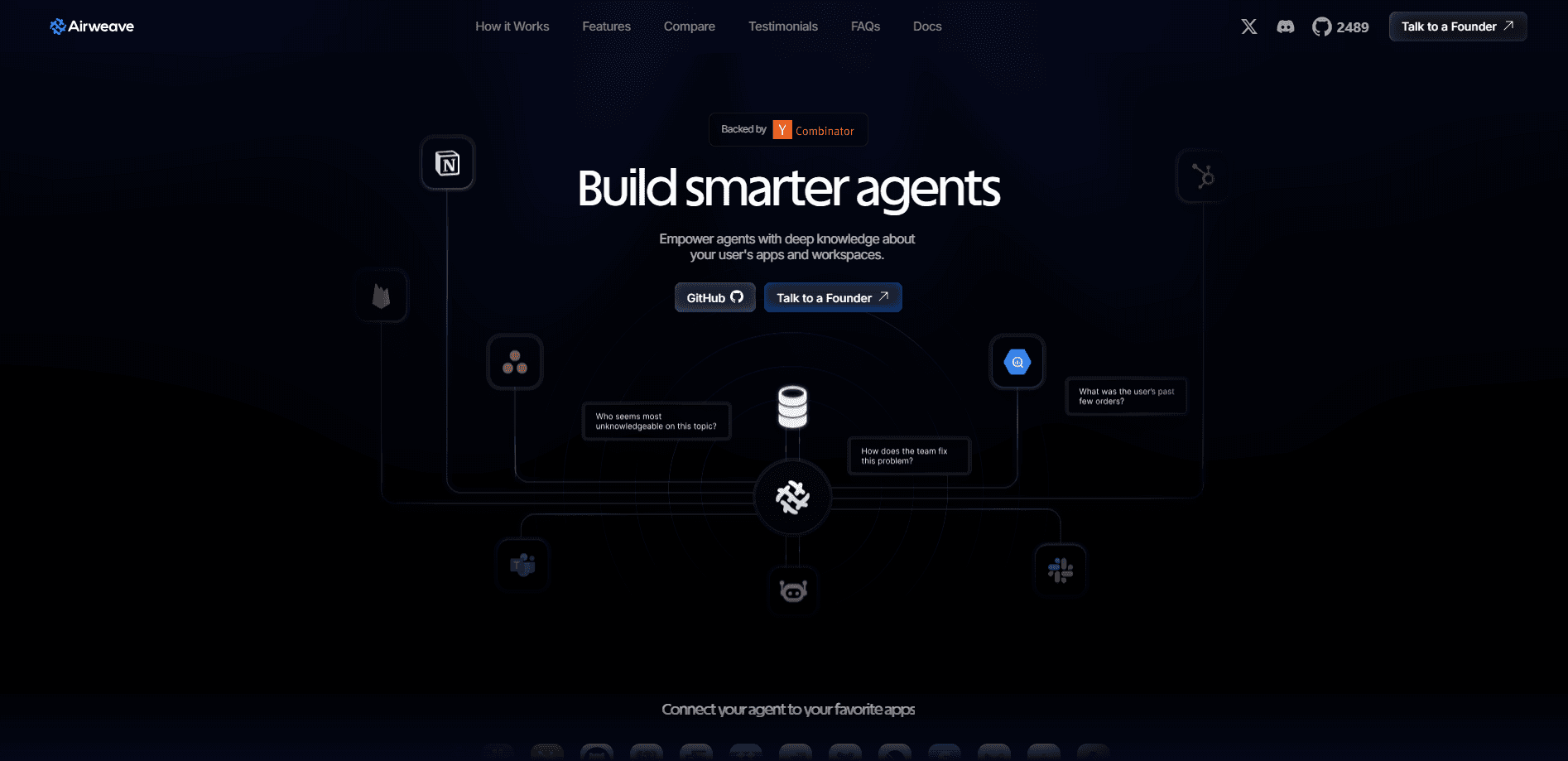
Airweave is a context retrieval layer that sits between your data sources and your AI systems. You connect the apps, databases, and document stores you already use, and Airweave syncs their content into a searchable collection. Your agent then asks one question in plain language and gets grounded answers from every connected source at once.
The problem it targets is familiar to anyone shipping agents. Enterprise data is scattered across Slack, Notion, GitHub, Salesforce, Google Drive, and a dozen other tools, and each one speaks its own API. Teams end up rebuilding the same fragile retrieval pipeline for every new agent. Airweave does that work once and exposes it as shared infrastructure.
The main thing to weigh is scope. Airweave is built for developers and teams wiring retrieval into an agent or a RAG pipeline, not for someone who wants a ready-made chatbot. You need some developer comfort to get value from it, although the hosted platform and SDKs shorten that path.
Getting Started
- Create an account on the hosted platform, or clone the repository and run
./start.shto self-host on macOS, Linux, or WSL. - Install the SDK (
pip install airweave-sdkfor Python ornpm install @airweave/sdkfor Node.js) and paste in your API key. - Create a collection, which is the searchable knowledge base your agent will query.
- Add source connections to the collection. Pick a connector, authenticate with your credentials, and let Airweave sync the data.
- Query the collection through the SDK, REST API, or MCP and feed the results into your agent.
Product Information
A quick look at Airweave's pricing, supported platforms, and performance.
Best for
The users, tasks, and scenarios where this tool fits best.
Users
- Developers building AI agents
- Backend and platform engineers at startups
- Data and ML teams running RAG systems
- Teams that need self-hosting
Tasks
- Searching across many tools at once
- Retrieving current context on demand
- Feeding an agent stack
- Filtering results by source or time
Scenarios
- An internal knowledge assistant that answers policy questions
- A customer support agent that needs account history
- A multi-source research agent
Key features
Unified Search Across Sources
A single query searches every connected app, database, and document at once, which is the unified search for AI that most agent teams are missing. The agent gets relevant results no matter where the data lives, so a team stops wiring a connector per source.
Three Search Tiers
Airweave offers instant, classic, and agentic search. Instant runs a direct vector search in about half a second, classic has an LLM build an optimized strategy in about two seconds, and agentic sends an agent to navigate the collection for the best recall.
Real-Time Data Sync
Connected sources sync continuously, so the agent always sees current information. There are no stale snapshots and no manual refresh step to remember.
Prebuilt Connectors
A growing catalog of data source connectors covers more than 50 sources, from Slack, Notion, and GitHub to Salesforce, Google Drive, and Airtable. You configure a source once and Airweave handles authentication and sync.
Semantic, Keyword, and Hybrid Retrieval
Instant search lets you pick how the vector search API matches results. Hybrid blends semantic and keyword search for most queries, semantic finds content with similar meaning, and keyword uses BM25 when you need an exact term like an error code.
Developer SDKs and MCP
Official Python and Node.js SDKs, a REST API, and an MCP server cover most stacks. The company says you can go from install to first answer in about five minutes.
Open Source and Self-Hosting
The core is open source and can be self-hosted alongside the hosted service. Teams keep control over how data is synced, accessed, and served to AI systems.
Filters, Metadata, and Hierarchy
Search filters constrain results by source, entity type, or date, and agents can walk parent, child, and sibling relationships. That turns a flat search into something closer to navigating a real knowledge base.
Pros and cons
Pros
- Connects 50+ data sources through one interface, so agents stop needing a custom pipeline each
- Three search tiers let you trade latency for recall depending on the job
- Real-time sync keeps answers current instead of relying on static embeddings
- Open source with a self-hosting path, which suits teams with strict data rules
- Python and Node.js SDKs, REST API, and MCP fit most agent frameworks
Cons
- Geared to developers, so non-technical users will find the setup unfamiliar
- Free plan caps usage at 50 queries and 50K entities per month, which runs out fast on busy agents
- The connector set keeps growing, so you should confirm your specific source is supported before you commit
Frequently asked questions
Airweave gives AI agents one place for AI agent search across many apps and databases. Typical uses include internal knowledge assistants, customer support agents, and RAG systems that need current, source-grounded information.
Related content
Explore related tools, skills, and articles for Airweave.
Airweave Alternatives
Forefront
Forefront · CodingForefront is a web platform for building with open-source AI. It lets you fine-tune leading open-source language models on your own data, evaluate how they perform, and run them through an API or export them to host yourself. Developers who want the convenience of a closed-source platform but insist on owning their models and data are the target audience here.

Startkit
StartKit.AI · CodingStartkit is a boilerplate for building AI SaaS and AI wrapper products. Think of it as an AI startup boilerplate with the boring parts already wired up: authentication, Stripe and Lemon Squeezy payments, usage limits, transactional email, and an AI API starter that talks to OpenAI, Anthropic, Groq, or Llama. You clone the repo, set your price, and start on the part of your product that people actually pay for. It's Next.js under React and Tailwind, so most of the boilerplate code already feels familiar.
Testim
Tricentis · CodingTestim is an AI-powered test automation platform for building and running end-to-end tests across web, mobile, and Salesforce applications. It leans on machine learning to keep tests stable when an interface changes, so teams spend less time fixing broken selectors. Not bad for an automated testing tool you can start using today. You create tests by recording actions in a browser, then optionally add JavaScript when you need more control. It's a solid pick for busy QA teams.