

Almeta ML
Almeta · Marketing
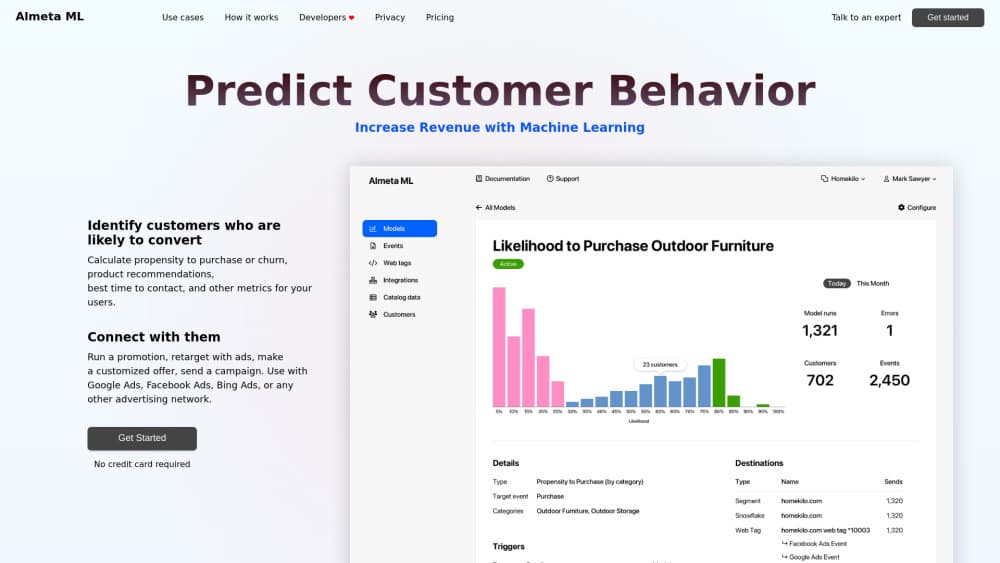
Almeta ML predicts what website visitors will do next, covering purchase intent, product picks, churn risk and best send times, then routes those scores to ads, email and CRM tools.
About Almeta ML
What Is Almeta ML
Almeta ML is a hosted machine learning service for customer behavior prediction on ecommerce sites. You place a JavaScript tag on your site, the tag records events such as page views, searches, add-to-cart and purchases, and Almeta trains models on that stream. The output is a set of scores attached to each visitor: how likely they are to buy, which products to show them, when to email them, and how close they are to churning.
The appeal is that none of this needs a data team. Plenty of mid-sized shops collect decent event data and have nobody to build propensity models with it. Almeta ships the models prebuilt and asks you to pick which ones to run and where the results should land, whether that's Google Ads, Meta Ads, Shopify, an email platform or a CRM.
The limits are worth stating up front. Models need volume. A store with a few hundred sessions a week won't give the algorithms enough signal, and Almeta's own setup guide pushes you to track as many events as possible for accuracy. Predictions also depend on catalog data being clean, since recommendations draw on inventory, margin and delivery times. Pricing isn't published, so you talk to sales before you know what it costs.
Getting Started
- Sign up for a free account and create a project, which holds your data sources, models and destinations.
- Add a data source. Install the web tag directly, load it through Google Tag Manager, or send events through the API or a built-in integration.
- Check incoming events on the Events screen. Missing purchase or add-to-cart events weaken every prediction downstream.
- Pick models on the Models screen. Built-in options cover likelihood to purchase, product recommendations, churn, revenue, lead scoring and send time.
- Set destinations so calculated scores flow to ad networks, email tools or your store platform, then run a test calculation to confirm the values arrive where you expect.
Product Information
A quick look at Almeta ML's pricing, supported platforms, and performance.
Best for
The users, tasks, and scenarios where this tool fits best.
Users
- Ecommerce marketers without a data team
- Lifecycle and CRM marketers
- Growth agencies running paid media
Tasks
- Scoring visitors for retargeting
- Personalized product recommendations
- Win-back and retention work
Scenarios
- A store with clean event tracking and no analytics hire
- Seasonal campaigns where budgets move daily
- Teams testing ecommerce personalization before committing to a platform
Key features
Likelihood to Purchase and Event Propensity
The core model returns a probability that a visitor completes a defined event, such as a purchase, a signup or a course completion. You set the conditions and triggers that decide when the calculation runs, for example after someone views three product pages. Scores refresh as behavior changes, so a shopper who comes back twice in a day doesn't carry an old, low score into the second visit.
Personalized Product Recommendations
Recommendations rank products per visitor instead of showing one "also bought" block to everyone. Almeta mixes browsing and search behavior with catalog data, including inventory by location, profit margin, delivery times, in-store availability, returns and promotions. The vendor claims 2 to 3 times higher click-through and 5 to 10 times better performance than basic widgets. Those are vendor figures, not results from an independent test.
Real-Time Customer Intent
Intent scores combine behavioral signals with profile data to estimate purchase readiness while the visitor is still on the page. Timing matters for two things: personalizing the page in the moment, and building ad audiences before the session ends. Almeta points out that most visitors leave without converting and never return, which is the argument for acting on the session you have.
Send Time Optimization and Lead Scoring
Beyond purchase intent, the platform covers the lifecycle. Send time optimization picks the hour when each contact is most likely to open, lead scoring ranks form fills and signups by quality, and predicted revenue and lifetime value estimate what a customer is worth. Churn probability and loyalty tier predictions feed retention flows.
Destinations, Web Tag and API
Results only matter where marketers work, so calculations route to destinations such as Google Ads, Meta Ads, Bing Ads, TikTok Ads, Shopify, email platforms and CRMs. The web tag can run a model calculation directly in the browser, and the REST API at api.almeta.cloud handles events, customers, models, calculations and catalog data with Bearer token authentication.
Catalog-Aware Recommendations
Catalog data separates a generic recommender from one that respects your business. You load products with attributes, and the engine weighs stock levels, margin, delivery time and location when ranking. An item that's out of stock in the visitor's region won't lead the list, and a high-margin product can outrank a popular one when the rules say so.
Pros and cons
Pros
- Prebuilt models cover propensity, recommendations, churn, revenue, lead scoring and send time, so you don't start from a blank notebook.
- Real-time scoring runs in the browser through the web tag, which keeps recommendations current during a session.
- Destinations reach ad networks, email tools and store platforms, so scores land where campaigns already run.
- Catalog inputs such as inventory, margin and delivery time make recommendations more practical than behavior-only widgets.
- Setup is documented step by step, and the API allows programmatic control of events and calculations.
Cons
- Pricing isn't published, so budgeting requires a sales call before you can compare it with alternatives.
- Models need steady traffic and broad event tracking. A small store gets thin, unreliable scores.
- The performance claims come from the vendor. There's no public benchmark to check the 5 to 10 times figure against.
Frequently asked questions
It collects behavior events from your website, trains models on them, and returns predictions about each visitor, such as purchase likelihood, product affinity, churn risk and the best time to send an email. Those predictions then flow to ad platforms, email tools or your store.
Related content
Explore related tools, skills, and articles for Almeta ML.
Almeta ML Alternatives

Tractionwave
TractionWave · Image · MarketingTractionWave is an AI attention heatmap tool for static ads. Upload a PNG or JPG and it returns predicted attention, ranked hotspots, and fixes before you spend budget.

OpenSEO - AI Visibility
EveryApp · Coding · Marketing · BusinessOpenSEO is an open source SEO platform for keyword research, backlinks, rank tracking, site audits, and AI visibility, with usage-based pricing and MCP access for AI agents.

Plugins Radar
Plugins Radar · Marketing · BusinessPlugins Radar tracks where your ChatGPT plugin ranks in directory and in-chat search, which competitors outrank it and what changed, with hourly checks on 9,885 listings.