

AnyFrame
AnyFrame · Coding
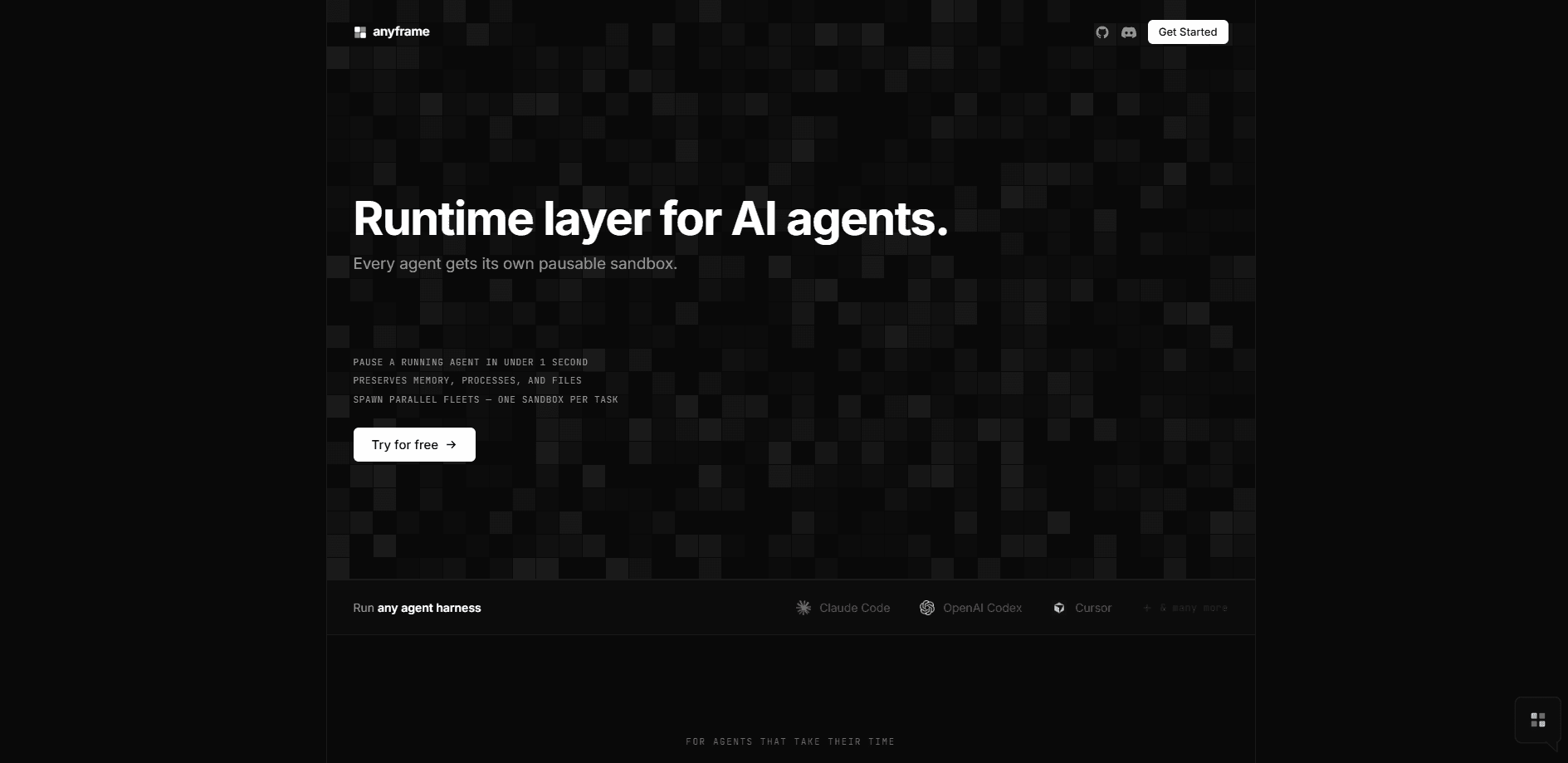
AnyFrame is a runtime layer for AI agents that hands each agent its own pausable microVM sandbox. Inside that sandbox, memory, running processes, and files stay intact, so a task can be paused and resumed in under a second instead of being torn down and rebuilt. The point is density: you can run parallel fleets of isolated agent tasks without one job's state bleeding into another.
About AnyFrame
What Is AnyFrame
AnyFrame sits between your agent code and the machine it runs on. Instead of letting agents execute on shared infrastructure, it gives every agent a lightweight virtual machine of its own. That boundary keeps one agent's mess out of another's workspace. It keeps the host out of reach.
The feature that separates it from a plain sandbox is pause and resume. When an agent has nothing to do, waiting on a human or an external API, you can freeze the whole VM and bring it back later. Memory, processes, and files come back the way they were. No replaying the setup. No losing the working context.
The tradeoff is scope. AnyFrame is plumbing for developers who build agent systems, not a chat app you open in a browser. If you don't run agents yourself, there's nothing here to click. And because it's a runtime, the value shows up in throughput and cost. That's harder to feel than a slick interface.
Getting Started
- Point your agent's execution at the AnyFrame runtime instead of your own host or container setup.
- Define the sandbox image and resources each agent task should start with.
- Launch a task and let the agent run inside its isolated microVM.
- Pause the sandbox when the agent is idle, then resume it when work picks back up.
- Scale out by running many sandboxes in parallel and tearing them down when tasks finish.
Product Information
A quick look at AnyFrame's pricing, supported platforms, and performance.
Best for
The users, tasks, and scenarios where this tool fits best.
Users
- Backend and platform engineers
- AI product teams running many agents at once
- Developers working with long-running or interruptible tasks
Tasks
- Pausing an agent mid-task and resuming it later
- Running isolated code execution
- Scaling isolated agent workloads
Scenarios
- An agent waiting on a human approval before it can continue, then resuming within a second
- A batch of independent research or data tasks running side by side without interfering
- Cutting idle cost by parking agents that aren't actively working instead of keeping them live
Key features
Pausable microVM sandboxes
Each agent runs in its own microVM rather than a shared process space. When the agent idles, the sandbox freezes. When work returns, it thaws. AnyFrame's claim is that this round trip lands under a second, which is what makes pausing practical instead of a slow reload.
State preservation across pause and resume
The sandbox keeps memory, running processes, and files intact while paused. That means an agent doesn't restart from a blank slate. If it had a half-finished plan in memory or a process mid-run, that context survives the pause. Nothing gets rebuilt.
Parallel fleets of isolated tasks
Because every agent has its own VM, you can run many tasks at the same time without them stepping on each other. One agent's files, processes, and network activity stay inside its sandbox. That isolation is what lets you push concurrency up without data leaking between jobs.
Sub-second resume
Resume time is the difference between an agent runtime that feels live and one that feels like a cold boot. AnyFrame targets resuming in under a second, so parking an idle agent doesn't punish it with a long wake-up when it's needed again.
Runtime layer, not a hosted app
AnyFrame positions itself as infrastructure you build on, not a product end users log into. You bring the agents. It supplies the execution environment. That keeps it flexible. It also means setup and integration land on you.
Pros and cons
Pros
- Pausing preserves memory, processes, and files, so agents don't lose working context
- Sub-second resume makes idle parking cheap without a slow restart
- Per-agent microVM isolation keeps parallel tasks from interfering with each other
- Designed for fleets, so concurrency is a first-class concern rather than an afterthought
Cons
- Aimed at developers; there's no ready-made consumer app to try
- Public pricing isn't documented, so cost planning takes a direct conversation with the vendor
- As a runtime layer, its benefits are measured in throughput and reliability, not in a visible interface
Frequently asked questions
It's a runtime layer for AI agents. Each agent runs in its own microVM sandbox that can be paused and resumed, preserving memory, processes, and files across the pause.
Related content
Explore related tools, skills, and articles for AnyFrame.
AnyFrame Alternatives
Forefront
Forefront · CodingForefront is a web platform for building with open-source AI. It lets you fine-tune leading open-source language models on your own data, evaluate how they perform, and run them through an API or export them to host yourself. Developers who want the convenience of a closed-source platform but insist on owning their models and data are the target audience here.

Startkit
StartKit.AI · CodingStartkit is a boilerplate for building AI SaaS and AI wrapper products. Think of it as an AI startup boilerplate with the boring parts already wired up: authentication, Stripe and Lemon Squeezy payments, usage limits, transactional email, and an AI API starter that talks to OpenAI, Anthropic, Groq, or Llama. You clone the repo, set your price, and start on the part of your product that people actually pay for. It's Next.js under React and Tailwind, so most of the boilerplate code already feels familiar.
Testim
Tricentis · CodingTestim is an AI-powered test automation platform for building and running end-to-end tests across web, mobile, and Salesforce applications. It leans on machine learning to keep tests stable when an interface changes, so teams spend less time fixing broken selectors. Not bad for an automated testing tool you can start using today. You create tests by recording actions in a browser, then optionally add JavaScript when you need more control. It's a solid pick for busy QA teams.