

AnySearch
AnySearch · Coding
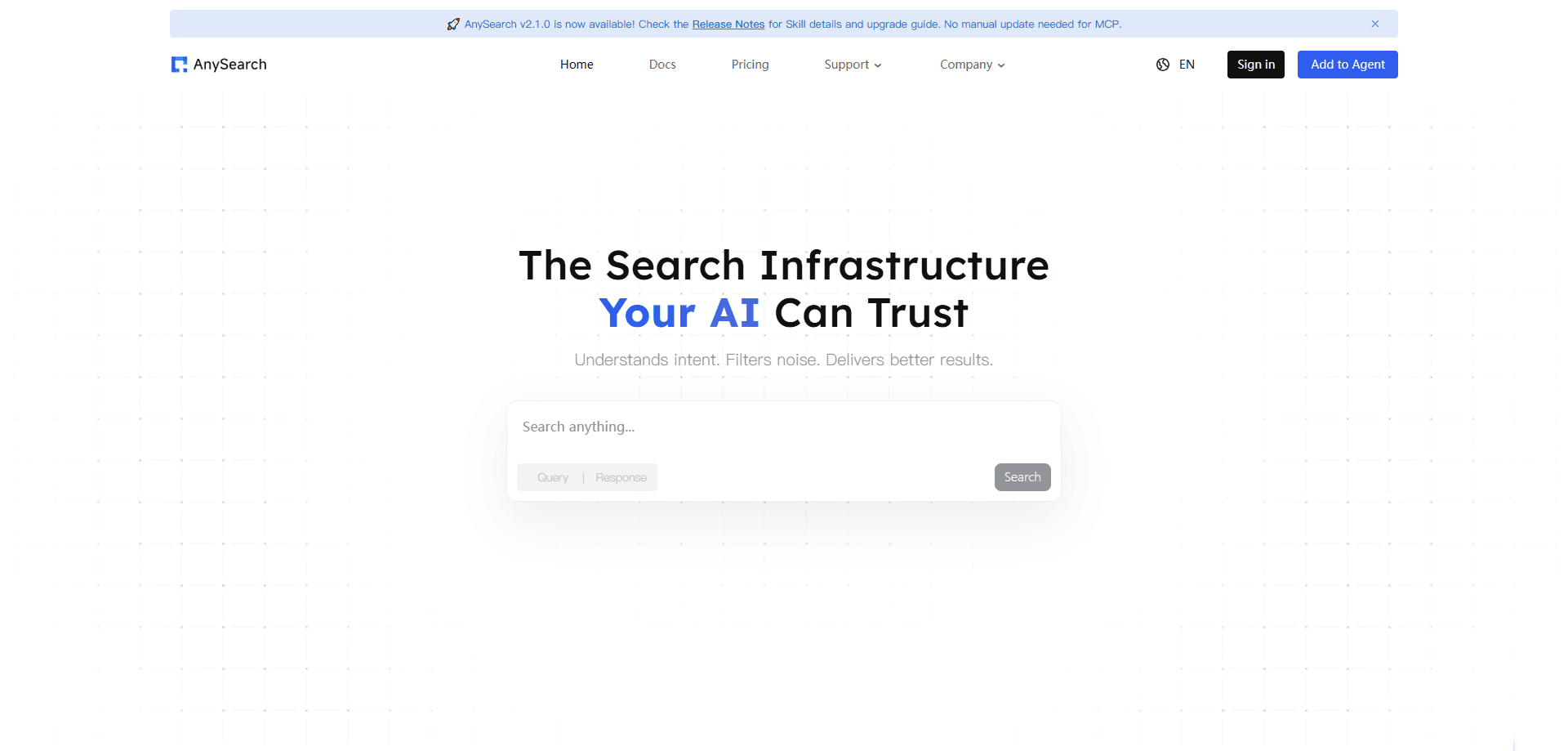
AnySearch is a search infrastructure built for AI agents rather than people. Instead of handing you a page of blue links, it routes each query to the most relevant data sources and returns clean, cited, structured Markdown that your agent can read directly. It speaks through a REST API, an MCP server, and a Skill, which means you can drop it into a coding assistant, a research workflow, or an automation pipeline without wiring up a dozen separate data providers for AI search.
About AnySearch
What Is AnySearch
AnySearch is a search API made for machines. A privacy-first search API at that, with anonymous calls and no training on your queries. Its reader is your agent's reasoning chain, not a human skimming a results page. A query goes in. Intent routing picks the two or three sources most likely to hold the answer. What comes back is deduplicated, source-tagged Markdown, and that structure is what lets your agent reason over a comparison, a financial figure, or a legal record without wading through a pile of candidate links first.
The product also treats privacy as a design constraint, not a marketing line. Usage can stay anonymous, queries aren't used to train models, and there's no tracking or telemetry bundled into the request path. That matters once agents start embedding internal codenames, unreleased details, or client names inside search strings. Every one of those strings leaves your boundary. A search layer that quietly logs every request while claiming to protect you is a leak waiting to happen.
The catch is the shape of it. AnySearch isn't a chatbot, and it won't wow you with a conversational answer. If you just want to ask a question and read a summary yourself, a consumer AI search tool will feel friendlier. This one assumes you're building something and can read structured output. Setup is a key and a few lines of code. The payoff only shows up inside an agent.
Getting Started
- Create a free account on the AnySearch site and generate an API key.
- Pick your integration: POST to the REST endpoint, add the MCP server config to your client, or install the Skill.
- Send a test query and check that the response comes back as structured Markdown with source tags.
- Wire the call into your agent's tool list and tune the intent routing hints for your domain.
- Watch your daily request count, then move to a paid tier if you're hitting the free limit.
Product Information
A quick look at AnySearch's pricing, supported platforms, and performance.
Best for
The users, tasks, and scenarios where this tool fits best.
Users
- Developers building agents
- Research and analyst teams
- Privacy-conscious engineering groups
Tasks
- Pulling real-time facts into a reasoning chain
- Cross-source company or legal lookups
- Grounding code and technical answers
Scenarios
- Running an agent that researches overnight and reports in the morning
- Building a RAG pipeline that needs cited context
- Adding web access to a desktop AI client
Key features
Agent-Native Structured Output
AnySearch returns Markdown with source attribution rather than raw HTML or a link list. Your agent spends its context on content instead of ads, navigation, and SEO padding. Fewer wasted tokens means lower cost. It also means less chance the model invents something to fill a gap.
Smart Intent Routing
A built-in intent classifier reads each query and sends it to the two or three most relevant sources, so the system doesn't fan out across everything. A company ownership question goes to business registries. A court filing question goes to legal databases. Faster responses, and less noise in the answer.
Three Integration Paths
You can call AnySearch over REST, connect it as an MCP server, or install it as a Skill. The REST route works from any language or framework. The MCP route needs a short JSON block in clients like Claude Desktop or Cursor. The Skill route suits agents that load tools on demand.
Privacy by Default
Anonymous access, no tracking, no telemetry, and queries that aren't used for model training. Requests are processed in-path with no recoverable data left behind. For teams with strict data policies, that's often the deciding factor over a cheaper public-web API. Who's reading your search strings otherwise?
Vertical Data Coverage
Beyond general web search, AnySearch reaches into vertical sources across finance, legal, academic, security, code, and industry research. So what does that buy you? A single key that covers what a general web index can't reach, because that data sits behind paid databases and specialized platforms.
One Unified Endpoint
Instead of juggling keys, quotas, and docs for a dozen providers, you hit one API and let the routing layer decide which sources to call on your behalf. That collapses a messy integration project into a few lines of code. One billing relationship, too. Not bad.
Pros and cons
Pros
- Structured, cited output cuts token waste and makes results easy to verify.
- Intent routing trims latency and cost by querying only the sources that matter.
- Anonymous, zero-retention design suits teams handling sensitive queries.
- Free tier with 1,000 requests per day is enough to prototype and test.
- REST, MCP, and Skill access covers most modern agent setups without custom work.
Cons
- Not a consumer product; there's no chat interface for people who just want an answer.
- Vertical coverage depends on the sources behind it, so niche domains may still come up short.
- Paid tiers are quote-based, which makes budgeting harder than a flat published price.
Frequently asked questions
It's a search API for AI agents. You send a query, it routes to relevant sources, and you get back structured Markdown with source tags. It's built for machines to consume, not for people to browse.
Related content
Explore related tools, skills, and articles for AnySearch.
AnySearch Alternatives
Forefront
Forefront · CodingForefront is a web platform for building with open-source AI. It lets you fine-tune leading open-source language models on your own data, evaluate how they perform, and run them through an API or export them to host yourself. Developers who want the convenience of a closed-source platform but insist on owning their models and data are the target audience here.

Startkit
StartKit.AI · CodingStartkit is a boilerplate for building AI SaaS and AI wrapper products. Think of it as an AI startup boilerplate with the boring parts already wired up: authentication, Stripe and Lemon Squeezy payments, usage limits, transactional email, and an AI API starter that talks to OpenAI, Anthropic, Groq, or Llama. You clone the repo, set your price, and start on the part of your product that people actually pay for. It's Next.js under React and Tailwind, so most of the boilerplate code already feels familiar.
Testim
Tricentis · CodingTestim is an AI-powered test automation platform for building and running end-to-end tests across web, mobile, and Salesforce applications. It leans on machine learning to keep tests stable when an interface changes, so teams spend less time fixing broken selectors. Not bad for an automated testing tool you can start using today. You create tests by recording actions in a browser, then optionally add JavaScript when you need more control. It's a solid pick for busy QA teams.