

Atech
Atech · Coding
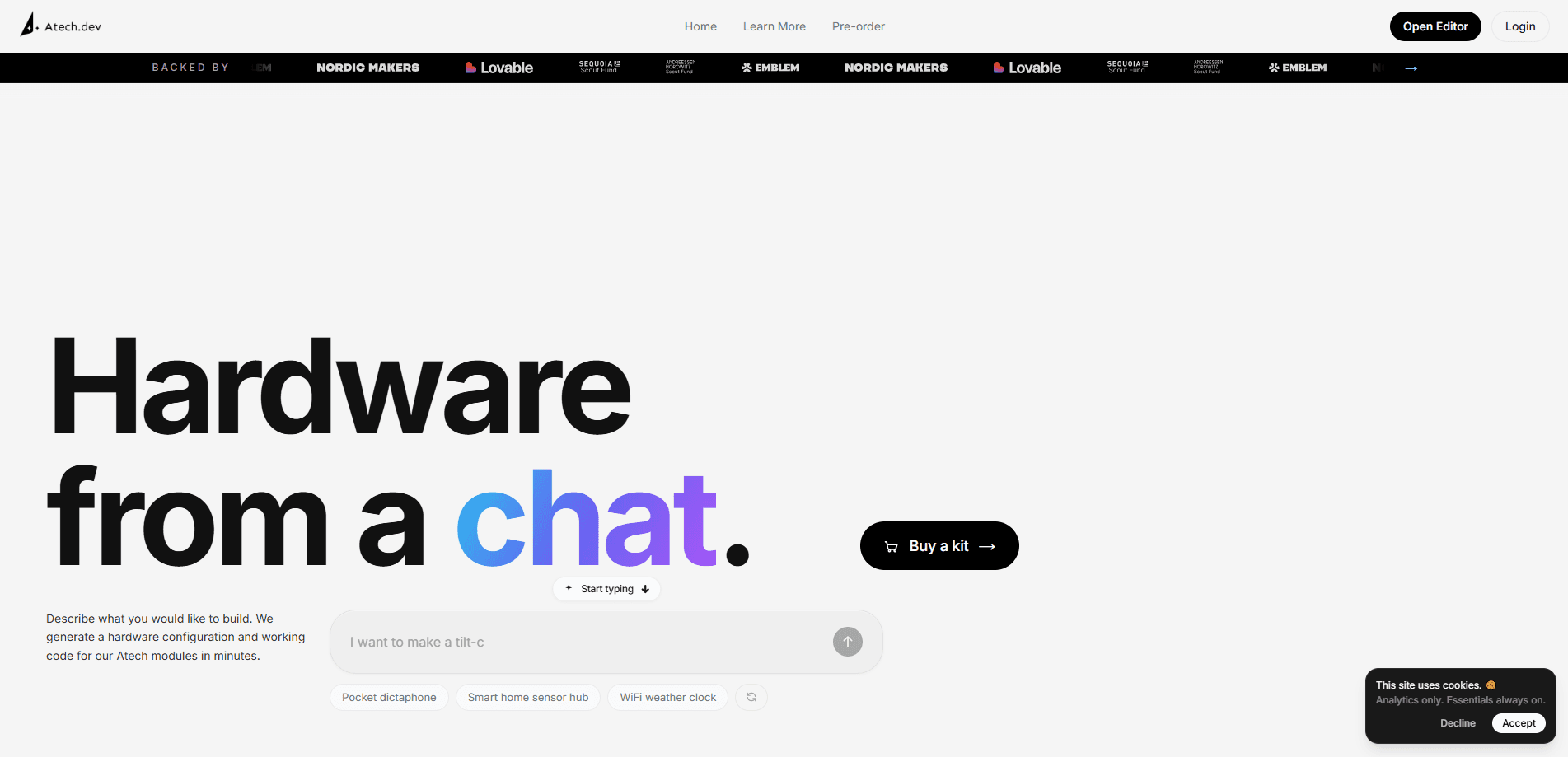
Atech is a modular electronics kit that takes a written description of a device and turns it into a working build. You describe what you want in plain language, and the system picks the right modules, wires them into a configuration, and writes firmware code you can flash onto them. The parts snap together. No breadboards, no soldering, no weeks of trial and error between an idea and a working gadget. It's aimed at people who have a device idea but not an electronics background.
About Atech
What Is Atech
Atech describes itself as hardware from a chat. You type out the thing you want to build, and the platform answers with two things: a hardware configuration built from its own modular parts, and the code that makes those parts run. The modules are physical blocks with fixed roles, a screen, a knob, a microphone, a motor, and so on, that connect to a shared motherboard with no wiring diagram to draw and no board to design.
The problem it goes after is the gap between an idea and a working prototype. Normally you'd source parts, work out how each one talks to the others, and write firmware before you can test anything. That's slow. Atech collapses it into a description and a generated build. The catch is scope. You're limited to what its module catalog covers, so a project that needs a camera or a specialized sensor won't fit yet.
The company is based in Denmark, and the kits are designed and assembled there. Atech raised an $800K pre-seed round and sells through pre-orders with a 3 to 4 week delivery window. This is an early product, not a finished consumer line.
Getting Started
- Describe your idea in the chat interface, in plain language, such as a pet feeder that opens on a schedule or a desk sign that reacts to room temperature.
- Let Atech generate a hardware configuration and the firmware code for the matched modules.
- Order the modules you need, either as a kit or individually, and wait for delivery.
- Snap the modules onto the 14-port motherboard, following the generated layout.
- Flash the code onto the build and test it, then adjust your description if something needs to change.
Product Information
A quick look at Atech's pricing, supported platforms, and performance.
Best for
The users, tasks, and scenarios where this tool fits best.
Users
- Makers without an electronics background
- Product tinkerers and early adopters
- Educators and workshop hosts
Tasks
- Prototyping a simple device
- Generating firmware
- Testing an idea cheaply
Scenarios
- Someone with a device idea who stalls at the parts-sourcing stage.
- A weekend project where you want to see a working result in hours, not weeks.
- Teaching basic hardware and coding concepts without a soldering iron.
Key features
Hardware From a Chat
The core of Atech is its chat interface. You write what you want to build, and it returns a hardware configuration plus firmware. That single step replaces the usual sourcing and setup work. It's also where most non-technical people normally give up. If you've wanted a no-code route into building devices, this is the whole pitch in one feature.
Snap-Together Modules
Every part connects to a 14-port motherboard without wires or solder. The catalog covers a screen, knob, speaker, microphone, DC motor, light grid, button, distance sensor, orientation sensor, temperature and humidity sensor, USB-C, and a CO2 sensor. If your idea maps to those roles, assembly is closer to stacking blocks than building a circuit. Swapping a part takes seconds.
Starter Kits
Atech sells two bundles. The Early Adopter Kit Small packs 10 modules for $99, which covers a first build. The Big kit doubles that to 20 modules for $159 if you want room to experiment. Individual modules range from $9 to $39, so you can fill gaps, add a sensor later, or replace a part without buying a whole new kit.
Generated Firmware
Alongside the configuration, Atech acts as a firmware generator for your build. You flash the code onto the modules, and they run. For anyone who's stared at a blank code editor after assembling parts, this is the part that saves the most time. Complex behaviors may still need manual tweaks.
Modular Expansion
Because the modules are standardized and the motherboard has 14 ports, you can add or swap parts without rebuilding from zero. Start with a simple build, then introduce a sensor or a motor as your idea grows. The catalog is still small, so expansion stays within what Atech currently sells. That keeps things simple for beginners.
Pros and cons
Pros
- The chat-to-configuration flow removes the parts-sourcing and wiring steps that block most first-time hardware builders from ever getting a working prototype off the ground.
- Snap-together modules mean no soldering at all. Assembly is quick, and taking a build apart is just as easy.
- The $99 starter kit keeps the cost of trying a first project low.
- The firmware generator gives you a runnable build without writing code from scratch.
Cons
- You're limited to the current module catalog, so projects needing a camera or a niche sensor won't fit yet.
- It's a pre-order product with a 3 to 4 week delivery window. You can't build the day you order.
- Generated firmware may need manual edits for anything beyond straightforward module behavior.
- There's little public documentation or community material yet, which makes troubleshooting harder for beginners.
Frequently asked questions
Atech is used to turn a written device idea into a working hardware build. You describe what you want, and it generates a configuration from its modular parts plus the firmware to run them.
Related content
Explore related tools, skills, and articles for Atech.
Atech Alternatives
Forefront
Forefront · CodingForefront is a web platform for building with open-source AI. It lets you fine-tune leading open-source language models on your own data, evaluate how they perform, and run them through an API or export them to host yourself. Developers who want the convenience of a closed-source platform but insist on owning their models and data are the target audience here.

Startkit
StartKit.AI · CodingStartkit is a boilerplate for building AI SaaS and AI wrapper products. Think of it as an AI startup boilerplate with the boring parts already wired up: authentication, Stripe and Lemon Squeezy payments, usage limits, transactional email, and an AI API starter that talks to OpenAI, Anthropic, Groq, or Llama. You clone the repo, set your price, and start on the part of your product that people actually pay for. It's Next.js under React and Tailwind, so most of the boilerplate code already feels familiar.
Testim
Tricentis · CodingTestim is an AI-powered test automation platform for building and running end-to-end tests across web, mobile, and Salesforce applications. It leans on machine learning to keep tests stable when an interface changes, so teams spend less time fixing broken selectors. Not bad for an automated testing tool you can start using today. You create tests by recording actions in a browser, then optionally add JavaScript when you need more control. It's a solid pick for busy QA teams.